PakAlumni Worldwide: The Global Social Network
The Global Social Network
Harvard Scientist Debunks Hindu Nationalists "Racial Purity" Myth
Male ancestors of the vast majority of present-day South Asians (Indians, Pakistanis, Bangladeshis) came from West Eurasia, Central Asia and Iran, according to the latest DNA research led by Harvard geneticist Dr. David Reich. Reich's team came to this conclusion after studying the Y-chromosomes of present-day Indians. Some Hindu Indian scientists have used mitochondrial DNA (mtDNA) samples, extracted from the bones of recently discovered ancient skeletal remains of a couple in Rakigarhi in Haryana, to claim the local indigenous origins of all Hindus. Y-chromosomes are passed from father to son while mitochondrial DNA is passed from mother to children. The Harvard team's findings thoroughly debunk Hindu Nationalists' "racial purity" myth similar to that promoted by White Supremacist racists in the West. Reich writes: "The Hindutva ideology that there was no major contribution to Indian culture from migrants from outside South Asia is undermined by the fact that approximately half of the ancestry of Indians today is derived from multiple waves of mass migration from Iran and the Eurasian steppe within the last five thousand years".
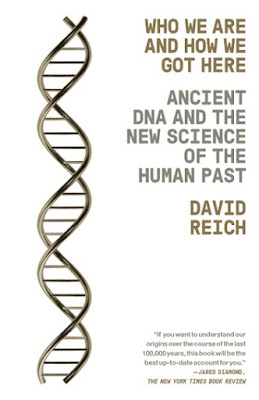 |
| David Reich's "Who We Are" |
Reich's Indian counterparts were highly resistant to the Harvard team findings of foreign origins of modern-day South Asians. Here's an excerpt from David Reich's "Who We Are and How We Got Here":
"Based on their own mitochondrial DNA studies, it was clear to them (Indians) that the great majority of mitochondrial DNA lineages present in India today had resided in the subcontinent for many tens of thousands of years.They did not want to be part of a study that suggested a major West Eurasian incursion into India without being absolutely certain as to how the whole-genome data could be reconciled with their mitochondrial DNA findings. They also implied that the suggestion of a migration from West Eurasia would be politically explosive. They did not explicitly say this, but it had obvious overtones of the idea that migration from outside India had a transformative effect on the (South Asian) subcontinent".
"To keep up the purity of the Race and its culture, Germany shocked the world by her purging the country of the Semitic races -- the Jews. Race pride at its highest has been manifested here. Germany has also shown how well-nigh impossible it is for races and cultures, having differences going to the root, to be assimilated into one united whole, a good lesson for us in Hindusthan to learn and profit by."
"Groups of traditionally higher social status in the Indian caste system typically have a higher proportion of ANI ancestry than those of traditionally lower social status, even within the same state of India where everyone speaks the same language. For example, Brahmins, the priestly caste, tend to have more ANI ancestry than the groups they live among, even those speaking the same language. Although there are groups in India that are exceptions to these patterns, including well-documented cases where whole groups have shifted social status, the findings are statistically clear, and suggest that the ANI-ASI mixture in ancient India occurred in the context of social stratification".
 |
| South Asian Ancestry. Source: Arain Gang |
 |
| 1901 Indian Census of UP Muslims |
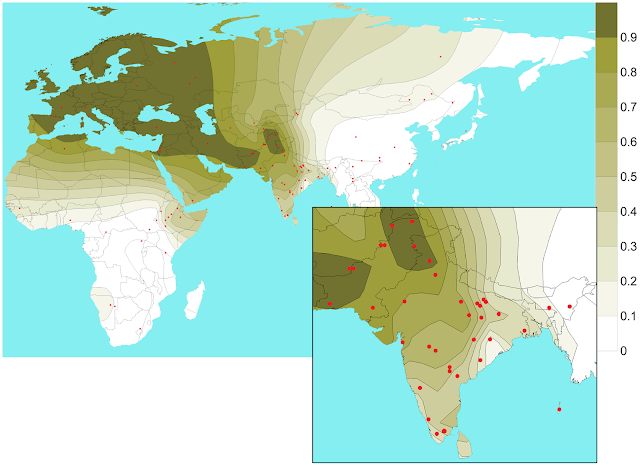 |
| Light Skin Gene Distribution. Source: PLOS Genetics |
 |
| 1901 India Census UP Hindu Population By Castes |
World Values Survey Finds Indians Most Racist
Indians Admire Israel and Hitler
Caste Apartheid in India
Religion, Caste and Politics in India by Christophe Jaffrelot
Mahatma Gandhi and His Struggle With India
Who Killed Karkare?
Procrastinating on Hindutva Terror
India's Guantanamos and Abu Ghraibs
Hindutva Government in Israeli Exile?
Growing US-India Military Ties Worry Pakistan
The 21st Century Challenges For Resurgent India
Views: 691
-
Comment by Riaz Haq on October 28, 2025 at 8:11pm
-
The Western Steppe Herders and the Formation of South Asian Ancestry
This map visualizes the main ancestral components of South Asian populations as modeled through Genoplot and Global25, highlighting the genetic impact of the Western Steppe Herders (WSH) contribution, the population associated with Bronze Age expansions from the Pontic–Caspian steppe (ca. 3000–1500 BCE).
The WSH component (light blue) represents the genetic legacy of the pastoralist societies connected with the Yamnaya and later Sintashta–Andronovo cultures, whose migrations profoundly reshaped the genetic and linguistic landscape of Eurasia. In South Asia, this ancestry entered the subcontinent around the mid-second millennium BCE, merging with pre-existing Neolithic and indigenous groups.
Its highest frequencies are observed among northern Indo-Aryan populations, notably in Punjab, Haryana, Kashmir, and parts of Uttar Pradesh, correlating closely with the historical diffusion of Indo-European (Indo-Aryan) languages and with Y-chromosome haplogroup R1a-Z93. The genetic signal diminishes gradually toward the Dravidian south and the Austroasiatic east, where AASI and Neolithic Iranian ancestries predominate.
This pattern indicates a north-to-south cline formed through male-biased gene flow, consistent with the arrival of steppe pastoralist groups who intermingled with established farming and hunter-gatherer populations. The interaction between the WSH, Neolithic Iranian, and AASI components produced the distinctive genomic structure of modern South Asians, reflecting a synthesis of steppe, Near Eastern, and indigenous South Asian lineages that continues to define the region’s diversity today.
-
-
Quote by A.G. Noorani: “Sar zamin-e-Hind par aqwam-e-aalam ke, Firaq, K
https://www.goodreads.com/quotes/10075773-sar-zamin-e-hind-par-aqwa...
Sar zamin-e-Hind par aqwam-e-aalam ke, Firaq, Kafile aate rahe aur Hindustan banta gaya (On the soil of Hindustan, O Firaq Caravans from all over the world kept coming, And so was Hindustan made)
A.G. Noorani, The RSS: A Menace to India
--------------
AI Overview
Study finds common ancestor of English and Sanskrit that ...
Sanskrit is an Indo-Aryan language that originated from the Proto-Indo-European (PIE) language family. It entered the Indian subcontinent around 1700–1500 BCE through migrating pastoralists from the Central Asian Pontic-Caspian steppes (north of the Black and Caspian Seas). As a sister to Ancient Greek, Latin, and Old Persian, its roots are shared with languages from Eurasia, rather than being indigenous solely to India.
Foreign/Proto-Indo-European Origins of Sanskrit
Proto-Indo-Iranian Ancestry: Sanskrit traces its linguistic ancestry back to Proto-Indo-Iranian, which further branches from the Proto-Indo-European (PIE) family.
Steppe Migrations: Genetic and archaeological studies indicate that Proto-Indo-Aryan speakers (the ancestors of Vedic Sanskrit) originated as pastoralists in the Steppe regions of Central Asia.
Movement to South Asia: These groups migrated into the Indian subcontinent, specifically the northwestern region (Sapta Sindhu area), around 1700-1500 BCE, bringing with them the language that developed into Vedic Sanskrit.
Sister Languages: Sanskrit shares a close relationship with other foreign languages, such as Avestan (ancient Iran) and Old Persian.
Shared Vocabulary: Structural and vocabulary similarities exist with early European languages, confirming a common ancestor outside the subcontinent.
Key Aspects of Early Sanskrit Development
Oral Tradition: Initially, the language was orally preserved, particularly in the form of Vedic hymns (e.g., the Rigveda).
Standardization: While its roots are "foreign" (outside India), the language was highly refined and standardized in South Asia by Panini around the 6th–5th century BCE.
"Deva-Vani": Although its roots are migratory, it was later known in India as Deva-Vani (language of the Gods).
While Sanskrit is essential to Indian culture, its earliest linguistic and geographical origins are firmly rooted in the Indo-European, Central Asian steppe migrations, making it a branch of a wider linguistic, rather than purely indigenous, tree.
-
-
AI OverviewMainstream linguistic and genetic research suggests that Indo-Aryan migrants, part of a larger Indo-European expansion from the Central Asian Steppe, brought an early form of Sanskrit to the Indian subcontinentbetween 2000 and 1500 BCE. These migrants interacted with local populations, leading to the development of Vedic Sanskrit, the language of the Rigveda.Key details regarding this migration and the introduction of Sanskrit include:
- Source and Movement: The Indo-Aryan speakers migrated from the Central Asian Steppe into the Indian subcontinent, moving through the northwest region.
- Timeline: The migration and subsequent influence on local languages occurred roughly during the first half of the second millennium BCE (c. 2000–1500 BCE).
- Language Evolution: The language brought by these groups, an early form of Sanskrit, interacted with the indigenous languages (likely Dravidian or Austroasiatic) already present in the region, rather than simply replacing them, ultimately evolving into Vedic Sanskrit.
- Evidence: The theory is supported by linguistics (similarities between Sanskrit, Greek, and Latin), archaeology (the decline of the Indus Valley Civilization and appearance of new cultural traits), and genetic studies.
- Alternative Views: Some scholars and researchers hold the "Indigenist" view, arguing for a native origin of Sanskrit within the Indian subcontinent (often referred to as the Out of India theory or Indigenous Aryanism).
The migration is seen not as a single conquest, but as a gradual influx that profoundly shaped the linguistic and cultural landscape of North India.
Comment
- ‹ Previous
- 1
- 2
- 3
- 4
- Next ›
Twitter Feed
Live Traffic Feed
Sponsored Links
South Asia Investor Review
Investor Information Blog
Haq's Musings
Riaz Haq's Current Affairs Blog
Please Bookmark This Page!
Blog Posts
US Immigrant Visa Freeze For 75 Countries: Why Pakistan But Not India?
The US State Department has suspended processing of immigrant visas from 75 countries, including Pakistan but not India. This action followed President Donald Trump's social media post that listed, without context, the percentage of immigrant households from these countries that rely on the US government financial assistance. While Mr. Trump’s post singled out immigrants,…
ContinuePosted by Riaz Haq on January 17, 2026 at 5:30pm
Indian NSA Doval Urges Young Hindus to Take Revenge on Muslims
In a recent speech to young Hindus in New Delhi, the Indian National Security Advisor Ajit Doval urged his audience to "avenge history". He talked about the looting and destruction of Hindu temples and many centuries humiliation suffered by Indians. Though he did not…
ContinuePosted by Riaz Haq on January 14, 2026 at 2:00pm — 3 Comments
© 2026 Created by Riaz Haq.
Powered by


You need to be a member of PakAlumni Worldwide: The Global Social Network to add comments!
Join PakAlumni Worldwide: The Global Social Network