PakAlumni Worldwide: The Global Social Network
The Global Social Network
Harvard Scientist Debunks Hindu Nationalists "Racial Purity" Myth
Male ancestors of the vast majority of present-day South Asians (Indians, Pakistanis, Bangladeshis) came from West Eurasia, Central Asia and Iran, according to the latest DNA research led by Harvard geneticist Dr. David Reich. Reich's team came to this conclusion after studying the Y-chromosomes of present-day Indians. Some Hindu Indian scientists have used mitochondrial DNA (mtDNA) samples, extracted from the bones of recently discovered ancient skeletal remains of a couple in Rakigarhi in Haryana, to claim the local indigenous origins of all Hindus. Y-chromosomes are passed from father to son while mitochondrial DNA is passed from mother to children. The Harvard team's findings thoroughly debunk Hindu Nationalists' "racial purity" myth similar to that promoted by White Supremacist racists in the West. Reich writes: "The Hindutva ideology that there was no major contribution to Indian culture from migrants from outside South Asia is undermined by the fact that approximately half of the ancestry of Indians today is derived from multiple waves of mass migration from Iran and the Eurasian steppe within the last five thousand years".
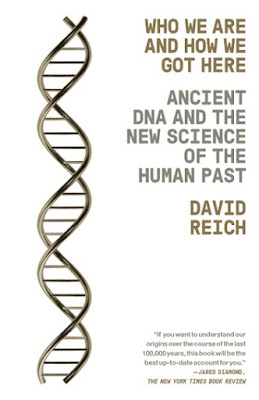 |
| David Reich's "Who We Are" |
Reich's Indian counterparts were highly resistant to the Harvard team findings of foreign origins of modern-day South Asians. Here's an excerpt from David Reich's "Who We Are and How We Got Here":
"Based on their own mitochondrial DNA studies, it was clear to them (Indians) that the great majority of mitochondrial DNA lineages present in India today had resided in the subcontinent for many tens of thousands of years.They did not want to be part of a study that suggested a major West Eurasian incursion into India without being absolutely certain as to how the whole-genome data could be reconciled with their mitochondrial DNA findings. They also implied that the suggestion of a migration from West Eurasia would be politically explosive. They did not explicitly say this, but it had obvious overtones of the idea that migration from outside India had a transformative effect on the (South Asian) subcontinent".
"To keep up the purity of the Race and its culture, Germany shocked the world by her purging the country of the Semitic races -- the Jews. Race pride at its highest has been manifested here. Germany has also shown how well-nigh impossible it is for races and cultures, having differences going to the root, to be assimilated into one united whole, a good lesson for us in Hindusthan to learn and profit by."
"Groups of traditionally higher social status in the Indian caste system typically have a higher proportion of ANI ancestry than those of traditionally lower social status, even within the same state of India where everyone speaks the same language. For example, Brahmins, the priestly caste, tend to have more ANI ancestry than the groups they live among, even those speaking the same language. Although there are groups in India that are exceptions to these patterns, including well-documented cases where whole groups have shifted social status, the findings are statistically clear, and suggest that the ANI-ASI mixture in ancient India occurred in the context of social stratification".
 |
| South Asian Ancestry. Source: Arain Gang |
 |
| 1901 Indian Census of UP Muslims |
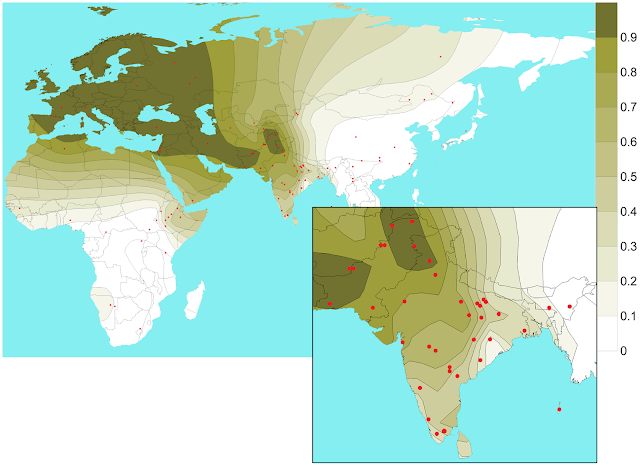 |
| Light Skin Gene Distribution. Source: PLOS Genetics |
 |
| 1901 India Census UP Hindu Population By Castes |
World Values Survey Finds Indians Most Racist
Indians Admire Israel and Hitler
Caste Apartheid in India
Religion, Caste and Politics in India by Christophe Jaffrelot
Mahatma Gandhi and His Struggle With India
Who Killed Karkare?
Procrastinating on Hindutva Terror
India's Guantanamos and Abu Ghraibs
Hindutva Government in Israeli Exile?
Growing US-India Military Ties Worry Pakistan
The 21st Century Challenges For Resurgent India
Views: 1083
-
Comment by Riaz Haq on May 9, 2026 at 6:04pm
-
Ancient India was shaped by waves of migration and mixing | Aeon Essays
By Kiran Kumbhar
https://aeon.co/essays/ancient-india-was-shaped-by-waves-of-migrati...
The content of the century-old Hindutva imagination of history indicates that it was fuelled less by a rational curiosity about the subcontinent’s past, and more by an intense hatred for Muslims and other non-Hindus. So, although it was clear to many scholars of the time, like Majumdar, that the Vedic culture was not the ‘sole foundation’ of India’s past and present, even this tentative consensus came to be mocked and attacked in the postcolonial period, with leaders like Nehru and scholars like Thapar becoming a consistent target of such attacks. Over the recent three decades, the ever-rising political power of Hindutva groups in India – largely via undemocratic means – has led to an amplification of this anti-intellectual project. It is in such a rife sociopolitical context, at the dawn of the 21st century, that scholars conducting genetic studies stepped in to offer their interpretations and arguments regarding the history of India’s peopling.
Many of the early genetic studies to deal with the South Asian past attempted to better understand the histories and movements of the subcontinent’s various tribal populations. This was in alignment with the long-standing genetic research studies of tribal communities (also known as Adivasis, roughly translated as ‘earliest residents’), even though the Adivasi people have otherwise been starkly marginalised, both in historical accounts and in the public discourse. For example, speaking during a session of the Constituent Assembly of India in December 1946, the political leader Jaipal Singh Munda, an Adivasi, did not mince his words as he described the disproportionate dominance of leaders from upper-caste groups in the Assembly and in Indian politics. To the members of the Assembly, which included Nehru, he said:
my people … have been disgracefully treated, neglected for the last 6,000 years … It is the new-comers – most of you here are intruders as far as I am concerned – it is the new-comers who have driven away my people from the Indus Valley to the jungle fastnesses.
First appearing in the 1970s, genetic studies of South Asia’s population history became common in science journals by the turn of the 21st century, with many focusing on tribal genomes. The edited collection The Indian Human Heritage (1998) was an early work to make substantial historical claims using genetic evidence, in a chapter called ‘Peopling of India’ by Madhav Gadgil and colleagues. A collaborative effort between the Indian Institute of Science in Bengaluru and Stanford University in California, it was based on mitochondrial DNA (‘mtDNA’) analysis of 101 individuals. It dated the arrival of Homo sapiens in South Asia to about 65,000-50,000 years ago, and argued that certain tribal groups ‘may be amongst the first group of Homo sapiens to have reached India’. Another study concluded that contemporary Indian tribal people were ‘descendants of the initial [Homo sapiens] settlers’, and a 2008 study said that the ‘tribes of [the] southern and eastern region along with Dravidian and Austro-Asiatic speakers of central India are the modern representatives of earliest settlers of subcontinent.’
-
-
Ancient India was shaped by waves of migration and mixing | Aeon Essays
By Kiran Kumbhar
https://aeon.co/essays/ancient-india-was-shaped-by-waves-of-migrati...
Today, almost all people in South Asia carry this ‘First South Asians’ ancestry in their genomes
Indeed, the past three decades have witnessed the rise of DNA – of both contemporary individuals and people from the remote past (‘ancient DNA’) – as an important category of primary sources that scholars use to explore the histories of the people of the world. However, not all genetic studies on India have come to the same or similar conclusions on even the basic aspects of population movements, alerting us to the frequently forgotten fact that, just like other historical sources – eg, hymns and archaeological finds and archival documents – DNA is prone to differing interpretations by different researchers. Nonetheless, many genetic studies, accompanied by historically, archeologically and linguistically grounded analyses, are being increasingly considered important interventions by historians of South Asia.
From these early studies and extant archaeological knowledge, we know that when anatomically modern Homo sapiens arrived first in the subcontinent about 65,000-50,000 years ago, they would have found the region already inhabited by other human species, whom we now term hominins. Over time, the hominin population declined and that of modern humans increased, so much so that ‘between approximately 45 and 20 kya [thousand years ago] most of humanity lived in Southern Asia’. (In this study, ‘Southern Asia’ included parts of Southeast Asia.) As the centuries and millennia went by, these early humans of South Asia developed art forms like ornamental ostrich eggshell beads dating 40,000 to 25,000 years ago, and exquisite rock art dating to 12,000 years ago. These hunter-gatherer people – the descendants of the earliest modern humans in the subcontinent – were labelled as ‘First Indians’ by the Indian journalist Tony Joseph in his celebrated book Early Indians (2018). In this essay I will use that label with a minor change, and call these early residents the ‘First South Asians’. Genetic scientists say that, today, almost all people in South Asia carry this ‘First South Asians’ ancestry in their genomes to varying degrees, with tribal groups possessing more of it than others.
-
-
Ancient India was shaped by waves of migration and mixing | Aeon Essays
By Kiran Kumbhar
https://aeon.co/essays/ancient-india-was-shaped-by-waves-of-migrati...
he genetic studies that first generated significant public interest and received wide coverage in the media were those that attempted to explore the history of the caste system and of the Aryan migrations. A 2001 study by Michael Bamshad and colleagues argued that ‘the upper castes have a higher affinity to Europeans than to Asians, and the upper castes are significantly more similar to Europeans than are the lower castes.’ Soon after, Frontline – a major English-language biweekly in India – published the essay ‘The Genetics of Caste’ by R Ramachandran, which summarised the arguments of this and other related genetic studies, as well as pointing to their limitations. Other studies came to different conclusions, arguing that ‘the genetic diversity of the South Asian population predates the possible Aryan migration and does not map easily, if at all, on caste groups. In fact, the differing historical claims of these various genetic studies were quickly picked up by activists and groups of different political inclinations to influence opinion not just in India but at the United Nations in 2001 (in advocacy against caste-based discrimination) and in the United States in 2006 (to press for changes in how early Indian history was represented in California state textbooks).
A 2009 study by David Reich and colleagues – a collaborative effort between the Centre for Cellular and Molecular Biology in Hyderabad and Harvard University in Massachusetts – explored similar questions as previous studies, but utilised new methods of analysis, employed greater diversity in the caste and tribal groups studied, and examined vastly greater numbers of genetic markers. A later literature review termedit a ‘seminal study’ that had conducted ‘the first genome-wide survey in South Asia … in parallel with creating a new toolkit for population genetics analyses’. Like earlier studies, it showed that upper-caste groups shared greater genetic affinity with ‘West Eurasians’ (that is, ‘Europeans, central Asians, Near Easterners, and people of the Caucasus’, as Reich put it in his 2018 book) than did low-caste and tribal groups. The researchers coined new terms for early South Asian people who, in the abstract modelling involved in the study, were classified into two groups considered ancestral to all contemporary South Asians: Ancestral South Indians (ASI) and Ancestral North Indians (ANI).
-
-
Ancient India was shaped by waves of migration and mixing | Aeon Essays
By Kiran Kumbhar
https://aeon.co/essays/ancient-india-was-shaped-by-waves-of-migrati...
Subsequent studies further elaborated how the ASI and ANI populations came to be formed, and how they were related to the Harappans and the Aryans. Research from 2019 led by Vagheesh M Narasimhan at Harvard found that, around 7500 BCE, people from the Zagros mountain region of present-day Iran began moving to northwest South Asia. These people practised agriculture (perhaps in addition to hunting and gathering), and they either introduced farming to the First South Asians (who by now had spread across the subcontinent), or blended their agricultural practices with the farming that the latter perhaps had already been doing. Agriculture then thrived in northern South Asia for centuries, ultimately leading to the early stages of the Indus Valley Civilisation, which was kickstarted around 3500 BCE by the descendants of this mixture of Zagros-Iranian migrants and First South Asians.
The migrants from the northwest were descendants of pastoralists from the Eurasian Steppe region
When the Harappan cities went into decline after around 1900 BCE, their residents migrated eastward and southward, into regions where the First South Asians were still around. This resulted in another mixture: migrating Harappan people (who carried some Zagros-Iranian ancestry) mixing with First South Asians, giving rise to the Ancestral South Indian population. Narasimhan and colleagues have found a ‘strong correlation between ASI ancestry and present-day Dravidian languages’, while Reich and colleagues argued that the ASI people ‘may have spoken a Dravidian language before mixing with the ANI’.
-
-
Ancient India was shaped by waves of migration and mixing | Aeon Essays
By Kiran Kumbhar
https://aeon.co/essays/ancient-india-was-shaped-by-waves-of-migrati...
From the vantage point of today, the 2000-1000 BCE time period looks extremely dynamic with regard to demographic and cultural changes in the subcontinent. The Harappans were leaving their cities and moving around, the First South Asians were mixing with the Harappans and learning new languages and agriculture-related practices and, in the middle of all this, new migrants were moving in from the east as well as the northwest. Those in the east were the bearers of the Austroasiatic language family, and mixed with the First South Asians and the Ancestral South Indians depending on local demographics. The descendants of this mixture – which include people of the Munda tribal groups like Jaipal Singh Munda – now reside primarily in eastern and central India.
The migrants coming in from the northwest were the bearers of the Indo-European language family. They were descendants of pastoralists from the Eurasian Steppe region, an ancestrythat ‘matches that in Bronze Age Eastern Europe … [and hence] elegantly explains the shared distinctive features of Balto-Slavic and Indo-Iranian languages.’ On their arrival in the northwest of the subcontinent, these Steppe-origin people – ie, the Aryan people of 19th-century historical narratives – encountered the Harappans, and the mixture of those two groups resulted in the formation of what is called the Ancestral North Indian population. This mixture was characterised by a ‘male bias’: as Narasimhan and colleagues put it, ‘Steppe ancestry in modern South Asians is primarily from males and disproportionately high in [upper-caste groups like] Brahmin and Bhumihar groups.’ Over time, with people continuing to move across the subcontinent for a variety of reasons, there occurred tremendous mixing between the ASI and ANI populations, a mixing that geneticists claim dwindled by about 1,900 years ago, or the turn of the 1st millennium CE (aligning well with the time window that historians attribute to when the caste system, especially caste-based endogamy, started to become codified and more sociopolitically entrenched).
-
-
Ancient India was shaped by waves of migration and mixing | Aeon Essays
By Kiran Kumbhar
https://aeon.co/essays/ancient-india-was-shaped-by-waves-of-migrati...
It needs to be remembered that the labels of ASI and ANI were devised by geneticists in the context of abstract modelling, and that other studies have added some more categories to the ancestral population groups of modern South Asians. A less technical description of these early population movements and mixing, and of the extraordinary demographic dynamism of the 2000-1000 BCE period, would read something like this: numerous small and big instances of migrations and mixing-together of different groups, along with conflicts and battles, were taking place all over the subcontinent, and would over time, aided by several further mixtures, culminate in the current population profile of South Asia. Perhaps the most succinct description of this millennia-long process of constant internal and external migrations, invasions and mixing is found in the book The Sceptical Patriot (2014) by the Indian journalist Sidin Vadukut, who writes:
We are all, every single one of us, the outcomes of centuries of civilisational upheaval. We are part-Greek, part-Mongol, part-Persian, part-British, part-Mughal, part-French, Part-Portuguese, part-Arab, part-Turk, part-everything.
Clearly, genetic studies have important insights to offer to our understanding of history, especially in terms of providing more granular evidence for already existing scholarly arguments (eg, on the migrations of Steppe people in the 2nd millennium BCE, and on the history of caste-based endogamy). Still, let’s not forget that the methodology of these studies involves reducing whole humans into whole genomes and then into tiny bits of DNA. As a primary source for human history, genes are unlike monuments or rock inscriptions or poems, in that on their own they tell us little about culture, politics and power – the central elements of human history. There is only so much one can learn about human society and the human experience by feeding invisible bits of people’s tissues to machines in a sterile laboratory, thousands of miles and often thousands of years away from the fleshiness of their social, cultural and political contexts. There is also the potential risk of unlearning important stuff we’ve already learned, like the dangers of the pseudoscientific tendency to biologise social and cultural identity categories such as caste groups or even nationalities.
-
-
Ancient India was shaped by waves of migration and mixing | Aeon Essays
By Kiran Kumbhar
https://aeon.co/essays/ancient-india-was-shaped-by-waves-of-migrati...
That reality will continue to be vehemently opposed by powerful Hindutva groups and political parties
In fact, without the copious extant knowledge about the human past and present from centuries of research in the humanities and the social sciences, genetic analyses would be directionless and unable to meaningfully contribute to knowledge-making, a fact broadly acknowledged by many geneticists but often not apparent to the general public. The way I see it, in the context of historical research, geneticists are not exactly ‘barbarians coming late to the study of the human past’, but simply yet another group of scholars – certainly still novices – standing on the shoulders of earlier scholars of history, and standing shoulder to shoulder with contemporary ones.
Perhaps the most remarkable aspect of the history of the historical narratives of the peopling of India is that, even after more than two centuries of linguistic, archaeological and now genetic evidence pointing to very similar conclusions, especially regarding the reality of the 2nd-millennium BCE Aryan migrations into the subcontinent, the expression of that reality will continue to be vehemently opposed by powerful Hindutva groups and political parties. For a country with soul-crushing disparities and widespread misery, one is sometimes baffled by the disproportionate amount of time, energy and resources that many elite Indians spend on matters of antiquity. Indeed, it is important to ask what this history means, if anything, to the majority of Indians and South Asians who do not have the luxury to spend time mulling over the remote past. There’s probably no easy answer to this, but here’s a thought to get us started:
Hundreds of millions of Indians, almost all of them from low-caste and tribal communities, are so impoverished that, without government support in the form of free foodgrains, they would be at risk of starvation. At the same time, the wealth of the materially richest Indian is about $100 billion, which means that if he spent even the stately sum of $1,000 per day on food, and we start counting the days backward, he would still have an insanely vast amount of money left by the time we encounter the Harappans. In fact, he will have an insanely enormous amount left even when we reach the hunter-gatherers who were making ostrich eggshell beads, and even further back, at the time of the arrival of the very first Homo sapiensin the subcontinent some 65,000 years ago. As it turns out, India’s richest person will have completely spent all his wealth only after we reach the Middle Stone Age lives of the hominins of South Asia who left behind a huge cache of stone tools in Attirampakkam – some 275,000 years ago.
Comment
- ‹ Previous
- 1
- …
- 3
- 4
- 5
- Next ›
Twitter Feed
Live Traffic Feed
Sponsored Links
South Asia Investor Review
Investor Information Blog
Haq's Musings
Riaz Haq's Current Affairs Blog
Please Bookmark This Page!
Blog Posts
AI Revolution in Pakistan: Multiple AI Apps Launched for Farmers
With the expansion of the internet access in rural areas, several local language AI applications have recently been launched for downloads by farmers in Pakistan. These apps help with crop planning, soil sensing, personalized fertilizer recommendations, disease diagnoses, weather forecasts and market prices. A couple of these have been downloaded by half a million or more farmers in the country. Some of these apps use open source large language models (LLMs) like…
ContinuePosted by Riaz Haq on October 14, 2026 at 1:00pm
Tata's Boardroom Crisis: Will it Impact Philanthropy in India?
India's Tata Group is going through a major boardroom crisis. Noel Tata, the Chairman of the Tata holding company, has been removed from the Tata Group's board by N. Chandrasekaran, chairman of Tata Sons. Noel Tata has declared the decision illegal, a stance the board disputes. The crisis has been precipitated by a 2022 decision by India’s central bank to order the company to seek a stock market listing for Tata Sons, to comply with new rules governing systemically important…
Continue
© 2026 Created by Riaz Haq.
Powered by


You need to be a member of PakAlumni Worldwide: The Global Social Network to add comments!
Join PakAlumni Worldwide: The Global Social Network