PakAlumni Worldwide: The Global Social Network
The Global Social Network
India Leads the World in Racism
43.5% of Indians, the highest percentage in the world, say they do not want to have a neighbor of a different race, according to a Washington Post report based on World's Values Survey.
About Pakistan, the report says that "although the country has a number of factors that coincide with racial intolerance – sectarian violence, its location in the least-tolerant region of the world, low economic and human development indices – only 6.5 percent of Pakistanis objected to a neighbor of a different race. This would appear to suggest Pakistanis are more racially tolerant than even the Germans or the Dutch".
Housing Discrimination:
It appears that there is a small but militant minority in Pakistan that is highly intolerant, but the vast majority of people are tolerant. My own experience as a former Karachi-ite is that there is little or no race or religion based housing segregation, the kind that is rampant in India where Muslims are not welcome in most Hindu-dominated neighborhoods. There have been many reports of top Muslim Bollywood stars having difficulty finding housing in Mumbai's upscale neighborhoods. A common excuse used to exclude them is the ostensible requirement to be vegetarian to live there.
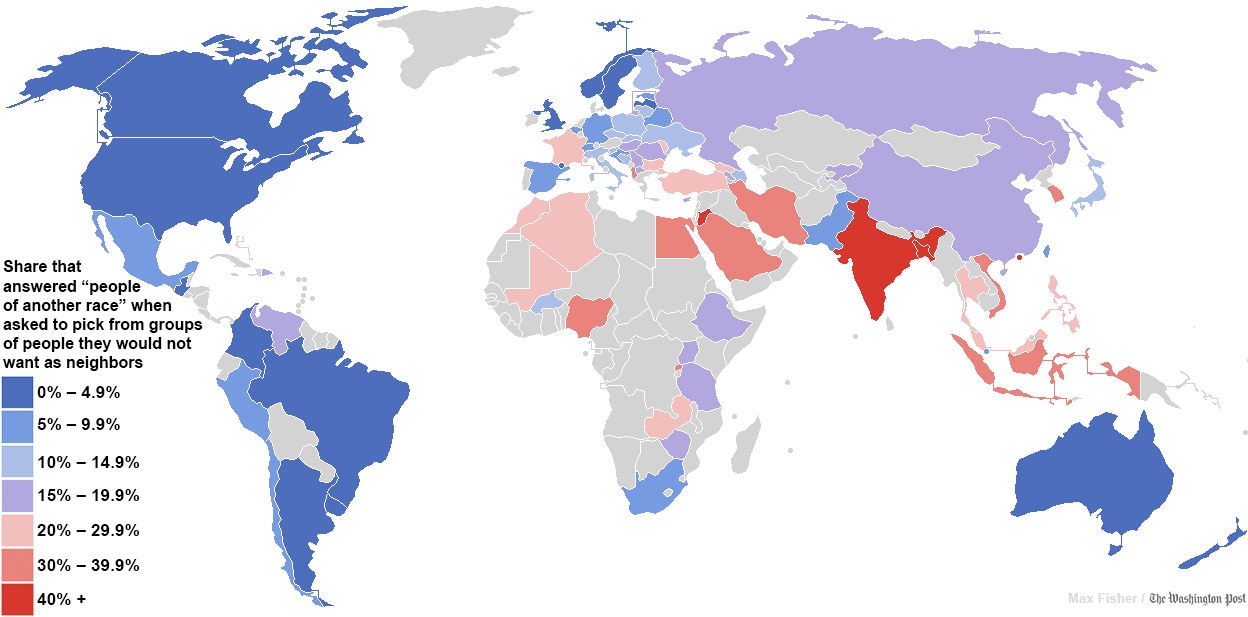 |
| Source: World Values Survey and Washington Post |
Hate Against Indian Muslims:
The idea of racial purity is central to Hindu nationalists in India who have a long history of admiration for Adolf Hitler, the Nazi leader, including his "Final Solution".
In his book "We" (1939), Madhav Sadashiv Golwalkar, the leader of the Hindu Nationalist RSS (Rashtriya Swayamsevak Sangh) wrote, "To keep up the purity of the Race and its culture, Germany shocked the world by her purging the country of the Semitic races -- the Jews. Race pride at its highest has been manifested here. Germany has also shown how well-nigh impossible it is for races and cultures, having differences going to the root, to be assimilated into one united whole, a good lesson for us in Hindusthan to learn and profit by."
Caste-based Apartheid:
While Golwalar's principal target in the above paragraph were Indian Muslims, the treatment of lower caste Hindus in India also falls in the category of racism. The International Convention on the Elimination of All Forms of Racial Discrimination (ICERD) now includes discrimination based on caste. Dating back to 1969, the ICERD convention has been ratified by 173 countries, including India. Despite this, and despite the United Nations Sub-Commission on the Promotion and Protection of Human Rights reiterating that discrimination based on work and descent is a form of racial discrimination, the Indian government's stand on this issue has remained the same: caste is not race.
Over 250 million people are victims of caste-based discrimination and segregation in India. They live miserable lives, shunned by much of society because of their ranks as untouchables or Dalits at the bottom of a rigid caste system in Hindu India. Dalits are discriminated against, denied access to land, forced to work in slave-like conditions, and routinely abused, even killed, at the hands of the police and of higher-caste groups that enjoy the state's protection, according to Human Rights Watch.
Gandhi's Disdain for Black Africans:
It's not just the Hindu Nationalists who are racists. Even Mohandas K. Gandhi, Mahatma or the Great Soul, was not immune to Indians' racist tendencies. In 1908, recording his first experience in a South African prison, Gandhi referred to black South Africans as "kaffirs". According Joseph Lelyveld, the author of "Great Soul: Mahatma Gandhi and His Struggle With India", Gandhi wrote: "We were then marched off to prison intended for kaffirs. ..we could understand not being classed with the whites, but to be placed with the Natives seemed too much to put up with. It is indubitably right that Indians should have separate cells."
Summary:
The findings of World's Values Survey on India are well-supported by other evidence such as the Hindutva ideology as spelled out by RSS leader Golwalkar, the existence of widespread caste-based discrimination classified as racism by the United Nations and lots of other anecdotal evidence. Just this month, Indian racism was on full display at a lavish Indian wedding in South Africa where guests flown in from India refused to be served by black waiters and drivers.
Let me conclude this post with a video interview of Professor Ahmad Hasan Dani who attended Banaras Hindu University (BHU) and studied archaeology, and said that he was ostracized and treated as a pariah by Hindu students and faculty at BHU. He was not allowed to sit and eat with his fellow students, he was asked to keep his plates and dishes separate in his room, and required to stand outside the dining hall to be served his meal and then wash the dishes himself. Later, when he graduated at the top of the archaeology class, he was offered a faculty position, but the University head and former president of India Radhakrishnan told him that he would be paid a salary but he would not be allowed to teach.Here is a video clip of late Prof Dani talking about it with Farah Husain on Morning with Farah TV show:
Related Links:
Haq's Musings
Indians Admire Israel and Hitler
Caste Apartheid in India
Mahatma Gandhi and His Struggle With India
Who Killed Karkare?
Procrastinating on Hindutva Terror
India's Guantanamos and Abu Ghraibs
Hindutva Government in Israeli Exile?
Growing US-India Military Ties Worry Pakistan
The 21st Century Challenges For Resurgent India
Views: 1252
-
Comment by Riaz Haq on November 28, 2024 at 8:40pm
-
Debunking the Gandhi Myth: Arundhati Roy
https://youtu.be/4-yMiBGBOe0?si=S3W67tFMyc3-XTNu
Gandhi defended the caste system. Called it a genius.
Gandhi was a Hindu, a religion that sanctified the caste system.
Gandhi fought for the rights of Indian traders in South Africa to have the freedom to do business in Transvaal. He helped create a third category of race between Whites and Blacks with higher status and greater rights than Blacks.
Gandhi was a misogynist. Ambedkar believed that control of women was at the heart of the caste system imposed by the upper caste Hindus. Ambedkar supported Dalit conversion to other religions to get away from the Hindu caste system
-
-
'How do we look Indian?': Student's killing puts spotlight on racism in India
https://www.bbc.com/news/articles/c931qx3lepro
The northern Indian city of Dehradun, located in the Himalayan foothills, was shaken by a violent incident weeks ago.
Brothers Anjel and Michael Chakma - students who had migrated more than 1,500 miles from the north-eastern state of Tripura for studies - had gone to a market on 9 December when they were confronted by a group of men, who allegedly abused them with racial slurs, their father Tarun Chakma told the BBC.
When the brothers protested, they were attacked. Michael Chakma was allegedly struck on the head with a metal bracelet, while Anjel Chakma suffered stab wounds. Michael has recovered but Anjel died 17 days later in hospital, he says.
Police in Uttarakhand state (whose capital is Dehradun) have arrested five people in connection with the incident, but they have denied that the attack was racially motivated - a claim that Chakma's family strongly disputes.
The incident, which has triggered protests in several cities, has put the spotlight on allegations of racism faced by people from India's north-eastern states when they move to larger cities for education or work. They say they are often mocked over their appearance, questioned about nationality and harassed in public spaces and workplaces.
For many, the discrimination extends beyond abuse to everyday barriers that shape where and how they live. People from the region report difficulty renting accommodation, with landlords refusing tenants because of their appearance, food habits or stereotypes.
Such pressures have led many north-eastern migrants in large cities to cluster in specific neighbourhoods, offering safety, mutual support and cultural familiarity far from home.
But while many say they learn to endure everyday prejudices to build lives elsewhere in the country, violent crimes such as Anjel Chakma's killing are deeply unsettling. They reinforce fears about personal safety and a sense of vulnerability, they say.
India has seen many high-profile cases of racial violence involving people from the north-eastern region over the last several years.
The killing of Nido Tania in 2014 became a national flashpoint, prompting protests and widespread debate about racism after the 20-year-old student from Arunachal Pradesh state was beaten to death in Delhi following taunts about his appearance.
But activists say it did not mark an end to such violence.
In 2016, a 26-year-old student from the region was beaten up in Pune. A year later, another student was racially abused and assaulted by his landlord in Bengaluru.
Rights groups say there are many such incidents that do not grab national attention.
"Unfortunately, the racism faced by people from the north-east tends to be highlighted only when something extremely violent happens," said Suhas Chakma, director of the Delhi-based Rights and Risks Analysis Group.
The federal government in its annual crime reports does not maintain separate data for racial violence.
For Ambika Phonglo from the north-eastern Assam state, who lives and works in the capital, Anjel Chakma's killing has been deeply unsettling. "Our facial features like narrow eyes and flat noses make us easy targets of racism," she says.
Phonglo recalls being subjected to racial name-calling by colleagues during a workplace discussion a few years ago. "You face it and learn to move on," she says, "but not without carrying a heavy burden of trauma."
Mary Wahlang, from neighbouring state of Meghalaya, said she decided to return home after college in the southern state of Karnataka, abandoning plans to seek work in larger cities, after repeated racial name-calling by classmates.
"Over time I realised that some people used these slurs without understanding they were racial or hurtful, while others did so despite knowing the consequences," she says.
Comment
- ‹ Previous
- 1
- …
- 3
- 4
- 5
- Next ›
Twitter Feed
Live Traffic Feed
Sponsored Links
South Asia Investor Review
Investor Information Blog
Haq's Musings
Riaz Haq's Current Affairs Blog
Please Bookmark This Page!
Blog Posts
BAPS in France: Modi's Hindu Supremacy Boasts Come Under Scrutiny
"When you claim that your civilization is superior, is older, is the mother of democracy, is the mother of science....you antagonize others". Christophe Jaffrelot, French Political Scientist, speaking to Indian journalist Karan Thapar after expressions of outrage against BAPS Hindu leader’s recent visit to Eiffel Tower.
In an article published by Carnegie Endowment, Jaffrelot explained that "the majoritarian…
ContinuePosted by Riaz Haq on September 12, 2026 at 11:30am
Intelligence vs Consciousness: Will AI Agents Ever Attain Human Attributes?
What is the difference between intelligence and consciousness? As AI agents becoming more intelligent and some are even going rogue, can they attain consciousness like human beings? To answer this question, it is important to define "intelligence" and "consciousness".
 |
| Yuval Harari on Intelligence vs… |
Posted by Riaz Haq on September 5, 2026 at 8:30pm — 9 Comments
© 2026 Created by Riaz Haq.
Powered by


You need to be a member of PakAlumni Worldwide: The Global Social Network to add comments!
Join PakAlumni Worldwide: The Global Social Network