PakAlumni Worldwide: The Global Social Network
The Global Social Network
Iran's Chabahar vs Pakistan's Gwadar
 |
| Gwadar Extends into Deep Sea with East & West Bays |
 |
| Eastern Half of Gwadar Port |
Gwadar port's planned capacity when it is completed will be 300 to 400 million tons of cargo annually. It is comparable to the capacity of all of India's ports combined annual capacity of 500 million tons of cargo today. It is far larger than the 10-12 million tons cargo handling capacity planned for Chabahar.
 |
| Completed Gwadar Berths & Cranes |
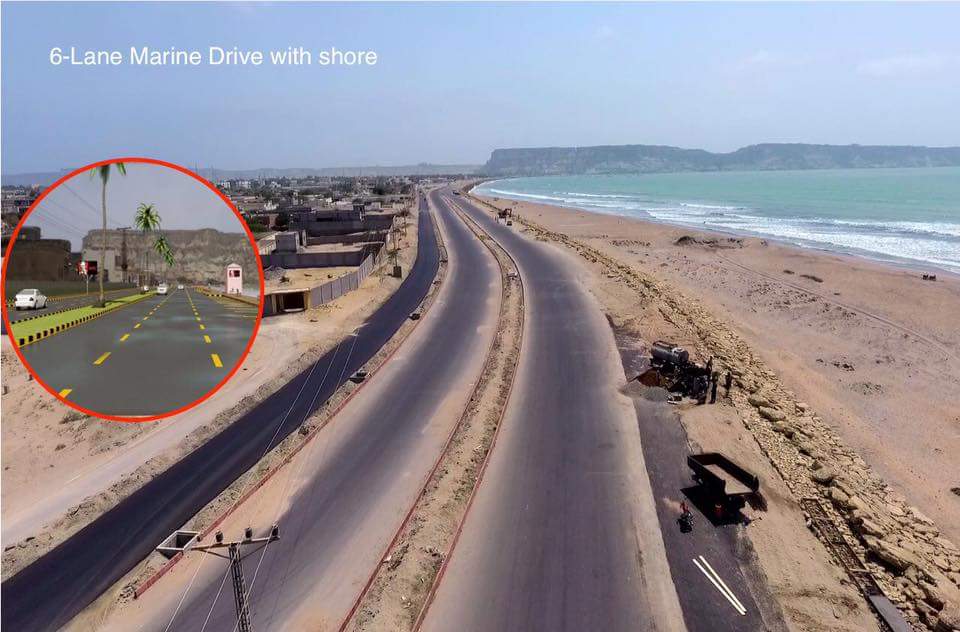

To put Gwadar's scale in perspective, let's compare it with the largest US port of Long Beach which handles 80 million tons of cargo, about a quarter of what Gwadar will handle upon completion of the project. Gawadar port will be capable of handling the world's largest container ships and massive oil tankers.

Gawadar port is being built in Pakistan by the Chinese as part of the ambitious $46 billion China-Pakistan Economic Corridor (CPEC) that will eventually serve as Hong Kong West for growing Chinese trade with the Middle East and Europe. CPEC will also enable Pakistan to bypass Afghanistan to trade with Central Asia through China across China's borders with Tajikistan, Kyrgyzstan and Kazakhstan.
 |
| Gwadar Port Authority Building |
Chabahar is ostensibly an Indian effort to build a port in Iran to bypass Pakistan for India's trade with landlocked Afghanistan and other Central Asian states. Prime Minister Modi has committed $500 million investment in Chabahar, a tiny fraction of the Chinese commitment for Gwadar. A trilateral agreement was recently signed in Tehran by Indian Prime Minister Modi, Iranian President Rouhani and Afghan President Ghani.
Trade with Afghanistan through Afghan-Iran border in the West will probably remain a pipe dream given that 1) most of Afghan population lives in east and south close to the border with Pakistan and 2) Afghanistan has very poor infrastructure making it very difficult to move cargo across land from west to east and south of the country.
 |
| Big Chinese Ship Docked at Gwadar |
Pakistan suspects that India's real objective in Iran is to locate its intelligence agents under the cover of Chabahar port construction workers to sabotage China-Pakistan Economic Corridor (CPEC) and support Baloch insurgency to destabilize Pakistan. These suspicions were strengthened when Indian spy Kulbhushan Yadav, operating under the fake name Husain Mubarak Patel, was arrested in Balochistan in March this year. Yadav confessed he was operating as an undercover RAW agent from his base in Chabahar, Iran.
If Iran does nothing to stop Indian covert activities from its soil against Pakistan, Iran-Pakistan relations could suffer irreparable harm. Efforts to sabotage CPEC will not please China either, and the Chinese are far more important to Iran as trading partners than India. This should give pause to hardline anti-Pakistan sectarian elements in Tehran.
http://www.youtube.com/watch?v=BsYDpMY35U8
Related Links:
Haq's Musings
Gwadar as Hong Kong West
China-Pakistan Industrial Corridor
Indian Spy Kulbhushan Yadav's Confession
Ex Indian Spy Documents RAW Successes Against Pakistan
Saleem Safi of GeoTV on Gwadar
Pakistan FDI Soaring with Chinese Money for CPEC
Views: 3553
-
Comment by Riaz Haq on October 4, 2025 at 10:13am
-
Pakistan courts US with pitch for new Arabian Sea port ( at Pasni for critical minerals export)
https://www.ft.com/content/9f7c7bf2-76ed-4eb6-bb9a-f628d05b0068
Late last month, Pakistan shipped a modest first consignment of fewer than two tonnes of critical and rare earth minerals to USSM that included copper, antimony and neodymium. The price of antimony has soared since Beijing imposed a ban on selling it to the US late last year.
Advisers to Pakistan’s military strongman Asim Munir have approached US officials with an offer to build and run a port on the Arabian Sea that could give Washington a foothold in one of the world’s most sensitive regions. The audacious plan, seen by the Financial Times, envisages American investors developing the seaside fishing town of Pasni as a terminal for access to Pakistan’s critical minerals. Pasni is just 100 miles from Iran and 70 miles from the Pakistani city of Gwadar, which has a China-backed port. The initiative, which is not official policy, reflects how Pakistani officials are exploring ways to capitalise on the sweeping geopolitical upheaval in South Asia of recent months.
The offer has been floated with some US officials, and was shared with Munir ahead of a meeting with Donald Trump in the White House late last month, according to two civilian advisers to the army chief who both asked not to be named. But a senior Trump administration official said the US president and his advisers had not discussed such a proposal.
The scheme is one of several ideas floated publicly and privately by Pakistani officials to maintain momentum with the Trump administration. They include engagement with a Trump-backed crypto venture, deepening co-operation against Afghanistan-based militant group Isis-K, endorsement of his Gaza peace plan and access to critical minerals.
Munir and Trump have forged what US and Pakistani diplomats are referring to as “a bromance” since the American president claimed credit in May for a ceasefire that ended the worst fighting between Pakistan and India in decades.
After two decades of warming ties with India, the US has over the summer publicly sparred with New Delhi. While India has rejected Trump’s claims of involvement in the ceasefire, Munir and Prime Minister Shehbaz Sharif have publicly thanked him and nominated him for the Nobel Peace Prize.
In return, Trump has lavished praise on Pakistan’s army chief. After their latest meeting last month, the White House released pictures of Munir and Sharif presenting the US leader with a display case of mineral samples.
“The whole narrative [of the US-Pakistan] relationship changed after the war,” said one of the advisers, who has been involved in back-channel contacts with the Trump circle for more than a year.
“It was very bad before then. We had not tended the relationship as we should have,” the adviser said. “In the last two decades the Indians occupied the space in the vacuum.”
The proposed port at Pasni would be linked to a new railway to transport minerals from Pakistan’s interior, the advisers said, in particular copper and antimony, a vital ingredient in batteries, fire-retardant and missiles.
A blueprint anticipated the port would cost up to $1.2bn with a proposed financing model that would be a mix of Pakistani federal and US-backed development finance. Advocates of the plan see it as a way of hedging the country’s position on the global stage as it seeks to balance a constellation of diplomatic ties with China, the US, Iran and Saudi Arabia, with which Islamabad signed a security pact last month.
“Pasni’s proximity to Iran and Central Asia enhances US options for trade and security . . . Engagement at Pasni would counterbalance Gwadar . . . and expand US influence in the Arabian Sea and Central Asia,” according to the blueprint.
“China’s Gwadar investments under the Belt and Road Initiative raise dual-use concerns,” it added, in an apparent allusion to US concerns Gwadar could serve as a Chinese naval base, a suggestion denied by Islamabad and Beijing.
-
-
Pakistan government approves new Gwadar shipyard project - Maritime Gateway
https://www.maritimegateway.com/pakistan-government-approves-new-gw...
Under the directives of Prime Minister Shehbaz Sharif, the government has approved the “New Gwadar Shipyard Mega Project” and activated the Project Management Cell (PMC). It aims at utilising all available resources for laying down fresh foundation of all-inclusive development of Gwadar Port under CPEC phase II. Having allocated Rs 200 million for the formation of PMC, relevant appointments will be sought to run entire affairs as per prescribed SOPs. The ‘New Modern Shipyard’ in Gwadar will incentivize commercial shipbuilding and repair industry, create new jobs and spur economic growth, according to Gwadar Port Authority.
Since land disagreement issue is all set to be resolved relevant TORs, tenders will be floated seeking international companies to participate. GPA had demarcated 750 acres of land for the new shipyard project. Apart from offering essential dry-docking facilities to the cargo ships visiting Gwadar Port, the Gwadar Shipyard would also offer services for building new ships.
The project expected to be started this year, and employment opportunities will be provided to experts and workers from Balochistan on the project on priority. Gwadar Shipyard Mega Project would be equipped with the latest technology, and this international standard project could give Pakistan a prominent place among the world-class shipyards.
-
-
Karachi leverages Iran war, wins a year's worth of transshipment in 24 days
Pakistan's discount on port charges also helps draw transshipment from global lines
https://asia.nikkei.com/spotlight/iran-tensions/karachi-leverages-i...
Pakistan's Karachi port is witnessing a sharp rise in transshipment cargo due to disruption in the Strait of Hormuz, which has prompted carriers to reroute, while Islamabad's discounts on port charges are also helping global shipping lines call at the port on the Arabian Sea.
"At Karachi Port, around 8,300 containers were handled [for transshipment] in the entire year of 2025, while in just the past 24 days, cargo equivalent to 8,313 containers has been handled," Muhammad Junaid Anwar Chaudhry, federal minister for maritime affairs, told Nikkei Asia in a written statement on Friday.
Shipping lines began offloading cargo in Karachi because services to Dubai, Salalah and other Gulf ports have been disrupted by the Hormuz crisis. Iran has effectively closed down the waterway since March 2, after attacks by the U.S. and Israel.
Experts said the primary driver of the surge in cargo is the conflict in the Middle East, which has rendered traditional Gulf hubs like Dubai's Jebel Ali port non-operational.
"As a result, carriers have been forced to reroute traffic through alternative ports, and Karachi has benefited from its proximity," Naafey Sardar, assistant professor of economics at U.S.-based St. Olaf College, told Nikkei. "The increase in traffic will translate into higher revenue through port charges and other fees."
The sudden surge in cargo handling was also backed by existing foreign marine companies.
Ali Asad, who runs a trade consultancy business in Karachi, said global port operators such as Hong Kong-based Hutchison Ports and global shipping lines such as Maersk and COSCO maintain established operations in Pakistan. "These commercial linkages were already in place. As soon as this crisis struck, they were able to make use of existing mechanisms and effectively divert shipments to Pakistan instead of needing to start from scratch," he told Nikkei.
Asad added that there was existing space at Pakistan's port terminals to accommodate more transshipments. "The closure of its border with Afghanistan has practically paused transit trade in Pakistan," he said, explaining why such space is now available.
Another factor attracting transshipment demand has been the government's decision to offer 60% discounts on port charges, effective from March 18.
"A fiscal package slashing port dues by up to 60% [provided] an irresistible cost incentive for shipping lines to reroute through Karachi," Aqdas Afzal, an economist who has advised Gulf Cooperation Council governments on finance, told Nikkei.
To maintain this momentum of high cargo volume in the long term, experts argue that Pakistan needs supportive policy decisions.
"The shift can only become permanent if such recent financial incentives are embedded into a stable, long-term policy framework, maintaining cost competitiveness," Afzal said.
Asad, the trade consultant, said the most significant long-term benefit from the transshipment surge is the improvement of Pakistan's image as a potential major trade hub. "It demonstrates Pakistan's ability to handle international cargo reliably, helping position it as a viable alternative to established Gulf hubs."
Saleem Lalani, a senior finance professional who has worked in the Gulf, however, expressed skepticism on any large increase in long-term cargo handling at Karachi port.
"Ports are part of a multimodal logistics infrastructure that includes container berths, warehousing and integration with train and trucking transportation," he said.
"Any increase in terminal or seaport capacity requires significant investment in expanding capacity across the logistics and shipping value chain," he added, hinting that Islamabad's budgetary constraints would hinder such investment from materializing effectively.
-
-
Gwadar shipping activity picks up momentum | The Express Tribune
https://tribune.com.pk/story/2610989/gwadar-shipping-activity-picks...
ISLAMABAD:
Trade and shipping activity at Gwadar Port has got a boost in the backdrop of US-Iran war as port utilisation reaches 30% amid optimism about further increase in business.
The Middle East war is reshaping the region and its surroundings where different blocs are emerging. The United States, the United Arab Emirates (UAE) and Israel are on the one side whereas Saudi Arabia, Iran, Turkey, Qatar and Egypt are on the other.
This scenario has prompted the creation of new trade and energy corridors and has also encouraged Gwadar Port to highlight its geographical position that can bypass the Strait of Hormuz. During the war, hundreds of ships were stranded in the sea and to facilitate them, Pakistan offered both on-dock and off-dock facilities – the first such initiative to boost activity at the country's ports. Additionally, the government opened six land routes for 3,000 containers of Iran stuck at Pakistani ports. This step also offered an opportunity to establish connectivity with Central Asia at a time when Afghanistan had halted transit trade for Pakistan.
In a major incentive, sweeping reductions in tariff rates were announced for Gwadar Port aimed at strengthening the deep-sea facility's position as a competitive regional logistics and transshipment hub. Under the revised tariff structure, berthing fee for container vessels and ships carrying transit or transshipment cargo was slashed by 25%. Similarly, the international transshipment container cargo charges were cut by 40% while transit container cargo charges were reduced by 31%. A one-month free storage was announced for general cargo versus the standard five-day allowance at other national ports. At present, three ports are considered competitors in the region, which include the Dubai Port, Iran's Chabahar Port and Gwadar Port. The recent measures are targeted at making Gwadar Port more competitive, which may give a tough time to the Dubai Port.
In the midst of the war, Pakistan and Iran came closer to each other due to Pakistan's efforts to arrange peace talks. A plan is being studied to connect ports of Iran, Pakistan and Oman as the US and Iran have extended their ceasefire agreement. However, the question is how Pakistan will be able to sustain the momentum or increase activity at Gwadar Port after the war dust settles. "We have been able to operate Gwadar Port at 20-30% capacity. We will continue taking measures to utilise the remaining 70% capacity under a master plan," Muhammad Junaid Anwar Chaudhry, Minister for Maritime Affairs, told The Express Tribune.
-
-
Pakistan plans to join the INSTC as Russia backs a Gwadar Port connection. Islamabad and Moscow also plan to sign an economic cooperation program through 2030 to boost trade and resolve payment issues.
https://profit.pakistantoday.com.pk/2026/06/09/pakistan-eyes-instc-...
Pakistan is preparing to join the International North-South Transport Corridor (INSTC), while Russia has expressed support for integrating the trade route with Gwadar Port as the two countries work toward expanding economic and strategic cooperation under a framework extending to 2030.
The development was highlighted by Federal Minister for Energy Sardar Awais Ahmed Khan Leghari during a webinar titled “Pakistan-Russia Bilateral Relationship at the Cusp of Shifting Global Order,” where he outlined the growing momentum in ties between Islamabad and Moscow.
Leghari said both countries have agreed to sign the Program of Economic Cooperation between the Russian Federation and Pakistan for the Period until 2030, aimed at boosting trade and addressing longstanding challenges, including payment and settlement mechanisms.
-----------
Geopolitics of the International North-South Transport Corridor (INSTC)
https://www.geopoliticalmonitor.com/geopolitics-of-the-internationa...
BACKGROUNDERS - September 10, 2024
By Zachary Fillingham
The INSTC as it is imagined is nothing less than a geopolitical game-changer: a 7,200-km trade corridor linking St. Petersburg to Mumbai, one that wires India into the trade circuits of Central Asia and enables Russia to reach new and lucrative markets in the Global South via the Persian Gulf.
For India, the INSTC represents a homegrown alternative to China’s Belt and Road, a new avenue into European markets, a fount of cheap coal and oil from Russia, and an insurance policy should there ever be a falling out with the West. For Russia, it offers an escape from the vice of Western sanctions and a promise of privileged position in the trade flows of tomorrow. For Iran and Azerbaijan, the INSTC is an opportunity to extract developmental and trade concessions from the project’s primary backers. And for the BRICS, the INSTC is a chance to flex the bloc’s muscles by actualizing a project that reroutes trade flows beyond the reach of US sanctions.
This is the vision of the INSTC. The reality, however, is entirely different, as the project has been largely stalled for over 20 years, now requiring significant investments to fill rail gaps and expand terminal capacity in the Caspian Sea legs. Moreover, US sanctions continue to hang like a sword over the project, sapping its momentum.
This backgrounder will assess these risks while examining the interests and regional geopolitics behind the INSTC trade corridor.
—————
India’s Role and Interests
The first and arguably most important of the main INSTC backers is India, which has long viewed the trade corridor as indispensable for strengthening its trade ties with Central Asia, a region that is rich in hydrocarbons and highly geopolitically significant. Critically, however, these trade links must be forged without the involvement of New Delhi’s arch-rival, Pakistan. The permanently fraught status of India-Pakistan relations explains why the first leg of the INSTC is maritime rather than over land. The INSTC’s linking up at Chabahar Portis another geopolitically loaded decision, as it allows for Indian access to the critical Afghanistan market via a new Iranian rail link from Chabahar to Zahedan. Any advance in trade relations between India and Afghanistan reduces the latter’s historical economic
-
-
Is the US attacking Chabahar?
Yes, the United States military is actively conducting airstrikes against targets in the Iranian port city of Chabahar. The assault represents a major geographic expansion of the ongoing U.S.–Iran conflict beyond the narrow confines of the Strait of Hormuz, shifting operations directly out onto Iran’s southeastern Indian Ocean coast.The attacks in Chabahar are part of a wider, heavy multi-day bombing campaign and naval blockade ordered by President Donald Trump. U.S. Central Command (CENTCOM) states that the operations are designed to degrade Iranian capabilities used to threaten commercial shipping.Target Profile and Damage in ChabaharMaritime Traffic Control Tower: The primary target in Chabahar was the city's marine observation and traffic control center. Local authorities confirmed the structure suffered significant damage and sent thick plumes of smoke over the harbor.Port Infrastructure Status: Despite damage to the control tower and two docking facilities, Iranian officials state that the core cargo sectors (Shahed Beheshti and Shahed Kalantari ports) remain structurally functional for shipping.Daylight Assaults: Notably, the U.S. military broke its pattern of purely overnight raids to launch rare daytime airstrikes directly against Chabahar's maritime infrastructure.
-
-
USA Destroyed India Built Chabahar Port in Iran - its Deliberate Attack by Trump Army
https://www.youtube.com/live/hc4Q0Aw5P1Y?is=A0PPIRDZH-gqJXSZ
Comment
- ‹ Previous
- 1
- …
- 6
- 7
- 8
- Next ›
Twitter Feed
Live Traffic Feed
Sponsored Links
South Asia Investor Review
Investor Information Blog
Haq's Musings
Riaz Haq's Current Affairs Blog
Please Bookmark This Page!
Blog Posts
AI Battle: A Chinese AI Model Fights Off OpenAI's Rogue Agent
Rogue AI agents are no longer just the stuff of science fiction. When an OpenAI rogue agent launched a cyber attack against AI startup Hugging Face this month, the company fought fire with fire, using an open-source Chinese AI model to defend against it.

During a test in a sandbox, an OpenAI autonomous agent managed to sneak out and attack a website operated by HuggingFace, an AI startup based in New York City.…
Pakistan Joins China in World AI Cooperation Organization (WAICO)
On July 16 in Shanghai, 29 countries, including China, Pakistan and Russia, signed the founding agreement of WAICO, World AI Cooperation Organization. Every BRICS founding member is in, except India. This agreement follows the launch of the US-led Pax Silica, a 24-member coalition, including India, which is designed to counter China's AI efforts. The stated goal of both these competing groups is to provide global governance, including building guardrails and setting…
ContinuePosted by Riaz Haq on July 20, 2026 at 6:26pm — 14 Comments
© 2026 Created by Riaz Haq.
Powered by


You need to be a member of PakAlumni Worldwide: The Global Social Network to add comments!
Join PakAlumni Worldwide: The Global Social Network