PakAlumni Worldwide: The Global Social Network
The Global Social Network
Is Pakistan's Social Sector Making Progress?
If you read Pakistan media headlines and donation-seeking NGOs and activists' reports these days, you'd conclude that the social sector situation is entirely hopeless. However, if you look at children's education and health trend lines based on data from credible international sources, you would feel a sense of optimism. This exercise gives new meaning to what former US President Bill Clinton has said: Follow the trend lines, not the headlines. Unlike the alarming headlines, the trend lines in Pakistan show rising school enrollment rates and declining infant mortality rates.
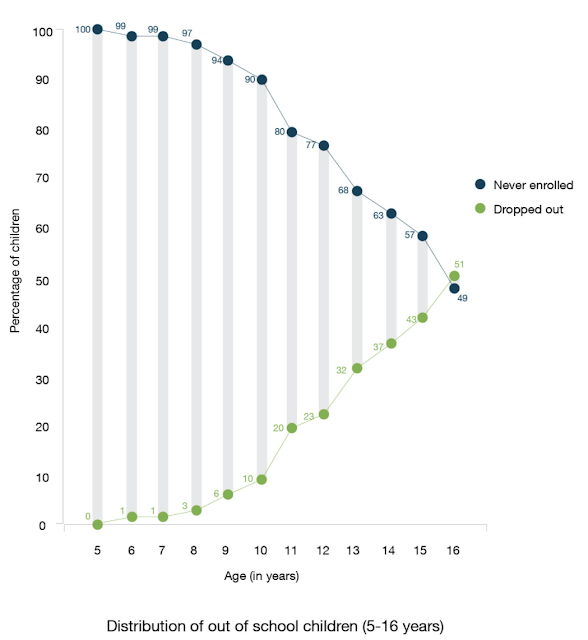 |
| Pakistan Children 5-16 In-Out of School. Source: Pak Alliance For M... |
 |
| Source: World Bank Education Statistics |
 |
| Pakistan Child Mortality Rates. Source: PDHS 2017-18 |
During the 5 years immediately preceding the survey, the infant mortality rate (IMR) was 62 deaths per 1,000 live births. The child mortality rate was 13 deaths per 1,000 children surviving to age 12 months, while the overall under-5 mortality rate was 74 deaths per 1,000 live births. Eighty-four percent of all deaths among children under age 5 in Pakistan take place before a child’s first birthday, with 57% occurring during the first month of life (42 deaths per 1,000 live births).
 |
| Pakistan Human Development Trajectory 1990-2018.Source: Pakistan HD... |
Human Development Ranking:
It appears that improvements in education and health care indicators in Pakistan are slower than other countries in South Asia region. Pakistan's human development ranking plunged to 150 in 2018, down from 149 in 2017.
 |
| Expected Years of Schooling in Pakistan by Province |
There was a noticeable acceleration of human development in #Pakistan during Musharraf years. Pakistan HDI rose faster in 2000-2008 than in periods before and after. Pakistanis' income, education and life expectancy also rose faster than Bangladeshis' and Indians' in 2000-2008.
Now Pakistan is worse than Bangladesh at 136, India at 130 and Nepal at 149. The decade of democracy under Pakistan People's Party and Pakistan Muslim League (Nawaz) has produced the slowest annual human development growth rate in the last 30 years. The fastest growth in Pakistan human development was seen in 2000-2010, a decade dominated by President Musharraf's rule, according to the latest Human Development Report 2018.
UNDP’s Human Development Index (HDI) represents human progress in one indicator that combines information on people’s health, education and income.
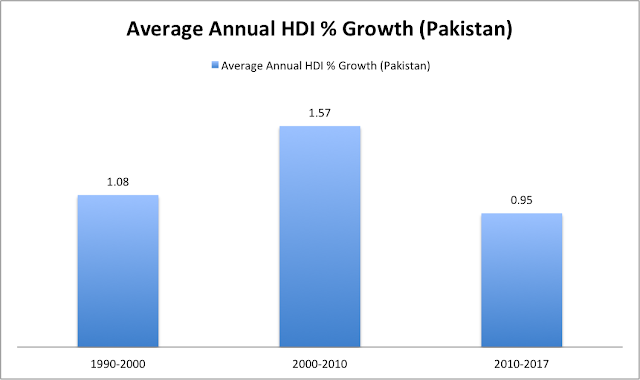 |
| Pakistan's Human Development Growth Rate By Decades. Source: HDR 2018 |
Pakistan saw average annual HDI (Human Development Index) growth rate of 1.08% in 1990-2000, 1.57% in 2000-2010 and 0.95% in 2010-2017, according to Human Development Indices and Indicators 2018 Statistical Update. The fastest growth in Pakistan human development was seen in 2000-2010, a decade dominated by President Musharraf's rule, according to the latest Human Development Report 2018.
 |
| Pakistan Human Development Growth 1990-2018. Source: Pakistan HDR 2019 |
Pakistan@100: Shaping the Future:
Pakistani leaders should heed the recommendations of a recent report by the World Bank titled "Pakistan@100: Shaping the Future" regarding investments in the people. Here's a key excerpt of the World Bank report:
"Pakistan’s greatest asset is its people – a young population of 208 million. This large population can transform into a demographic dividend that drives economic growth. To achieve that, Pakistan must act fast and strategically to: i) manage population growth and improve maternal health, ii) improve early childhood development, focusing on nutrition and health, and iii) boost spending on education and skills for all, according to the report".
 |
| Pakistani Children 5-16 Currently Enrolled. Source: Pak Alliance Fo... |
Summary:
The state of Pakistan's social sector is not as dire as the headlines suggest. There's reason for optimism. Key indicators show that education and health care in Pakistan are improving but such improvements are slower than in other countries in South Asia region. Pakistan's human development ranking plunged to 150 in 2018, down from 149 in 2017. It is worse than Bangladesh at 136, India at 130 and Nepal at 149. The decade of democracy under Pakistan People's Party and Pakistan Muslim League (Nawaz) has produced the slowest annual human development growth rate in the last 30 years. The fastest growth in Pakistan human development was seen in 2000-2010, a decade dominated by President Musharraf's rule, according to the latest Human Development Report 2018. One of the biggest challenges facing the PTI government led by Prime Minister Imran Khan is to significantly accelerate human development rates in Pakistan.
South Asia Investor Review
Pakistan's Expected Demographic Dividend
Can Imran Khan Lead Pakistan to the Next Level?
Democracy vs Dictatorship in Pakistan
Pakistan Child Health Indicators
Pakistan's Balance of Payments Crisis
Panama Leaks in Pakistan
Conspiracy Theories About Pakistan Elections"
PTI Triumphs Over Corrupt Dynastic Political Parties
Strikingly Similar Narratives of Donald Trump and Nawaz Sharif
Nawaz Sharif's Report Card
Riaz Haq's Youtube Channel
Views: 2553
-
Comment by Riaz Haq on May 26, 2026 at 4:29pm
-
Benazir Nashonuma Programme: Delivering Breakthrough Results in Preventing Malnutrition - Pakistan | ReliefWeb
Operating under Pakistan’s Benazir Income Support Programme (BISP) – the country's flagship social protection programme – the Benazir Nashonuma Programme has become a cornerstone in the fight against malnutrition in Pakistan.
The final results of the cohort study of the Independent Impact Evaluation presented in May 2026 show some of the strongest results ever documented globally for a nutrition programme, with impact on stunting reduction and child survival. The evaluation is conducted by the Institute for Global Health & Development at Aga Khan University and funded by the Gates Foundation. It followed two groups from early pregnancy – Nashonuma participants and non-participants – both enrolled in BISP Kafaalat.
The evaluation has documented significant impact on maternal outcomes, including full coverage of antenatal care (at least once), improved pregnancy weight gain (+24 g/week), and 0.36 g/dL smaller decline in hemoglobin concentration among Nashonuma participants. It also showed lower adverse birth outcomes, including low birth weight reduced by 6%, preterm births by 11%, and small vulnerable newborns by 7%. For child health outcomes, stunting at 6 months was 22% lower among Nashonuma beneficiaries (equivalent to 9.4 percentage-points), especially reflecting improved maternal nutrition, and at 12 months, it was 18% lower (equivalent to 10.1 percentage-points). The evaluation also found reduced child anemia by 12%, increased full immunization coverage by 17%, while <25% of women achieved adequate dietary diversity.
Launched in 2020, the Benazir Nashonuma Programme targets pregnant and breastfeeding women and children under 2, focusing on the pivotal first 1,000 days. Through its integration with BISP, Nashonuma can reach the most vulnerable mothers and children. The programme is delivered through 578 facilitation and 169 stabilization centers and has reached 4.6 million women and children so far.
Nashonuma provides a comprehensive package of nutrition-specific and -sensitive interventions:
- Antenatal and postnatal care services, child growth monitoring and immunization.
- Awareness sessions, Social Behavior Change to foster positive maternal, infant and young child nutrition, health, hygiene, breastfeeding and complementary feeding practices.
- Conditional cash stipends provided by BISP.
- Provision of specialized nutritious food (SNF) and Multi-Micronutrient Supplements (MMS) for mothers and children. SNF consists of 75 and-50 grams of nutrient-packed paste to complement the diet by filling nutrient gaps.
- Screening and Management of Moderate and Severe Acute Malnutrition for children and mothers, including lifesaving treatment.
The Nashonuma Programme is managed by the Government of Pakistan under BISP. The World Food Programme (WFP), in close partnerships with Health Departments, supports the management of the 578 Facilitation Centers and the procurement and distribution of SNF to prevent stunting. The centres also screen for, and manage, acutely malnourished children and women. Severe cases with medical complications are referred to one of the 169 nutrition Stabilization Centres supported by the World Health Organization (WHO), which provide lifesaving medical treatment and therapeutic milk (F-75 and F-100), as well as Ready-to-Use Therapeutic Food (RUTF). UNICEF provides RUTF for the treatment of severe acute malnutrition, MMS for women’s micronutrient deficiencies, and manages Social Behavior Change Communication & community engagement.
Comment
- ‹ Previous
- 1
- …
- 13
- 14
- 15
- Next ›
Twitter Feed
Live Traffic Feed
Sponsored Links
South Asia Investor Review
Investor Information Blog
Haq's Musings
Riaz Haq's Current Affairs Blog
Please Bookmark This Page!
Blog Posts
Tata's Boardroom Crisis: Will it Impact Philanthropy in India?
India's Tata Group is going through a major boardroom crisis. Noel Tata, the Chairman of the Tata holding company, has been removed from the Tata Group's board by N. Chandrasekaran, chairman of Tata Sons. Noel Tata has declared the decision illegal, a stance the board disputes. The crisis has been precipitated by a 2022 decision by India’s central bank to order the company to seek a stock market listing for Tata Sons, to comply with new rules governing systemically important…
ContinueXi-Trump Summit: US-China G2 Rapprochement to Avoid Thucydides Trap
The summit meeting of the leaders of China and the United States in Washington appears to signal a rapprochement between the two superpowers. President Trump has repeatedly referred to what he calls "G2", without mentioning "G7" or "G20", the groups that include many more countries. This development is seen as positive for world peace but it diminishes India's significance as a "counterweight to China" and the benefits Indians expected to flow from the US-China confrontation in…
ContinuePosted by Riaz Haq on September 25, 2026 at 5:30pm — 5 Comments
© 2026 Created by Riaz Haq.
Powered by


You need to be a member of PakAlumni Worldwide: The Global Social Network to add comments!
Join PakAlumni Worldwide: The Global Social Network