PakAlumni Worldwide: The Global Social Network
The Global Social Network
New Gwadar International Airport: Pakistan's 2nd Greenfield Class 4F Airport Nearing Completion
The architecture of the New Gwadar International Airport (NGIA) is inspired by a rising Phoenix. It is Pakistan's second greenfield airport built from scratch in a new location. With a 3,650-meter long runway, it is a Class 4F airport. NGIA is scheduled to begin test flights in December this year. The only other airport with a 3,600-meter long runway is the New Islamabad International Airport that opened for commercial flights in 2018. Karachi and Lahore international airports have runways lengths of 3,400 meters and 3,360 meters respectively, putting them in 4E class. All four of these major Pakistani airports can handle landing of Airbus A380, the largest commercial airliner in operation today.
 |
| New Gwadar International Airport Architecture Inspired by A Rising Phoenix |
New Gwadar International Airport (NGIA) is being built in Gwadar at a cost of $246 million on an area of 4,300 acres. Construction of NGIA started in October, 2019. The entire project is being built by the state-owned China Airport Construction Company funded by a Chinese government grant. It was originally scheduled for completion in 36 months. The work was slightly delayed due to the COVID19 pandemic. It is now expected to be ready for trial flights in December, 2022.
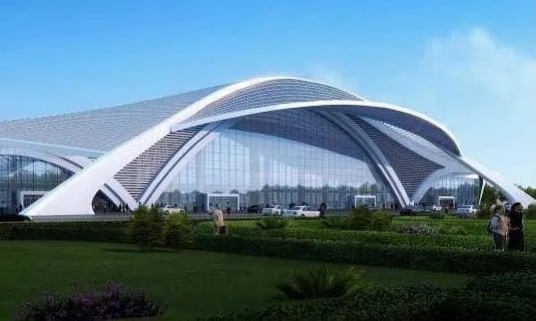 |
| New Gwadar International Airport, Gwadar, Pakistan |
NGIA is part of the China Pakistan Economic Corridor (CPEC) projects. Another key CPEC project recently completed in Gwadar is the 19-kilometer long six-lane East Bay Expressway. It was opened for traffic on June 3, 2022. East Bay Expressway connects to the Makran Coastal Highway which in turn is connected to the larger network of motorways and highways in the country as well as to China and the landlocked nations of Central Asia in CAREC.
 |
| East Bay Expressway, Gwadar, Pakistan |
The completion of New Gwadar International Airport and East Bay Expressway is an indication that the Western and Indian media headlines about the death of CPEC are not credible. To the contrary, the continuing progress on CPEC projects confirms the strong commitment of both the Chinese and the Pakistan government to move forward with their broad-based cooperation. Just yesterday, Pakistan's new Prime Minister Shehbaz Sharif reaffirmed that his government is determined to complete all the projects under the multi-billion-dollar China-Pakistan Economic Corridor (CPEC). Earlier, Chinese Foreign Ministry Spokesman Zhao Lijian said China would continue to support its companies in investing and operating in Pakistan to realize win-win results and shared development.
Related Links:
Views: 1219
-
Comment by Riaz Haq on September 14, 2025 at 6:24pm
-
Pakistan seeks $2 billion Chinese funding for CPEC
The federal government has finalised the agenda for the upcoming Joint Coordination Committee (JCC) meeting with China, seeking financing of over $2 billion for major infrastructure projects under the China-Pakistan Economic Corridor (CPEC).
https://tribune.com.pk/story/2566723/pakistan-seeks-2-billion-chine...
According to sources, the agenda includes the Karakoram Highway (KKH) Phase II, the Main Line-1 (ML-1) railway project, and the East Bay Expressway.
Pakistan has requested $1.5 billion in financing for KKH Phase II and the East Bay Expressway, while an additional $500 million has been proposed for the Rohri-Multan section of the ML-1 track.
The realignment of KKH Phase II alone is estimated to cost around Rs500 billion, while the 14-kilometre East Bay Expressway is projected to require over Rs30 billion.
Sources added that China will cover 85 per cent of the expenses for both the KKH Phase II and the East Bay Expressway projects.
-
-
Pakistan government approves new Gwadar shipyard project - Maritime Gateway
https://www.maritimegateway.com/pakistan-government-approves-new-gw...
Under the directives of Prime Minister Shehbaz Sharif, the government has approved the “New Gwadar Shipyard Mega Project” and activated the Project Management Cell (PMC). It aims at utilising all available resources for laying down fresh foundation of all-inclusive development of Gwadar Port under CPEC phase II. Having allocated Rs 200 million for the formation of PMC, relevant appointments will be sought to run entire affairs as per prescribed SOPs. The ‘New Modern Shipyard’ in Gwadar will incentivize commercial shipbuilding and repair industry, create new jobs and spur economic growth, according to Gwadar Port Authority.
Since land disagreement issue is all set to be resolved relevant TORs, tenders will be floated seeking international companies to participate. GPA had demarcated 750 acres of land for the new shipyard project. Apart from offering essential dry-docking facilities to the cargo ships visiting Gwadar Port, the Gwadar Shipyard would also offer services for building new ships.
The project expected to be started this year, and employment opportunities will be provided to experts and workers from Balochistan on the project on priority. Gwadar Shipyard Mega Project would be equipped with the latest technology, and this international standard project could give Pakistan a prominent place among the world-class shipyards.
-
-
Pakistan $100 billion maritime plan
https://www.arabnews.com/node/2621610/pakistan
KARACHI: Pakistan is implementing a $100 billion maritime development plan aimed at expanding its national shipping fleet, building new ship repair and recycling facilities, overhauling fisheries and upgrading maritime education, Maritime Affairs Minister Muhammad Junaid Anwar Chaudhry said on Thursday.
Pakistan has a 1,046-km coastline along a major global trade route, but its maritime economy has remained underdeveloped for decades, with limited commercial fleet capacity, outdated port infrastructure and declining seafood exports. Successive governments have identified the blue economy as a potential driver of growth, energy security and climate resilience, but investment and execution have lagged.
“Under the Prime Minister’s guidance, the Ministry of Maritime Affairs is implementing the ‘Maritime @100’ vision, a $100 billion blue economy plan by 2047,” Chaudhry said at the closing ceremony of the flagship Pakistan International Maritime Exhibition and Conference (PIMEC) in Karachi.
“The sea is our next frontier for trade, prosperity, energy, food and climate resilience,” he said. “Pakistan’s future lies in the sea.”
As part of the plan, Pakistan’s first Green Ship Repair and Recycling Yard will be established at Port Qasim, one of the country’s main commercial ports near Karachi that already hosts major steel and industrial facilities. The project will be developed as part of an integrated “Sea to Steel Maritime Industrial Complex” designed to support the revival of Pakistan Steel Mills, the state-owned steelmaker that has remained largely non-operational for years.
Chaudhry said the Pakistan National Shipping Corporation (PNSC) fleet has increased from 10 to 12 ships, with three more expected within two months. Tenders for 12 additional vessels are underway, with the fleet targeted to reach 30 ships by 2026 and 60 within three years.
He said Pakistan had also granted its first private ferry operator license, opening sea routes for passenger movement and coastal trade.
On Gaddani, one of the world’s largest ship-breaking yards long criticized for unsafe conditions and environmental pollution, the minister said a Rs12 billion ($43 million) modernization program is underway to meet Hong Kong Convention safety and environmental standards, shifting toward cleaner and more regulated recycling capacity.
Chaudhry said the National Fisheries and Aquaculture Policy 2025–2035 has been finalized, targeting a doubling of seafood exports within one year through upgraded cold-chain logistics, traceability certification and deep-sea fishing capacity.
A Maritime Education Endowment Fund has also been created, and the Pakistan Marine Academy will be upgraded into a Maritime University to train seafarers, marine engineers, technologists and ocean science specialists.
The minister said the government’s century-long maritime strategy, termed “Maritime Century (2047–2147),” envisions developing new deep-sea ports, AI-enabled shipbuilding and recycling complexes, “Made-in-Pakistan” vessels and 100 percent green and digital ports with multimodal connectivity.
By 2047, Pakistan aimed to emerge as a global blue economy hub driving sustainable growth across the North Arabian Sea and Indian Ocean, the minister concluded.
-
-
Karachi leverages Iran war, wins a year's worth of transshipment in 24 days
Pakistan's discount on port charges also helps draw transshipment from global lines
https://asia.nikkei.com/spotlight/iran-tensions/karachi-leverages-i...
Pakistan's Karachi port is witnessing a sharp rise in transshipment cargo due to disruption in the Strait of Hormuz, which has prompted carriers to reroute, while Islamabad's discounts on port charges are also helping global shipping lines call at the port on the Arabian Sea.
"At Karachi Port, around 8,300 containers were handled [for transshipment] in the entire year of 2025, while in just the past 24 days, cargo equivalent to 8,313 containers has been handled," Muhammad Junaid Anwar Chaudhry, federal minister for maritime affairs, told Nikkei Asia in a written statement on Friday.
Shipping lines began offloading cargo in Karachi because services to Dubai, Salalah and other Gulf ports have been disrupted by the Hormuz crisis. Iran has effectively closed down the waterway since March 2, after attacks by the U.S. and Israel.
Experts said the primary driver of the surge in cargo is the conflict in the Middle East, which has rendered traditional Gulf hubs like Dubai's Jebel Ali port non-operational.
"As a result, carriers have been forced to reroute traffic through alternative ports, and Karachi has benefited from its proximity," Naafey Sardar, assistant professor of economics at U.S.-based St. Olaf College, told Nikkei. "The increase in traffic will translate into higher revenue through port charges and other fees."
The sudden surge in cargo handling was also backed by existing foreign marine companies.
Ali Asad, who runs a trade consultancy business in Karachi, said global port operators such as Hong Kong-based Hutchison Ports and global shipping lines such as Maersk and COSCO maintain established operations in Pakistan. "These commercial linkages were already in place. As soon as this crisis struck, they were able to make use of existing mechanisms and effectively divert shipments to Pakistan instead of needing to start from scratch," he told Nikkei.
Asad added that there was existing space at Pakistan's port terminals to accommodate more transshipments. "The closure of its border with Afghanistan has practically paused transit trade in Pakistan," he said, explaining why such space is now available.
Another factor attracting transshipment demand has been the government's decision to offer 60% discounts on port charges, effective from March 18.
"A fiscal package slashing port dues by up to 60% [provided] an irresistible cost incentive for shipping lines to reroute through Karachi," Aqdas Afzal, an economist who has advised Gulf Cooperation Council governments on finance, told Nikkei.
To maintain this momentum of high cargo volume in the long term, experts argue that Pakistan needs supportive policy decisions.
"The shift can only become permanent if such recent financial incentives are embedded into a stable, long-term policy framework, maintaining cost competitiveness," Afzal said.
Asad, the trade consultant, said the most significant long-term benefit from the transshipment surge is the improvement of Pakistan's image as a potential major trade hub. "It demonstrates Pakistan's ability to handle international cargo reliably, helping position it as a viable alternative to established Gulf hubs."
Saleem Lalani, a senior finance professional who has worked in the Gulf, however, expressed skepticism on any large increase in long-term cargo handling at Karachi port.
"Ports are part of a multimodal logistics infrastructure that includes container berths, warehousing and integration with train and trucking transportation," he said.
"Any increase in terminal or seaport capacity requires significant investment in expanding capacity across the logistics and shipping value chain," he added, hinting that Islamabad's budgetary constraints would hinder such investment from materializing effectively.
-
-
Gwadar shipping activity picks up momentum | The Express Tribune
https://tribune.com.pk/story/2610989/gwadar-shipping-activity-picks...
ISLAMABAD:
Trade and shipping activity at Gwadar Port has got a boost in the backdrop of US-Iran war as port utilisation reaches 30% amid optimism about further increase in business.
The Middle East war is reshaping the region and its surroundings where different blocs are emerging. The United States, the United Arab Emirates (UAE) and Israel are on the one side whereas Saudi Arabia, Iran, Turkey, Qatar and Egypt are on the other.
This scenario has prompted the creation of new trade and energy corridors and has also encouraged Gwadar Port to highlight its geographical position that can bypass the Strait of Hormuz. During the war, hundreds of ships were stranded in the sea and to facilitate them, Pakistan offered both on-dock and off-dock facilities – the first such initiative to boost activity at the country's ports. Additionally, the government opened six land routes for 3,000 containers of Iran stuck at Pakistani ports. This step also offered an opportunity to establish connectivity with Central Asia at a time when Afghanistan had halted transit trade for Pakistan.
In a major incentive, sweeping reductions in tariff rates were announced for Gwadar Port aimed at strengthening the deep-sea facility's position as a competitive regional logistics and transshipment hub. Under the revised tariff structure, berthing fee for container vessels and ships carrying transit or transshipment cargo was slashed by 25%. Similarly, the international transshipment container cargo charges were cut by 40% while transit container cargo charges were reduced by 31%. A one-month free storage was announced for general cargo versus the standard five-day allowance at other national ports. At present, three ports are considered competitors in the region, which include the Dubai Port, Iran's Chabahar Port and Gwadar Port. The recent measures are targeted at making Gwadar Port more competitive, which may give a tough time to the Dubai Port.
In the midst of the war, Pakistan and Iran came closer to each other due to Pakistan's efforts to arrange peace talks. A plan is being studied to connect ports of Iran, Pakistan and Oman as the US and Iran have extended their ceasefire agreement. However, the question is how Pakistan will be able to sustain the momentum or increase activity at Gwadar Port after the war dust settles. "We have been able to operate Gwadar Port at 20-30% capacity. We will continue taking measures to utilise the remaining 70% capacity under a master plan," Muhammad Junaid Anwar Chaudhry, Minister for Maritime Affairs, told The Express Tribune.
-
-
The Basol Dam is a newly completed water-storage and supply project located near Ormara in the Gwadar District of Balochistan, Pakistan. [1, 2]
Project Overview and Location
Location: Built on the Basol River, roughly 54 kilometers northwest of Ormara Town and accessible via the Makran Coastal Highway.
Cost: Completed at an approximate cost of Rs. 20 billion.
Purpose: Designed to boost water security and climate resilience in the arid coastal belt of Balochistan.[1, 2, 3, 4, 5]
Key Benefits
Drinking Water: Supplies roughly 3 million gallons of clean drinking water per day to Ormara Town, the Jinnah Naval Base, Cadet College Ormara, and nearby local communities.
Irrigation: Provides vital irrigation water to thousands of hectares of agricultural land in the surrounding command area.
Flood Storage: Successfully captures and stores seasonal floodwaters and heavy rainfall inflows.
https://youtu.be/qmmg15fo-9U?is=M_JE3hL3exl6-0HA
Comment
- ‹ Previous
- 1
- …
- 4
- 5
- 6
- Next ›
Twitter Feed
Live Traffic Feed
Sponsored Links
South Asia Investor Review
Investor Information Blog
Haq's Musings
Riaz Haq's Current Affairs Blog
Please Bookmark This Page!
Blog Posts
Is the Pakistani Military Ready for Modern Drone Warfare?
The Russia-Ukraine war and the US-Israel-Iran war have recently demonstrated the effectiveness of drone warfare. Is the Pakistani military learning lessons from them to prepare for future conflicts? Let's examine the answer to this question based on recent announcements.
 |
| Pakistan's Long Range Drone… |
Posted by Riaz Haq on August 20, 2026 at 12:00pm — 3 Comments
Solar Energy Revolution Sparks Battery Boom in Pakistan
After installing over 50 GW of solar panels as of early 2026, Pakistanis are now adding batteries at a rapid pace. The country has imported nearly 7.6 GWh of batteries, with nearly 60% of that total arriving during 2025 alone. Pakistanis are now installing batteries at a rate exceeding 5 GWh annually, according to a recent report by Renewable First. Batteries enable consumers to store excess solar electricity generated during daylight hours for use at night and to smooth out…
ContinuePosted by Riaz Haq on August 12, 2026 at 5:30pm — 4 Comments
© 2026 Created by Riaz Haq.
Powered by


You need to be a member of PakAlumni Worldwide: The Global Social Network to add comments!
Join PakAlumni Worldwide: The Global Social Network