PakAlumni Worldwide: The Global Social Network
The Global Social Network
Only 27% in Pakistan Identify as Pakistanis First
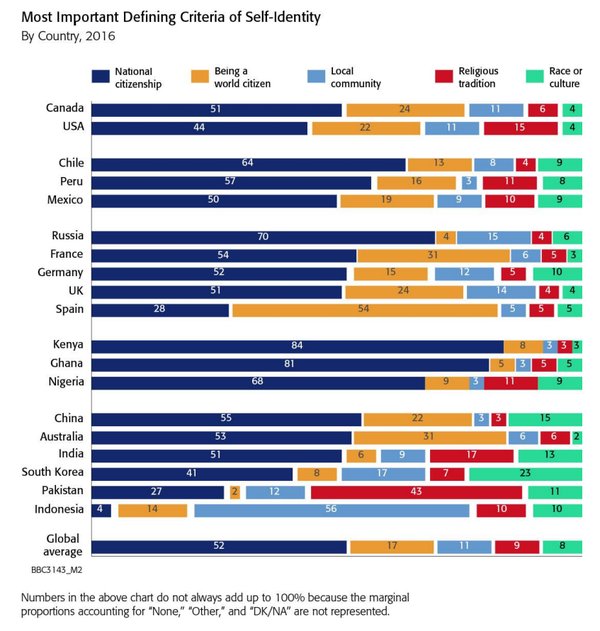
Only 27% of the people in Pakistan identify themselves as Pakistanis first while 51% of Indians see themselves as Indians first. On the other hand, 43% of Pakistanis (vs 17% of Indians) say their religious identity comes first, according to Globescan Survey 2016 conducted in 18 countries including India and Pakistan.

Pakistanis' Self-identification:
The top choice of religion as the dominant identity by 43% of respondents in Pakistan is followed by 27% seeing themselves as Pakistani, 12% picking local community, 11% saying race or culture and 2% claiming global citizenship. Those identifying as Pakistanis is up from 22% in 2011 while those who say they are Muslims first have decreased from a whopping 59% in 2011.
Pakistan Among 3 Stand-outs:
Pakistan is among three countries that stand out in how their populations see their identity. Spaniards are by far the most likely to identify with world citizenship (54%). For 56 per cent of Indonesians, belonging to their local community is the strongest defining identity. And for Pakistanis, a strong plurality (43%) identify first as a member of their religion.
Indonesia, where only 4% of the people identify themselves as Indonesian nationals, has over 18,000 islands spread over 8 million square kilometers, many with their own distinct languages and cultures. Former Indonesian President General Suhatro's mass literacy campaign to teach Bahasa Indonesia to promote nationhood has apparently not had a big impact.
The poll, conducted by GlobeScan among more than 20,000 people worldwide between December 2015 and April 2016, was released as part of the BBC World Service Identity Season—a Spring season of broadcasts on the World Service’s 27 language services exploring stories about how people identify themselves around the world, according to Globscan press release.
Global Citizenship:
Among all 18 countries where the identity question was asked in 2016, the poll suggests more than half (51%) see themselves more as global citizens than citizens of their country, against 43 per cent who identify nationally. This is the first time since tracking began in 2001 that there is a global majority who leans this way, and the results in 2016 are driven by strong increases since 2015 in non-OECD countries including Nigeria (73%, up 13 points), China (71%, up 14 points), Peru (70%, up 27 points), and India (67%, up 13 points).
Modern Nationalism:
Nation-state is a relatively recent concept in the history of mankind. Affiliations with religions, sects, and various units such as tribes, villages and towns significantly pre-date identification of people with modern nation-states.
The percentage of respondents identifying themselves as Pakistani first has increased from 22% in 2011 to 27% in 2016. Pakistani nationalism is still evolving. Rapid growth of literacy and modern mass media are helping promote a common national language and culture in the country, particularly since the beginning of the 21st century. Development of various national and state institutions is accelerating the process.
In spite of continuing tribal, sectarian and ethic conflicts in many parts of the world, including Pakistan, modern nationalism has become the most visible political force since the 20th century. This force is backed by development and promotion of national languages and cultures. It is underpinned by organized military and security apparatus enforcing constitutions and laws developed by broad consensus in democratic societies.
Summary:
While 27% identification with the nation-state in Pakistan is about half the global average of 52%, this figure is growing with the promotion of Urdu as lingua franca and common culture promoted by the increasingly powerful mass media and entertainment industry in the country.
Related Links:
Pakistan: A Blessing for South Asian Muslims?
Quaid-e-Azam Mohammad Ali Jinnah Inspired by Misaq-e-Madina
Views: 1187
Comment
Twitter Feed
Live Traffic Feed
Sponsored Links
South Asia Investor Review
Investor Information Blog
Haq's Musings
Riaz Haq's Current Affairs Blog
Please Bookmark This Page!
Blog Posts
Can Pakistan Scale Up Affordable Energy Availability to Achieve Prosperity?
Pakistan is currently classified as a lower middle-income country, with the ambition to become a high-income country. Its policymakers now recognize that no country has transitioned from middle-income to high-income status without generating substantial electricity at affordable rates. The link between energy and prosperity has been well-established since the advent of the Industrial Revolution. The AI Revolution has further reinforced it. Can Pakistan make the…
ContinuePosted by Riaz Haq on October 21, 2026 at 6:00pm
AI Revolution in Pakistan: Multiple AI Apps Launched for Farmers
With the expansion of the internet access in rural areas, several local language AI applications have recently been launched for downloads by farmers in Pakistan. These apps help with crop planning, soil sensing, personalized fertilizer recommendations, disease diagnoses, weather forecasts and market prices. A couple of these have been downloaded by half a million or more farmers in the country. Some of these apps use open source large language models (LLMs) like…
ContinuePosted by Riaz Haq on October 14, 2026 at 1:00pm — 3 Comments
© 2026 Created by Riaz Haq.
Powered by


You need to be a member of PakAlumni Worldwide: The Global Social Network to add comments!
Join PakAlumni Worldwide: The Global Social Network