PakAlumni Worldwide: The Global Social Network
The Global Social Network
Pakistan Cut Public Debt in Half On Musharraf's Watch in 1999-2008
In 1999, President Pervez Musharraf inherited a massive debt of over 100% of GDP run up by the Pakistan Peoples Party and the Pakistan Muslim League (Nawaz) governments in 1990s. Musharraf's policies not only revived the bankrupt economy but also brought down debt to 52% of GDP by 2007.
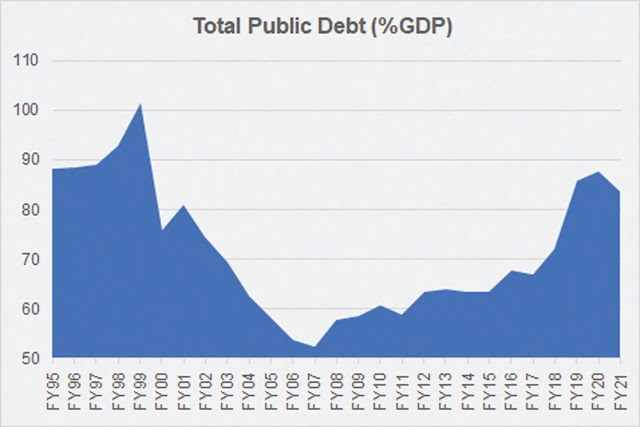 |
| Pakistan Debt to GDP 1995-2021. Source: IMF |
PPP Government's 2008 Letter to IMF:
In a letter to the International Monetary Fund in 2008, the PPP government hailed Musharraf's economic record without mentioning his name in the following words:
"Pakistan's economy witnessed a major economic transformation in the last decade (2000-2008). The country's real GDP increased from $60 billion to $170 billion, with per capita income rising from under $500 to over $1000 during 2000-07.....the volume of international trade increased from $20 billion to nearly $60 billion. The improved macroeconomic performance enabled Pakistan to re-enter the international capital markets in the mid-2000s. Large capital inflows financed the current account deficit and contributed to an increase in gross official reserves to $14.3 billion at end-June 2007. Buoyant output growth, low inflation, and the government's social policies contributed to a reduction in poverty and improvement in many social indicators". (see MEFP, November 20, 2008, Para 1).
Savings and Investments:
New cement plants met growing demand that more than doubled cement consumption, FMCG (fast moving consumer goods) sector took off to meet demand from growing middle class and production of cars and motorcycles jumped.
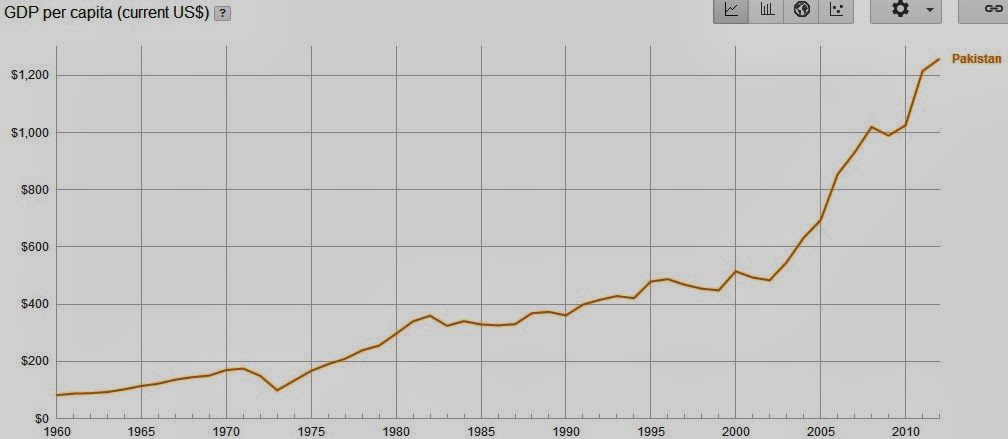
In addition to the economic revival, Musharraf focused on the social sector as well. Pakistan's Human Development Index (HDI) score grew an average rate of 2.7% per year under President Musharraf from 2000 to 2007, and then its pace slowed to 0.7% per year in 2008 to 2012 under elected politicians, according to the 2013 Human Development Report titled “The Rise of the South: Human Progress in a Diverse World”.

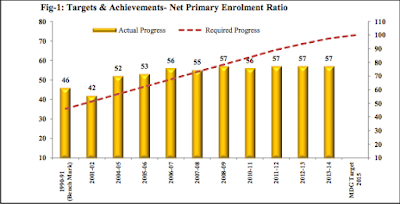 |
| Primary Enrollment Source: Economic Survey of Pakistan |
 |
| Youth Literacy Rate Source: Economic Survey of Pakistan |
Overall, Pakistan's human development score rose by 18.9% during the Musharraf years and increased just 3.4% under elected leadership since 2008. The news on the human development front got even worse in the last three years, with HDI growth slowing down as low as 0.59% — a paltry average annual increase of under 0.20 per cent. Going further back to the decade of 1990s when the civilian leadership of the country alternated between PML (N) and PPP, the increase in Pakistan's HDI was 9.3% from 1990 to 2000, less than half of the HDI gain of 18.9% on Musharraf's watch from 2000 to 2007.
 |
| R&D Spending Jumped 7-fold as % of GDP 1999-2007 Source: World ... |
Acceleration of HDI growth during Musharraf years was not an accident. Not only did Musharraf's policies accelerate economic growth, helped create 13 million new jobs, cut poverty in half and halved the country's total debt burden in the period from 2000 to 2007, his government also ensured significant investment and focus on education and health care. The annual budget for higher education increased from only Rs 500 million in 2000 to Rs 28 billion in 2008, to lay the foundations of the development of a strong knowledge economy, according to former education minister Dr. Ata ur Rehman. Student enrollment in universities increased from 270,000 to 900,000 and the number of universities and degree awarding institutions increased from 57 in 2000 to 137 by 2008. Government R&D spending jumped from 0.1% of GDP in 1999 to 0.7% of GDP in 2007. In 2011, a Pakistani government commission on education found that public funding for education has been cut from 2.5% of GDP in 2007 to just 1.5% - less than the annual subsidy given to the various PSUs including Pakistan Steel and PIA, both of which continue to sustain huge losses due to patronage-based hiring.
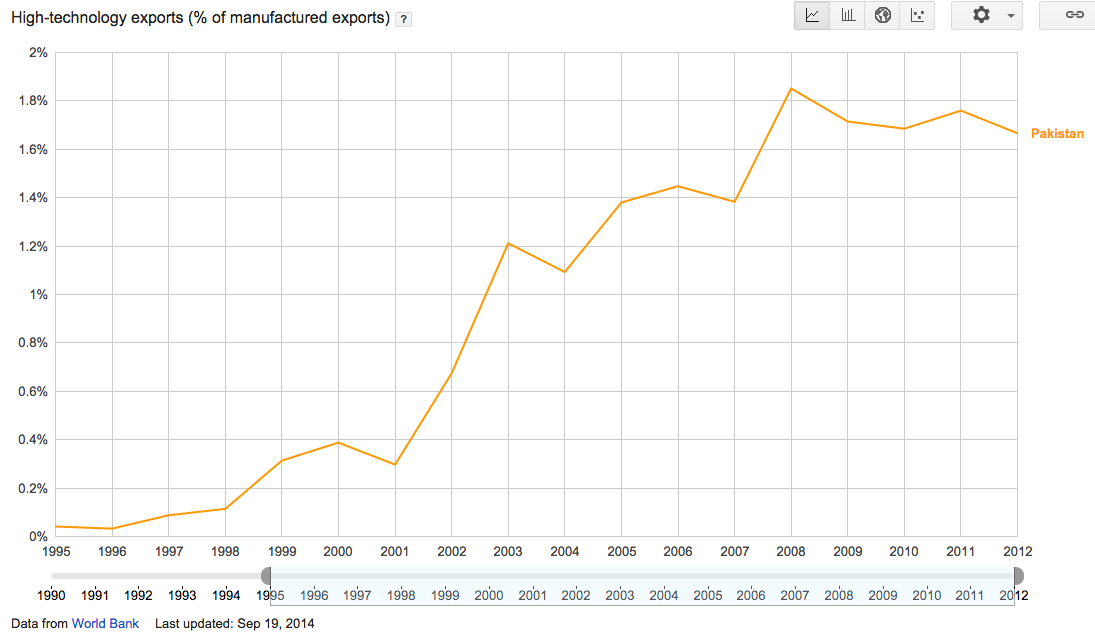 |
| Pakistan's High-Tech Exports Tripled as % of Manufactured Exports. ... |
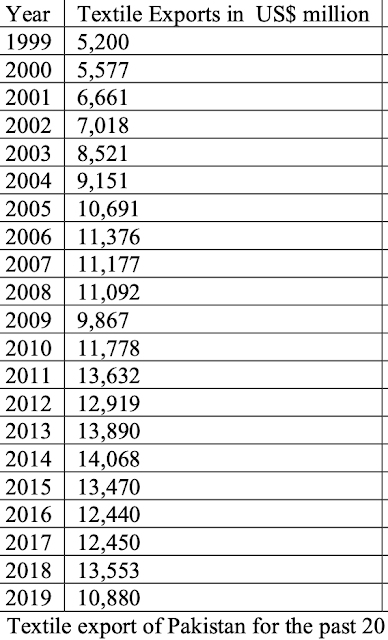
Pakistan textile exports more than doubled from $5.2 billion to more than $11 billion during the Musharraf years. Exports soared 19.43% in 2001, 20% in 2004, 24.5% in 2005 and 11.23% in 2006, all on President Musharraf's watch, according to "The Rise and Fall of Pakistan's Textile Industry: An Analytical View" published by Javed Memon, Abdul Aziz and Muhammad Qayyum.
 |
|
|
Pakistan experienced rapid economic and human capital growth in years 2000 to 2008 on President Pervez Musharraf's watch. Savings, investments and exports hit new records and the rate of increase in human development reached new highs not seen before or since this period. Without this human capital, there would be no tech industry, no freelancers and no fast-growing tech exports today.
 |
| Employment Growth in South Asia. Source: World Bank |
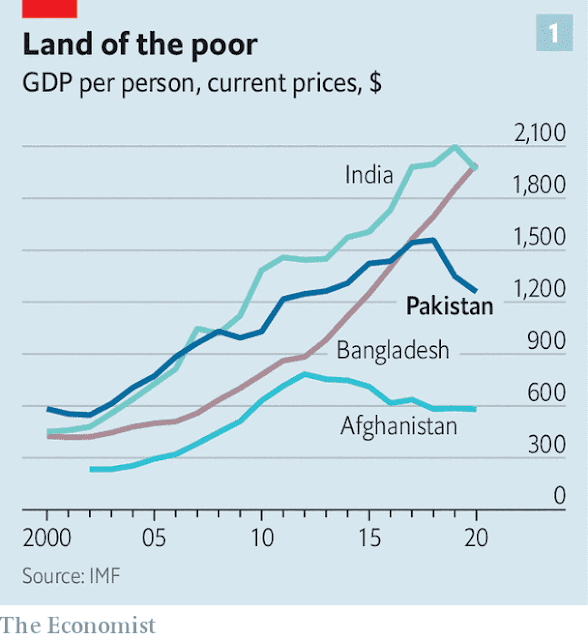 |
| Comparing Per Capita GDP Trajectory in South Asia. Source: The Economist |
Until 2010, Bangladesh was a laggard in South Asia region. Its per capita income was about half of Pakistan's. Now Bangladesh's per capita GDP is higher than both India's and Pakistan's. What changed? The biggest change is Bangladeshi leader Shaikh Hasina's decision to stifle the unruly Opposition and the media to bring political and economic stability to the South Asian nation of 160 million people. It has eliminated a constant sense of crisis and assured investors and businesses of continuity of government policies. With development taking precedence over democracy, Shaikh Hasina followed the example of Asian Tigers by focusing on export-led economic growth of her country. She incentivized the export-oriented garment industry and invested in human development. Bangladesh now outperforms India and Pakistan in a whole range of socioeconomic indicators: exports, economic growth, infant mortality rate, primary school enrollment, fertility rate and life expectancy.
Related Links:
Views: 243
-
Comment by Riaz Haq on February 11, 2022 at 2:16pm
-
#Pakistan #forex #reserves increase by $1.6 billion to $17,336.8 in the week ending Feb 4. Pak received $1 billion from #IMF and $1 billion raised in Pakistan International #Sukuk #Bond issuance. #economy https://www.reuters.com/markets/rates-bonds/pakistan-reserves-incre...
KARACHI, Pakistan, Feb 10 (Reuters) - Pakistan's foreign exchange reserves increase by $1,609 million to $17,336.8 million in the week ending February 4, compared to $15,727.6 in the previous week, the central bank said on Thursday.
RESERVES
($ billions)
Week ending Feb 4
Previous Week
Change/pct
Held by the State Bank of Pakistan
$17,336.8 mln
$15,727.6 mln
10.2
Held by commercial banks
$6,384.1 mln
$6,356.9 mln
0.4
Total
$23,720.9 mln
$22,084.5 mln
7.4
During the week ended February 4, State Bank of Pakistan received $1,053 million from International Monetary Fund (IMF) under Extended Fund Facility (EFF) program.
Proceeds against Pakistan International Sukuk Bond issuance of $1,000 million were also received in the week.
Pakistan's central bank reserves increased by $1,609 million, after accounting for external debt payments, the State Bank said on Thursday.
Comment
Twitter Feed
Live Traffic Feed
Sponsored Links
South Asia Investor Review
Investor Information Blog
Haq's Musings
Riaz Haq's Current Affairs Blog
Please Bookmark This Page!
Blog Posts
Kashmir: Farooq Abdullah Lauds Pakistan's Diplomatic Support
Speaking at an event in the Indian Occupied Kashmir, veteran Kashmiri leader Farooq Abdullah has lauded Pakistan's support for Kashmiris' rights. “They (Indian leaders in Delhi) are silent today because there is noise in the world, and our neighbor (Pakistan) is constantly behind this. Everywhere they say, ‘the decision regarding Kashmir has not been made’. That is what is saving us. Otherwise, their intentions are not good", he said. He warned that Kashmiris risked losing their…
ContinuePosted by Riaz Haq on October 29, 2026 at 6:00pm — 1 Comment
Can Pakistan Scale Up Affordable Energy Availability to Achieve Prosperity?
Pakistan is currently classified as a lower middle-income country, with the ambition to become a high-income country. Its policymakers now recognize that no country has transitioned from middle-income to high-income status without generating substantial electricity at affordable rates. The link between energy and prosperity has been well-established since the advent of the Industrial Revolution. The AI Revolution has further reinforced it. Can Pakistan make the…
ContinuePosted by Riaz Haq on October 21, 2026 at 6:00pm — 10 Comments
© 2026 Created by Riaz Haq.
Powered by


You need to be a member of PakAlumni Worldwide: The Global Social Network to add comments!
Join PakAlumni Worldwide: The Global Social Network