PakAlumni Worldwide: The Global Social Network
The Global Social Network
Pakistan EV Launches to Accelerate Clean Energy Transition
Pakistani automobile joint ventures with Chinese automakers BYD and Changan have recently launched several all-electric and plug-in hybrid models of automobiles in Pakistan. Earlier, Honda Atlas Cars Pakistan Limited announced plans to build a hybrid electric vehicles plant in the country. Other major brands like Toyota, Haval, and Hyundai are already offering similar models in the country. It all began with the 2019 electric vehicle policy approved by the government of Prime Minister Imran Khan to incentivize the electrification of the auto industry. Pakistan EV policy goal is to achieve 30% of new cars sales, 50% of new 2-wheeler and 3-wheeler sales and 30% of new truck sales by 2030. By 2040, the target is 90% of all new vehicle sales to be electric. The main incentive is the reduction of sales tax from 17% for internal combustion engine (ICE) vehicles to 1% for all-electric (EV) vehicles.
 |
| BYD EV. Source: CNBC |
 |
| Soaring Imports of Chinese Solar Panels in Pakistan. Source: Bloomberg |
Pakistan has contributed only 0.28% of the CO2 emissions but it is among the biggest victims of climate change. The US, Europe, India, China and Japan, the world's biggest polluters, must accept responsibility for the catastrophic floods in Pakistan and climate disasters elsewhere. A direct link of the disaster in Pakistan to climate change has been confirmed by a team of 26 scientists affiliated with World Weather Attribution, a research initiative that specializes in rapid studies of extreme events, according to the New York Times.
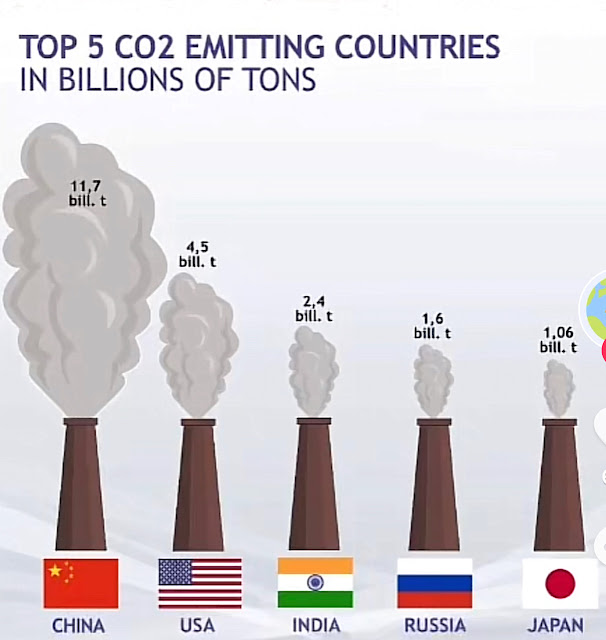 |
| Top 5 Current Polluters. Source: Our World in Data |
Currently, the biggest annual CO2 emitters are China, the US, India and Russia. Pakistan's annual CO2 emissions add up to just 235 million tons. On the other hand, China contributes 11.7 billion tons, the United States 4.5 billion tons, India 2.4 billion tons, Russia 1.6 billion tons and Japan 1.06 billion tons.
 |
| Pakistan's Annual CO2 Emission. Source: Our World in Data |
The United States has contributed 399 billion tons (25%) of CO2 emissions, the highest cumulative carbon emissions since the start of the Industrial Revolution in the late 18th century. The 28 countries of the European Union (EU28), including the United Kingdom, come in second with 353 billion tons of CO2 (22%), followed by China with 200 billion tons (12.7%).
Related Links:
Haq's Musings
South Asia Investor Review
Solar Power Boom in Pakistan
Pakistan Electric Vehicle Policy
Nuclear Power in Pakistan
Can Urban Forests Beat the Heat in Pakistani Cities
Pakistan's Response to Climate Change
IPP Contacts Bankrupting Pakistan
Renewable Energy for Pakistan
Net Metering in Pakistan
Pakistan's Digital Public Infrastructure Transforming Lives
My Family's Contribution to Climate Action
China-Pakistan Economic Corridor
Ownership of Appliances and Vehicles in Pakistan
CPEC Transforming Pakistan
Pakistan's $20 Billion Tourism Industry Boom
Riaz Haq's YouTube Channel
PakAlumni Social Network
Views: 440
-
Comment by Riaz Haq on August 3, 2025 at 10:21am
-
Husain Haqqani
@husainhaqqani
Pakistan’s Nishat Group has earmarked $100 million to build electric-powered vehicles in partnership with one of China’s largest car exporters, Chery Automobile Co.
Local car assembling starts in October, & manufacturing will follow.
@business
reports.
https://x.com/husainhaqqani/status/1951209832200958217
------------
Faseeh Mangi
@FaseehMangi
Pakistani tycoon Mian Mansha is setting up a factory to build EV cars with one of China’s largest car exporters, Chery Automobile
The conglomerate has earmarked about $100 million
They plans to debut five cars today and start local assembling in Oct.
https://x.com/FaseehMangi/status/1951189257227223537
-------
Nishat, Chery launch Omoda, Jaecoo
https://www.dawn.com/news/1928185/nishat-chery-launch-omoda-jaecoo
LAHORE: One of Pakistan’s leading business conglomerates, Nishat Group, has partnered with Chery International — China’s largest automobile exporter — to launch its global brands, Omoda and Jaecoo, in the local market. The high-profile unveiling event was held on Friday.
The group announced plans to establish a car manufacturing facility near Faisalabad, with local assembly of electric vehicles (EVs) expected to commence in November. An investment of $100 million will be made through its subsidiary, Nexgen Auto, to support EV manufacturing and marketing operations in Pakistan.
In a significant industry first, five car models were unveiled simultaneously — more than typically seen at automotive launches. The line-up included two long-range battery electric vehicles (E5 and J6), two plug-in hybrids (J7 and C7), and a hybrid vehicle (J5). The event was attended by a broad spectrum of participants, including political figures, environmental advocates, automotive influencers, and car enthusiasts.
Speaking at the event, Nishat Group Chairman Mian Mohammad Mansha welcomed the government’s focus on electric mobility, calling it a timely move to address climate and economic challenges. He said the group had chosen to partner with Chery International due to its commitment to environmental sustainability.
“The introduction of electric vehicles will help combat pollution and significantly reduce the country’s oil import bill,” he said. He added that his group’s existing automotive venture, Hyundai, has already sold over 50,000 units. Mr Mansha also announced plans to offer bank financing for electric cars through MCB Bank, another entity under the Nishat umbrella.
Mr Qi Joe, President of Chery International South Asia, expressed confidence in the partnership, stating that the collaboration would help position Omoda and Jaecoo among Pakistan’s top car brands.
In a statement, the company said the launch highlighted Nishat Group’s commitment to innovation and excellence. “The unveiling of a future-ready line-up, tailored to the evolving needs of Pakistani consumers, reflects Nishat Group’s strategic vision for the country’s automotive industry,” it noted.
The event marks a milestone for Nexgen Auto in its goal to redefine mobility in Pakistan by introducing cutting-edge technology, sustainable design, and intelligent performance. With the entry of Omoda and Jaecoo, the company aims to bring global innovation and a modern driving experience to local roads, setting a new industry benchmark.
-
-
Hybrids save $27m in fuel imports - Business - DAWN.COM
https://www.dawn.com/news/1952253
KARACHI: More than 30,000 hybrid electric vehicles (HEVs) have hit Pakistani roads over the past two years, saving an estimated 30 million litres of fuel and reducing the oil import bill by around $27 million.
Lucky Motor Corporation (LMC) Chief Executive Mohammad Faisal said the savings could multiply if hybrids accounted for 25-30pc of the overall vehicle market. Pakistan’s auto market, including cars, vans, SUVs and pickups, averages 180,000-200,000 units annually, with HEVs now holding over 50pc share in the sport utility vehicles (SUV) segment during the first quarter of FY26.
Since 2021, 13 new electrified models have been launched in Pakistan, nine of which are hybrids from Korean, Chinese and Japanese assemblers. Mr Faisal said the trend reflects growing consumer confidence in HEVs due to easier maintenance, consistent fuel savings and better resale value compared to battery electric vehicles (BEVs) and plug-in hybrids (PHEVs).
-
-
BYD adds to China's expanding automotive footprint in Pakistan
https://kr-asia.com/byd-adds-to-chinas-expanding-automotive-footpri...
BYD is emerging as a key player in Pakistan’s automotive market as the Chinese electric vehicle manufacturer prepares to begin local assembly in the country, and to reshape a sector long controlled by Japanese carmakers like Suzuki, Toyota, and Honda.
“The plant is expected to become operational in the third to fourth quarter of 2026, with the first locally assembled BYD vehicles anticipated to reach the market later in the year,” Danish Khaliq, vice president in charge of sales and strategy at Mega Motor Company, BYD’s official partner in Pakistan, told Nikkei Asia.
BYD Pakistan, the name Mega Motor Company uses for marketing and branding purposes, began selling imported EVs in Pakistan in 2024. The local partner is currently preparing BYD’s first assembly plant near Karachi with an annual production capacity of 25,000 vehicles.
BYD surpassed Tesla of the US as the world’s top EV supplier for the first time in 2025.
BYD Pakistan declined to share its sales in the South Asian country with Nikkei Asia, but it said that the assembly plant construction is expected to carry an estimated cost of USD 150 million. Local media have reported that BYD sold around 2,000 units in 2025.
BYD is not the first Chinese marque in Pakistan. FAW Motors entered the market in 2017, followed by state-owned Changan Automobile, which began local assembly in 2018. State-owned BAIC Motor followed in 2019. BYD will, however, be the first local EV assembler in Pakistan.
“Rising smog levels in major cities and the transport sector’s contribution to air pollution have made clean mobility an urgent consideration rather than a distant goal,” Khaliq said. “At the same time, the growing fuel import bill has strengthened the case for alternative energy solutions.”
Chinese automakers tend to focus on higher-end EVs and hybrid vehicles rather than conventional gasoline cars, where competition from Japanese manufacturers is relatively limited. For example, Great Wall Motor (GWM), the top-selling Chinese automaker in Pakistan, began local assembly in 2021 and reportedly sold about 10,000 units, including Haval-branded hybrid SUV models, in 2025.
Shehryar Qadir, senior vice chairman of the Pakistan Association of Automotive Parts & Accessories Manufacturers (PAAPAM), told Nikkei that Chinese automakers currently account for about 20% of Pakistan’s passenger vehicle market.
Kamran Kamal, a BYD Pakistan executive, once told local media that the new energy vehicles Chinese automakers are betting on will make up as much as 50% of passenger vehicles sold in Pakistan by 2030.
Experts said that the Chinese automaker push into the Pakistan market is primarily driven by a favorable government policy that will remain in place until June.
-
-
BYD adds to China's expanding automotive footprint in Pakistan
https://kr-asia.com/byd-adds-to-chinas-expanding-automotive-footpri...
Pakistan’s automotive development and export policy for 2021–2026 offers reduced duties and tax incentives for vehicle imports and the establishment of assembly plants, aiming to attract new entrants, increase competition, and promote gradual localization in the country’s automobile sector.
This policy covers newcomers to the entire automobile industry, and does not favor only Chinese brands or EVs.
“Under this policy, Chinese companies are importing vehicles and assembling them locally through completely built units or semi-assembled routes, without major investment in localization or technology transfer,” Mashood Khan, an automotive sector expert based in Karachi, told Nikkei.
“Their current market presence is therefore shaped more by policy incentives than by long-term industrial commitment,” he said.
Qadir, from PAAPAM, agreed: “New entrants under [Pakistan’s new car] policies had 20% concession on parts imports, which is huge in the auto parts manufacturing industries, where profit margins are around the 5% mark,” he said. “This resulted in lower costs and very high margins for the [Chinese].”
GWM’s Haval H6 is priced at around USD 18,000–22,000 in Pakistan, while Toyota’s RAV4 sells at USD 30,000–35,000. BYD’s Atto 3 is available at dealers for USD 20,000–23,000, while its Seal U model is priced around USD 25,000–28,000.
Toyota Indus Motor Company, Toyota’s local unit, did not respond to Nikkei‘s query by the time of publication.
“The reason why the Japanese manufacturers could not take advantage of this was that policy advantage was only offered to greenfield investment, so only new entrants could avail this advantage,” Qadir told Nikkei, adding that new entrants, such as Hyundai Motor and Kia, have also taken advantage of the auto policy.
He foresees the policy likely being extended beyond June this year. “Auto policy 2026–31’s zero draft was shared by Engineering Development Board [an apex government body under the Ministry of Industries and Production] in November 2025. Policy formulation is currently underway,” he told Nikkei.
Habib Ullah Khan, an expert on emerging economies based in Karachi, pointed out that Chinese firms also benefit from a decade of Beijing’s EV subsidies, and the world’s largest domestic testing ground.
“[The Chinese] have perfected aggressive pricing through scale and are now capable of launching EVs near conventional vehicle price points,” he told Nikkei.
Qadir is cognizant of the flip side of the typical Chinese automaker strategy, noting that the China market is saturated with over 100 EV brands, with less than 7% in profit.
“Due to this intense competition in China, companies are forced to look outwards at overseas markets, often at lower price points, to push volumes,” he said.
The growing presence of Chinese automakers threatens Japanese companies in Pakistan, which have historically dominated the auto market.
“Pakistan is a fascinating place to study the Chinese challenge to Japanese auto makers,” said Habib Ullah Khan. “What is happening in Pakistan will be replicated all over the world where Japanese car makers dominate.”
Industry insiders said that Japanese manufacturers operating in Pakistan already have high levels of localization and a broader product mix. They continue to dominate small cars and sedans and retain market leadership despite rising competition.
“While Chinese brands are gaining acceptance in SUVs due to global shifts and feature-rich offerings, their long-term success will depend on how quickly they can match Japanese localization levels,” Mashood Khan, the auto expert, said.
-
-
Faseeh Mangi
@FaseehMangi
Signs are emerging that the latest conflict is hastening Pakistan’s transition to EVs
VLEKTRA Electric Motorcycles expects battery-powered two-wheelers to account for 10% to 15% of the market in 2026, up from less than 1% two years ago.
https://x.com/FaseehMangi/status/2037545212139188341?s=20
-----------------
Iran War Is Pushing Consumers to Break Up With Fossil Fuels
EVs, solar panels, induction stoves and heat pumps, now cheaper than ever, are becoming more attractive as the conflict upends oil and gas markets.
By Todd Woody
https://www.bloomberg.com/news/features/2026-03-26/war-oil-price-sh...
Just weeks ago, the US electric car market looked moribund. Amid plummeting EV sales, dealers were offering discounts as Detroit automakers scrapped electric lineups to make more gas-guzzling SUVs.
Then oil prices surged after the US and Israel attacked Iran.
Now, a used electric car showroom in San Francisco suggests the tide is turning again. As gasoline prices climb — hitting $6.81 a gallon at a nearby station on Wednesday — a flurry of drivers are making appointments to check out Ever’s lightly used EVs, many priced under $30,000.
“Gas prices are coming up in almost every customer conversation,” said Maximilian Quertermous, Ever’s co-founder and chief operating officer. “The momentum of the last few weeks is among the strongest we’ve seen.”
Ever is just one dealership, but signs of a shift are playing out across the world. In Southeast Asia, buyers are flocking to Chinese EV giant BYD Co.’s stores, while electric rickshaws are selling out in Pakistan. A shortage of cooking oil in India is driving a run on electric stoves. From Germany to Nigeria, interest in rooftop solar is surging. And in the UK, some homeowners are taking the plunge on expensive heat pumps.
---------
In neighboring Pakistan, solar took off after the Ukraine war. Now, signs are emerging that the latest conflict is hastening the nation’s transition to EVs after the price of gasoline jumped more than 20%.
Syed Raza Mohsin, founder of VLEKTRA Electric Motorcycles, said he expects battery-powered two-wheelers to account for 10% to 15% of the market in 2026, up from less than 1% two years ago. “Solar is a very good example of how private citizens themselves found a solution for high energy prices,” he said. “We are seeing similar trends in motorcycles.”
Electric rickshaw maker Tezmo Motors has already sold out its March inventory, according to founder Moez Naseer, and is expecting a “very huge surge of orders.” Naseer said two fleet operators have placed orders since the Iran war started. “We are so petrol reliant, so people are finally figuring it out that we cannot rely on this anymore,” he said.
In the Philippines, the government is stepping in to fill the gap. This week, a state-owned pension fund started offering loans of up to 500,000 pesos ($8,300) for home solar panels after President Ferdinand Marcos Jr. declared a national energy emergency due to the war.
-
-
Pakistan in talks with world’s largest EV battery maker CATL on investment cooperation — business chamber | Arab News
- Envoy to Beijing says China-Pakistan MoUs, joint ventures worth over $13 billion signed in two years
- Says Pakistan eyeing “first-mover advantage” in sodium battery sector amid global clean energy transition
KARACHI: Pakistan is in discussions with China’s CATL, the world’s largest electric vehicle battery manufacturer, over potential investment and cooperation in advanced battery technologies, Pakistan’s ambassador to Beijing said this week, as Islamabad pushes to attract industrial investment under the next phase of the China-Pakistan Economic Corridor (CPEC).
China remains Pakistan’s largest strategic and economic partner, with the two countries deepening cooperation through CPEC, the flagship Pakistan arm of China’s Belt and Road Initiative launched in 2015. The first phase of CPEC focused largely on power generation, roads and transport infrastructure, while the second phase has increasingly shifted toward industrial cooperation, technology transfer, manufacturing, agriculture and special economic zones.
Pakistan has recently intensified efforts to attract Chinese private-sector investment as it seeks to stabilize its economy under an IMF-backed reform program and position itself as a regional manufacturing and logistics hub.
“Pakistan and China have made significant progress in strengthening bilateral economic cooperation with more than 300 Memorandums of Understanding (MOUs) and over three dozen joint venture agreements signed during the last two years, carrying a cumulative value exceeding $13 billion,” Pakistan’s Ambassador to China Khalil Hashmi said during a meeting on Monday with a Chinese business delegation at the Karachi Chamber of Commerce and Industry.
Highlighting emerging opportunities in energy and technology, Hashmi said Pakistan was “currently engaged in active discussions with CATL,” which he described as one of the world’s largest battery manufacturers specializing in lithium-ion and increasingly sodium-based battery technologies.
“He said Pakistan is encouraging the company to establish cooperation and investment initiatives in the country, expressing optimism that concrete developments may emerge during the forthcoming visit of the Prime Minister to China,” according to a statement released by the Karachi Chamber.
Global demand for EV batteries and energy storage systems has surged in recent years as governments and industries transition toward cleaner energy and electric mobility. CATL, headquartered in China, is the world’s dominant EV battery producer and supplies major global automakers including Tesla, BMW, Volkswagen and Ford.
Pakistan has increasingly positioned itself as a potential destination for battery manufacturing and mineral processing investment, particularly as global attention shifts toward supply chains linked to electric vehicles, renewable energy and energy storage.
Hashmi said the global market was gradually moving from lithium-ion batteries toward sodium-based battery technologies and noted that Pakistan possessed “abundant raw materials required for such industries.”
“Pakistan aims to capitalize on the first-mover advantage in this evolving sector and is working steadily toward attracting investment in advanced battery manufacturing and new energy technologies,” the statement said, quoting the ambassador.
Hashmi also said Pakistan had established a mechanism to improve implementation of Chinese investment agreements, adding that nearly 30 percent of signed MoUs were now being converted into practical contracts and business ventures.
-
-
Pakistan says China’s Dongjin Group to invest $15 million in battery plant in Faisalabad
https://www.arabnews.com/node/2643228/amp
Move expected to help Pakistan meet growing demand for batteries, driven by increasing number of electric vehicles, solar systems
Plant likely to create jobs, support allied industries, including electronics, automotive components, packaging, chemicals, says official
ISLAMABAD: Chinese company Dongjin Group recently announced its plan to invest $15 million in a dry battery facility in the eastern city of Faisalabad, state-run Associated Press of Pakistan (APP) reported on Monday.
Dongjin Group designs, manufactures and sells lead acid batteries and chargers used in UPS systems, telecom, medical equipment, electric vehicles, solar and wind power systems and others. The Chinese company recently announced its plan to invest $15 million in the facility, APP said, adding that it will be established in the Special Economic Zone near Faisalabad.
The investment agreement was signed with the Punjab Board of Investment and Trade (PBIT), the state-run media reported.
“Chinese company Dongjin Group’s plan to establish a dry battery manufacturing facility in Allama Iqbal Industrial City is expected to help Pakistan meet growing demand for batteries, driven by the expansion of electric vehicles and solar energy systems,” APP said.
Sharqui Ali Tipu, director of marketing at PBIT, said Dongjin Group decided to establish the plant after observing the increasing demand of batteries in Pakistan, particularly due to the growing use of electric vehicles and solar energy solutions in the country.
He said the project is expected to generate economic and industrial activity across multiple sectors, while facilitating the transfer of modern technology.
Tipu said the battery plant is likely to support allied industries, including electronics, automotive components, packaging, chemicals and engineering support services. He added that it would also create employment opportunities in Faisalabad and its surrounding areas.
“Under Pakistan’s Special Economic Zone incentive package, the company will be eligible for a 10-year income tax holiday and a one-time exemption from customs duties and taxes on the import of plant and machinery,” APP said.
Almas Hyder, former chairman of the Engineering Development Board, an apex government body under the Ministry of Industries & Production, noted that Pakistan is moving toward localizing lithium-ion battery manufacturing to strengthen energy security and reduce import dependence.
Hyder said batteries have become strategically important globally due to their growing demand linked to renewable energy, electric vehicles and grid stability.
“The greater the battery production in Pakistan, the higher the chances of reducing dependence on expensive electricity and imported fossil fuels,” Hyder was quoted as saying by the APP.
Comment
- ‹ Previous
- 1
- 2
- 3
- 4
- Next ›
Twitter Feed
Live Traffic Feed
Sponsored Links
South Asia Investor Review
Investor Information Blog
Haq's Musings
Riaz Haq's Current Affairs Blog
Please Bookmark This Page!
Blog Posts
Is the India Growth Story Over?
In a television speech to the nation, Indian Prime Minister Narendra Modi urged his people to make sacrifices by spending less on fuel, fertilizer, and travel. He also asked them not to buy gold for a year. “To save foreign exchange, we must accept the challenge of patriotism,” he said. It appears that India's problems do not just stem from the effects of the US-Iran war; India's problems started well before that. Flight of foreign capital has put the Indian currency under tremendous…
ContinuePosted by Riaz Haq on May 11, 2026 at 9:00pm — 3 Comments
Pakistan's New Infrastructure Investments and Trade Routes
Pakistan has recently launched 5G wireless service in multiple cities and closed financing on the 306 kilometer 6-lane Sukkur-Hyderabad M6 motorway. In addition, Pakistan is seeing significant increase in the utilization of its Gwadar and Karachi ports after the closure of the Strait of Hormuz due to the US-Iran war. This will help open the trade routes from Pakistan to Central Asia via Iran, bypassing unstable Afghanistan. It has the potential to eventually make Pakistan a major…
ContinuePosted by Riaz Haq on May 4, 2026 at 5:00pm — 10 Comments
Switch to the Mobile Optimized View
© 2026 Created by Riaz Haq.
Powered by


You need to be a member of PakAlumni Worldwide: The Global Social Network to add comments!
Join PakAlumni Worldwide: The Global Social Network