PakAlumni Worldwide: The Global Social Network
The Global Social Network
Pakistan Plans to Convert Coal-Fired Power Plants to Burn Domestic Thar Lignite
With a new 330 MW mine-mouth coal-fired power plant in Tharparkar, Pakistan has now reached 990 MW of power fueled by the local lignite. Thar coal production is being expanded and plans are in place to convert three more imported anthracite coal fired plants to burn domestic lignite as soon as its production is expanded and a rail link is completed to transport the fuel to the rest of the country. Plans call for using Thar coal in three coal-fired plants currently burning imported coal: Sahiwal Coal Power, China Hub Coal Power and Port Qasim Coal, each of 1,320MW installed capacity. These power plants may require some limited equipment changes to burn domestic lignite. It is worth noting that Pakistan contributes less than 1% of the global greenhouse-gas emissions. Using the higher polluting domestic Thar lignite is crucial to Pakistan's desperate need for cheap energy to spur industrialization for economic growth without running into recurring balance of payments crises.
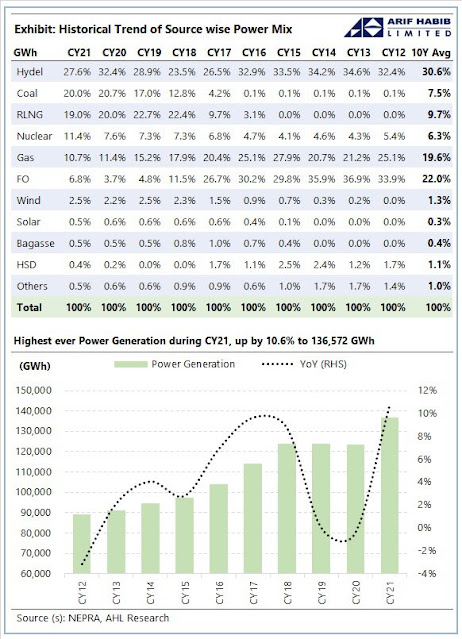 |
| Pakistan Electric Power Generation Fuel MiX. Source: Arif Habib |
Last year, hydroelectric dams contributed 37,689 GWH of electricity or 27.6% of the total power generated, making hydropower the biggest contributor to power generated in the country. It was followed by coal (20%), LNG (19%) and nuclear (11.4%). Nuclear power plants generated 15,540 GWH of electricity in 2021, a jump of 66% over 2020. Overall, Pakistan's power plants produced 136,572 GWH of power in 2021, an increase of 10.6% over 2020, indicating robust economic recovery amid the COVID19 pandemic.
Lucky power plant in Karachi has been designed to use Thar Lignite Coal when it is available in sufficient quantity. Until that time, it will operate on imported lignite coal. Domestic lignite production is being expanded in a bid to replace costly fossil fuel imports that are depleting Pakistan's foreign exchange reserves and exacerbating circular debt in the power sector, according to Nikkei Asia.
SECMC (Sindh Engro Coal Mining Company) has commissioned a study for converting the China-Pakistan Economic Corridor coal plants in Hub, Jamshoro and Sahiwal to indigenous lignite. A 105km long Thar Rail project is being planned to connect Thar coal fields with Main Line (ML-1) at the New Chhor Halt Station to transport lignite to the power plants in the rest of the country. The transportation of lignite by trucks to Karachi and Kallar Kahar shows its movement by road and rail is feasible and safe despite higher moisture.
 |
| Pakistan Electric Power Generation. Source: Arif Habib |
 |
| Cost Per Unit of Electricity in Pakistan. Source: Arif Habib |
Construction of 1,100 MW nuclear power reactor K2 unit in Karachi was completed by China National Nuclear Corporation in 2019, according to media reports. Another similar reactor unit K3 is now in operation. It will add another 1,100 MW of nuclear power to the grid in 2022. Chinese Hualong One reactors being installed in Pakistan are based on improved Westinghouse AP1000 design which is far safer than Chernobyl and Fukushima plants.
The biggest and most important source of low-carbon energy in Pakistan is its hydroelectric power plants, followed by nuclear power. Pakistan ranked third in the world by adding nearly 2,500 MW of hydropower in 2018, according to Hydropower Status Report 2019. China added the most capacity with the installation of 8,540 megawatts, followed by Brazil (3,866 MW), Pakistan (2,487 MW), Turkey (1,085 MW), Angola (668 MW), Tajikistan (605 MW), Ecuador (556 MW), India (535 MW), Norway (419 MW) and Canada (401 MW).
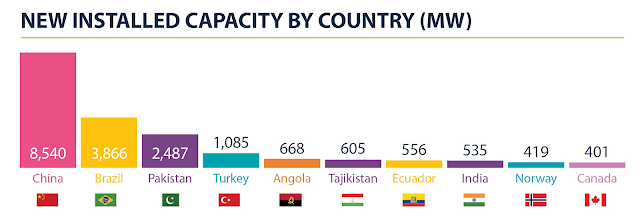 |
| New Installed Hydroelectric Power Capacity in 2018. Source: Hydrowo... |
Hydropower now makes up about 28% of the total installed capacity of 33,836 MW as of February, 2019. WAPDA reports contributing 25.63 billion units of hydroelectricity to the national grid during the year, “despite the fact that water flows in 2018 remained historically low.” This contribution “greatly helped the country in meeting electricity needs and lowering the electricity tariff for the consumers.”
 |
| Pakistan's Current Account Balance vs International Oil Prices. Sou... |
Recent history shows that Pakistan's current account deficits vary with international oil prices. Pakistan's trade deficits balloon with rising imported energy prices. One of the keys to managing external account balances lies in reducing the country's dependence on foreign oil and gas.
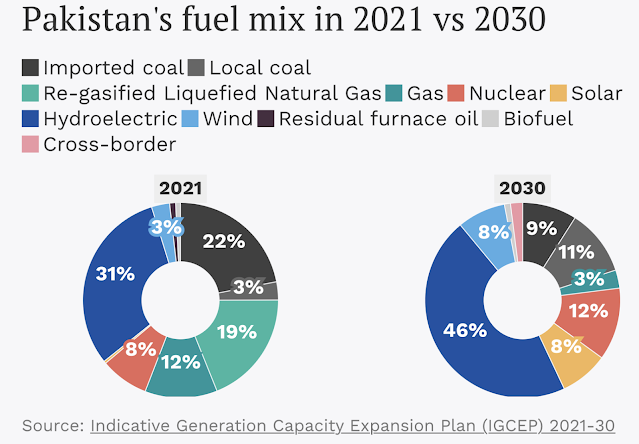 |
| Pakistan Power Generation Fuel Mix. Source: Third Pole |
It is true that Pakistan has relied on imported fossil fuels to generate electricity. The cost of these expensive imported fuels like furnace oil mainly used by independent power producers (IPPs) has been and continues to be a major contributor to the "exaggerated external demand driven by its rentier economy" referred to by Atif Mian in a recent tweet. However, Pakistan has recently been adding hydro, nuclear and indigenous coal-fired power plants to gradually reduce dependence on imported fossil fuels.
Related Links:
Haq's Musings
South Asia Investor Review
Pakistan Among World's Largest Food Producers
Food in Pakistan 2nd Cheapest in the World
Indian Economy Grew Just 0.2% Annually in Last Two Years
Pakistan to Become World's 6th Largest Cement Producer by 2030
Has Bangladesh Surged Past India and Pakistan in Per Capita Income?
Pakistan's Computer Services Exports Jump 26% Amid COVID19 Lockdown
Coronavirus, Lives and Livelihoods in Pakistan
Vast Majority of Pakistanis Support Imran Khan's Handling of Covid1...
Pakistani-American Woman Featured in Netflix Documentary "Pandemic"
Incomes of Poorest Pakistanis Growing Faster Than Their Richest Cou...
Can Pakistan Effectively Respond to Coronavirus Outbreak?
How Grim is Pakistan's Social Sector Progress?
Double Digit Growth in Pakistan's Energy Consumption Confirms Econo...
Trump Picks Muslim-American to Lead Vaccine Effort
COVID Lockdown Decimates India's Middle Class
Pakistan to be World's 7th Largest Consumer Market by 2030
Pakistan's Balance of Payments Crisis
How Has India Built Large Forex Reserves Despite Perennial Trade De...
Conspiracy Theories About Pakistan Elections"
PTI Triumphs Over Corrupt Dynastic Political Parties
Strikingly Similar Narratives of Donald Trump and Nawaz Sharif
Nawaz Sharif's Report Card
Riaz Haq's Youtube Channel
Views: 961
-
Comment by Riaz Haq on October 8, 2026 at 9:39am
-
Pakistan's Thar coal project has crossed in cumulative foreign exchange savings by replacing expensive imported fuel with indigenous coal. [1, 2]Key Savings & Financial Breakdown
- Power Generation Costs: The Phase-III expansion of Thar Block-II reduces generation costs by Rs 15 billion annually. [1]
- Coal Tariff Reduction: Levelised coal tariffs are projected to drop from $36.72 to $32.01 per tonne as production scales up. [1]
Production & Capacity Growth- Block-II Expansion: Phase-III raises annual production capacity by 47%—from 7.6 million tonnes to 11.2 million tonnes. [1]
- Household Reach: The expanded power supply provides electricity to roughly 4.5 million householdsdaily. [1]
Would you like more details on specific Thar coal blocks (such as Block-I or Block-II) or data on upcoming industrial coal-to-gas/urea conversion projects?
Comment
- ‹ Previous
- 1
- …
- 3
- 4
- 5
- Next ›
Twitter Feed
Live Traffic Feed
Sponsored Links
South Asia Investor Review
Investor Information Blog
Haq's Musings
Riaz Haq's Current Affairs Blog
Please Bookmark This Page!
Blog Posts
Can Pakistan's Small Nuclear Arsenal Survive India's First Strike?
Possession of nuclear weapons is considered "the ultimate deterrent" by eminent international geopolitical analysts like Professor John Mearsheimer of Chicago University. However, it appears that Mearsheimer has also raised questions about the survivability of a small land-based nuclear arsenal in the event of a first strike by a nuclear-armed adversary. Is this likely to tempt India to launch first strike against Pakistan's nuclear assets?…
ContinuePosted by Riaz Haq on November 13, 2026 at 5:00pm — 1 Comment
How Significant is Pakistan's Fa'az Air-to-Air Missile Flight Test?
Pakistan's recent successful flight test of Fa'az, its indigenous air-to-air missile, has garnered significant international attention. What is its significance? First, it is a major breakthrough for its national defense industry, elevating Pakistan into an elite, relatively small group of nations possessing the complex engineering expertise required to build weapons capable of hunting fighter jets. Second, it enhances the country's self-reliance and makes it less vulnerable…
ContinuePosted by Riaz Haq on November 6, 2026 at 10:30am — 5 Comments
© 2026 Created by Riaz Haq.
Powered by


You need to be a member of PakAlumni Worldwide: The Global Social Network to add comments!
Join PakAlumni Worldwide: The Global Social Network