PakAlumni Worldwide: The Global Social Network
The Global Social Network
Pakistan's Mobile Broadband Speeds Faster Than India's
Even before 3G and 4G roll-outs, Pakistan's mobile data users enjoy an average bandwidth of 1.5 Mbits/sec and peak bandwidth of 14.7 Mbits/sec, according to a report published by Akamai Technologies, Inc. The Akamai data includes usage from smartphones, tablets, computers, and other devices that connect to the Internet through mobile network providers. The only mobile broadband option available to users in Pakistan has so far been PTCL's EVO.
|
Results of Google-sponsored Survey in Pakistan Source: Express Tribune |
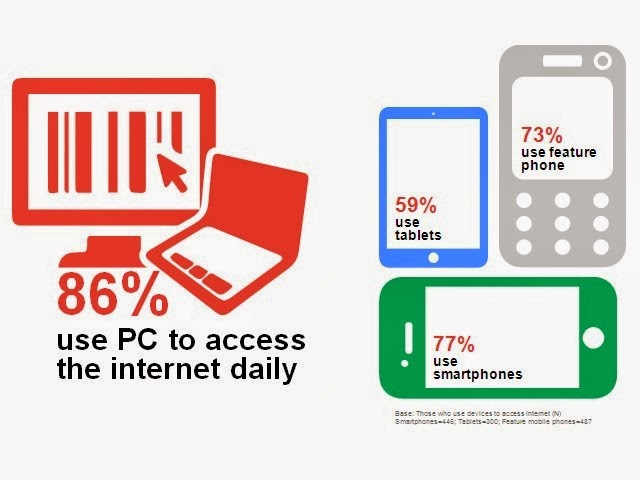
Akamai Technologies, the creator of this report, operates an Internet content delivery network headquartered in Cambridge, Massachusetts. Akamai's network is one of the world's largest distributed-computing platforms, responsible for serving between 15 and 30 percent of all web traffic around the world.
|

Akamai report ranks 16 countries in Asia by mobile Internet speeds. South Korea tops the list with average 14.7 Mbits/sec and 41.3 Mbits/sec peak. Vietnam is at the bottom with 1.1 Mbits/sec average and 6.5 Mbits/sec peak. India ranks second from bottom with 1.3 Mbps average and 8.7 Mbps peak.
With 3G and 4G roll-outs currently underway in Pakistan by multiple carriers, companies like Zong are talking about delivering speeds of up to 42 Mbps while other companies are offering 3G speeds of up to 21 Mbps. Even if they fall short, I expect that the average mobile broadband speeds in Pakistan should still be lot faster than what's available in the country today.
Related Links:
Pakistan Rolls Out Mobile Apps in Public Sector
Pakistan Launches 100 MBPS FTTH Broadband
Mobile Internet to Overtake Desktop in 2014 in Pakistan
Biometric Information Technology in Pakistan
Views: 381
-
Comment by Riaz Haq on July 10, 2014 at 10:42pm
-
Less money moves through wireless transfers in India than in either Pakistan or Bangladesh, both of which have smaller populations.
As we report this week, in much of the developing world, mobile money is evolving. Initially just a means of making payments, it’s now becoming a platform for an entire financial-services industry. But one of the world’s biggest and poorest countries has remained immune to the attractions of mobile money. Despite the potential benefits, “the uptake has been limited,” says Graham Wright of MicroSave, a financial-inclusion organisation working in India. “And because of those challenges, the mobile operators are unsure about how much to invest in this business.”
That doesn’t mean there isn’t opportunity. India has 15 mobile money providers, second only to Nigeria. Of the 904 million mobile subscriptions in India, 371 million (pdf) are in rural areas. Analysts think that mobile money transfers in India could be worth $350 billion annually (paywall) by next year. Yet the state of the industry remains small: Less money moves through wireless transfers in India than in either Pakistan or Bangladesh, both of which have smaller, poorer populations.
So why, despite boasting 15 mobile money services, does India lag so far behind other developing nations?
The simple answer is regulation. India requires mobile operators to work with banks to provide the services. Mobile networks would like instead to have their own agents who can cash out the digital money into hard currency. Much of the infrastructure is already in place, because there are so many locations where customers can top up on airtime. But the mobile operators aren’t allowed to use those sales outlets as financial agents.
+
Yet the banks aren’t filling the gap. They have failed to serve rural areas, especially thinly-populated ones. Nor are they particularly keen on sending agents to operate in small villages. A report (pdf, p.31) on financial services for the poor, commissioned by the Reserve Bank of India, called the situation in both rural and urban India “grim,” with 64% of Indians lacking bank accounts. “The business case for providing mobile money services to the unbanked in the most remote rural areas of India is not appealing to banks,” reports the GSM Association (pdf), a trade body of mobile operators.http://qz.com/222964/why-mobile-money-has-failed-to-take-off-in-india/
-
-
Mobilink Pakistan's parent company VimpelCom Ltd. ("VimpelCom", "Company" or "Group") VIP, -1.88% a leading global provider of telecommunications services operating in 14 countries and headquartered in Amsterdam, and Twitter, Inc., the world leader in public social network services today announced that they have agreed a partnership to offer VimpelCom's customers new ways to connect and engage with communities and content on Twitter.------
Mobilink Pakistan is the first VimpelCom operating company to launch Twitter mobile services under this partnership. VimpelCom will expand the service to its other operations.The agreement is a part of VimpelCom's consistent strategy of providing its customers with the best mobile internet experience, complementing its current partnerships with Google Play and Windows Phone store to allow VimpelCom smartphone customers using their mobile accounts to pay for digital content, with Opera Software to deliver better mobile web browsing and with WhatsApp and Wikimedia to increase customer engagement and stimulate use of the mobile internet.
http://www.marketwatch.com/story/vimpelcom-and-twitter-partner-to-s...
Comment
Twitter Feed
Live Traffic Feed
Sponsored Links
South Asia Investor Review
Investor Information Blog
Haq's Musings
Riaz Haq's Current Affairs Blog
Please Bookmark This Page!
Blog Posts
Can Pakistan Scale Up Affordable Energy Availability to Achieve Prosperity?
Pakistan is currently classified as a lower middle-income country, with the ambition to become a high-income country. Its policymakers now recognize that no country has transitioned from middle-income to high-income status without generating substantial electricity at affordable rates. The link between energy and prosperity has been well-established since the advent of the Industrial Revolution. The AI Revolution has further reinforced it. Can Pakistan make the…
ContinuePosted by Riaz Haq on October 21, 2026 at 6:00pm — 2 Comments
AI Revolution in Pakistan: Multiple AI Apps Launched for Farmers
With the expansion of the internet access in rural areas, several local language AI applications have recently been launched for downloads by farmers in Pakistan. These apps help with crop planning, soil sensing, personalized fertilizer recommendations, disease diagnoses, weather forecasts and market prices. A couple of these have been downloaded by half a million or more farmers in the country. Some of these apps use open source large language models (LLMs) like…
ContinuePosted by Riaz Haq on October 14, 2026 at 1:00pm — 4 Comments
© 2026 Created by Riaz Haq.
Powered by


You need to be a member of PakAlumni Worldwide: The Global Social Network to add comments!
Join PakAlumni Worldwide: The Global Social Network