PakAlumni Worldwide: The Global Social Network
The Global Social Network
Pakistan's Vast Oil Reserves
Pakistan has more shale oil than Canada, according to the US Energy Information Administration (EIA) report released on June 13, 2013.
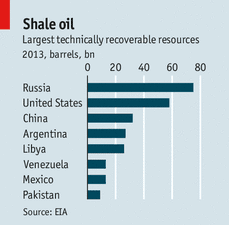
The US EIA report estimates Pakistan's total shale oil reserves at 227 billion barrels of which 9.1 billion barrels are technically recoverable with today's technology. In addition, the latest report says Pakistan has 586 trillion cubic feet of shale gas of which 105 trillion cubic feet (up from 51 trillion cubic feet reported in 2011) is technically recoverable with current technology.
The top ten countries by shale oil reserves include Russia (75 billion barrels), United States (58 billion barrels), China (32 billion barrels), Argentina (27 billion barrels), Libya (26 billion barrels), Venezuela (13 billion barrels), Mexico (13 billion barrels), Pakistan (9.1 billion barrels), Canada (8.8 billion barrels) and Indonesia (7.9 billion barrels).

Pakistan's current annual consumption of oil is only 150 million barrels. Even if it more than triples in the next few years, the 9.1 billion barrels currently technically recoverable would be enough for over 18 years. Similarly, even if Pakistan current gas demand of 1.6 trillion cubic feet triples in the next few years, it can be met with 105 trillion cubic feet of technically recoverable shale gas for more than 20 years. And with newer technologies on the horizon, the level of technically recoverable shale oil and gas resources could increase substantially in the future.
 |
| Source: US EIA Report 2013 |
As can be seen in the shale resource map, most of Pakistan's shale oil and gas resources are located in the lower Indus basin region, particularly in Ranikot and Sembar shale formations.
 |
| Source: US EIA Report 2013 |
Since the middle of the 18th century, the Industrial Revolution has transformed the world. Energy has become the life-blood of modern economies. Energy-hungry machines are now doing more and more of the work at much higher levels of productivity than humans and animals who did it in pre-industrial era. Every modern, industrial society in history has gone through a 20-year period where there was extremely large investment in the power sector, and availability of ample electricity made the transition from a privilege of an urban elite to something every family would have. If Pakistan wishes to join the industrialized world, it will have to do the same by having a comprehensive energy policy and large investments in the power sector. Failure to do so would condemn Pakistanis to a life of poverty and backwardness.


The availability of large domestic shale oil and gas expands the opportunity to reduce Pakistan's dependence on imports to overcome the current energy crisis and to fuel the industrial economy. But it'll only be possible with high priority given to investments in developing the energy sector of the country.
Related Links:
Haq's Musings
US EIA International Data on Per Capita Energy Consumption
Pakistani Guar in Demand For American Shale Fracking
Affordable Fuel for Pakistan's Electricity
Pakistan Needs Shale Gas Revolution
US Census Bureau's International Stats
Pakistan's Vast Shale Gas Reserves
US AID Overview of Pakistan's Power Sector
US Can Help Pakistan Overcome Energy Crisis
Abundant and Cheap Coal Electricity
US Dept of Energy Report on Shale Gas
Pakistan's Twin Energy Crises
Pakistan's Electricity Crisis
Pakistan's Gas Pipeline and Distribution Network
Pakistan's Energy Statistics
US Department of Energy Data
Electrification Rates By Country
CO2 Emissions, Birth, Death Rates By Country
China Signs Power Plant Deals in Pakistan
Pakistan Pursues Hydroelectric Projects
Pakistan Energy Industry Overview
Energy from Thorium
Comparing US and Pakistani Tax Evasion
Pakistan's Oil and Gas Report 2010
Circular Electricity Debt Problem
International CNG Vehicles Association
Rare Earths at Reko Diq?
Lessons From IPP Experience in Pakistan
Correlation Between Human Development and Energy Consumption
Views: 4581
-
Comment by Riaz Haq on October 24, 2026 at 11:20am
-
Recent Offshore & Onshore Highlights
- Offshore Bidding Round: Four local-led consortiums—headed by state-run OGDCL, Pakistan Petroleum Ltd (PPL), Mari Energies, and Prime Energy—won the rights. Turkey's national oil company TPAO joined as a partner with a 25% stake in an awarded block. [1, 2]
- Key Onshore Discoveries:
- Heavy Crude Technology: OGDCL partnered with Canada's Synergetic Oil Tools Inc. to deploy Passive Energy Tool technology to enhance output from domestic heavy crude fields. [1]
Sector Context- Production vs. Demand: Domestic crude production hovers around 70,000 barrels per day against a national demand of roughly 500,000 barrels per day, leaving the country heavily reliant on fuel imports.[1]
- Global Ranking: According to data from the U.S. Energy Information Administration, Pakistan ranks around 52nd globally with an estimated 500 million barrels of proven oil reserves, contrary to online rumors claiming massive top-tier rankings. [1]
-
-
Pakistan is advancing its unconventional energy sector through pilot projects and horizontal drilling led by the Oil and Gas Development Company Limited (OGDCL) to offset declining conventional natural gas output and expensive LNG imports.
Reserves and Potential
• Indus Basin Estimates: OGDCL estimates the Indus Basin holds roughly 135 trillion cubic feet (TCF) of shale gas in place, with notable concentrations identified in Sindh's Sanghar (74 TCF) and Hyderabad (7.5 TCF) districts.
• Broader Assessments: Historical US Energy Information Administration (EIA) reports and geological studies place Pakistan's technically recoverable or in-place shale resources anywhere from 51 TCF to over 105–586+ TCF (with some broader theoretical basin assessments running much higher).
• Key Formations: Major shale-bearing units include the Sembar, Ranikot, Ghazij, Mughal Kot, and Lower Goru formations.
Current Development Status
• Pilot Projects & Horizontal Drilling: OGDCL completed vertical pilot well testing in Sindh (such as the KUC-1 well) and has moved into horizontal drilling and hydraulic fracturing.
• Production Projections: Officials estimate that full-scale development could eventually yield up to 800–900 million standard cubic feet per day (MMscfd) of shale gas, though widespread commercial viability and large-scale output will take several years of continued drilling and infrastructure investment.
• Challenges: Development faces hurdles such as complex geological formations, high initial capital and technology requirements, water availability for fracking, and low regulated domestic gas prices.
https://youtu.be/thFrahrTUtM?is=EzPiF41PstfW-ZIU
-
-
Turkey sets out to explore Pakistan's offshore hydrocarbon fields
https://www.bairdmaritime.com/offshore/exploration-development/turk...
Turkey's Oruc Reis seismic research vessel will begin exploration for hydrocarbon resources in offshore fields in Pakistan, Turkish Energy Minister Alparslan Bayraktar said on Friday, adding that drilling was expected to start in 2027.
Last year, Turkey's state oil company TPAO signed hydrocarbon exploration and production agreements with Pakistani companies including Mari Energies, Fatima, OGDCL, PPL, Prime and GHDL for three offshore and two onshore fields in Pakistan.
Bayraktar, who attended a ceremony to welcome Oruc Reis at Karachi Port alongside Pakistan's Foreign Minister Ishaq Dar and Petroleum Minister Ali Pervaiz Malik, said on social media the vessel would carry out two- and three-dimensional seismic survey operations in the Indus and Makran basins to, "uncover the potential there".
The step marked a "strong turning point" in energy cooperation between the two countries, he said, noting that it came at a time of turbulence in global oil and gas markets.
Last month, Bayraktar said the planned operations off Pakistan had been delayed by about six months due to the war in Iran.
Comment
- ‹ Previous
- 1
- 2
- 3
- 4
- Next ›
Twitter Feed
Live Traffic Feed
Sponsored Links
South Asia Investor Review
Investor Information Blog
Haq's Musings
Riaz Haq's Current Affairs Blog
Please Bookmark This Page!
Blog Posts
Can Pakistan's Small Nuclear Arsenal Survive India's First Strike?
Possession of nuclear weapons is considered "the ultimate deterrent" by eminent international geopolitical analysts like Professor John Mearsheimer of Chicago University. However, it appears that Mearsheimer has also raised questions about the survivability of a small land-based nuclear arsenal in the event of a first strike by a nuclear-armed adversary. Is this likely to tempt India to launch first strike against Pakistan's nuclear assets?…
ContinuePosted by Riaz Haq on November 13, 2026 at 5:00pm — 2 Comments
How Significant is Pakistan's Fa'az Air-to-Air Missile Flight Test?
Pakistan's recent successful flight test of Fa'az, its indigenous air-to-air missile, has garnered significant international attention. What is its significance? First, it is a major breakthrough for its national defense industry, elevating Pakistan into an elite, relatively small group of nations possessing the complex engineering expertise required to build weapons capable of hunting fighter jets. Second, it enhances the country's self-reliance and makes it less vulnerable…
ContinuePosted by Riaz Haq on November 6, 2026 at 10:30am — 5 Comments
Switch to the Mobile Optimized View
© 2026 Created by Riaz Haq.
Powered by


You need to be a member of PakAlumni Worldwide: The Global Social Network to add comments!
Join PakAlumni Worldwide: The Global Social Network