PakAlumni Worldwide: The Global Social Network
The Global Social Network
Pakistanis Second Fastest Growing Group Among Asian-Americans
There are now more Asians migrating to the United States than Hispanics, reflecting a decline in illegal
immigration as American employers increase their demand for
high-skilled workers. About 430,000 Asians, or 36 percent of all new immigrants, arrived in
the U.S. in 2010, according to the latest census data. That's higher than 370,000, or 31 percent, who were Hispanic.

A study published by the Pew Research Center details what it describes as "the rise of Asian-Americans", a
highly diverse and fast-growing group making up roughly 5 percent of the
U.S. population. Mostly foreign-born and naturalized citizens, their
numbers have been boosted by increases in visas granted to specialized
workers and to wealthy investors as the U.S. economy becomes driven less
by manufacturing and more by technology.
The Pew survey is based on an analysis of census data as well as
interviews with 3,511 Asian adults living in the U.S., conducted by cell
phone or landline from Jan. 3 to March 27. The poll has a margin of
error of plus or minus 2.4 percentage points for all respondents, higher
for subgroups.
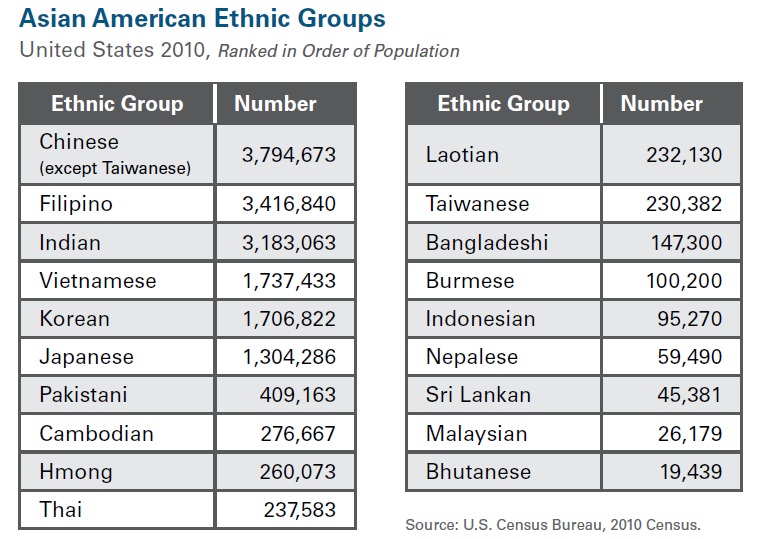
Pakistani-Americans (pop: 409,163) are the seventh largest community among Asian-Americans, behind Chinese (3.8 million), Filipinos (3.4 million), Indians (3.2 million), Vietnamese (1.74 million), Koreans (1.7 million) and Japanese (1.3 million), according to Asian-American Center For Advancing Justice . They are still a miniscule fraction of the overall US population. However, their numbers have more than doubled in the last decade due to increased immigration, according to US Census 2010 data. With 100% increase since 2000, Pakistanis are the second fastest growing Asian immigrant group in the United States. With median household income of $63,000, Pakistani-Americans also earn more than an average American household. The most common jobs of Pakistani-Americans include doctors, engineers,
accountants, salespersons, administrators/managers and financial analysts, and 55 per cent hold at least a
bachelor’s degree which is higher than 49% of all Asian-Americans and almost twice the 28% of overall American population with college degrees.

Here are some of the highlights of Pakistani-American data from US Census 2010 as gleaned from a report titled "A Community of Contrasts Asian Americans in the United States: 2011" published by Asian-American Center For Advancing Justice:
1. There are 409,163 Pakistani-Americans in 2010, the 7th largest Asian-American community in America.
2. Pakistani-American population doubled from 2000 (204,309) to 2010 (409,163), the second largest percentage increase after Bangladeshis' 157% increase in the same period.
3. The median household income of Pakistani-American families is nearly
$63,000 versus $51,369 average for all Americans.
4. 55% of Pakistanis have a bachelor's degree or higher.
5. 55% of Pakistanis own their own homes.
6. 6% of Pakistani-American population is mixed race.
7. 65% of Pakistanis in America are foreign-born. 57% of foreign-born Pakistani-American population is made up of naturalized citizens.
8. There are 120,000 Pakistani legal permanent residents of which 42% are eligible to naturalize.
9. There were 69,202 immigrant visas issued to Pakistanis from 2001 to 2010, the 5th highest among Asian nations.
10. 28% of Pakistanis have limited English proficiency.
11. 15% of Pakistanis are classified as poor; only 1% of them are on public assistance.
12. 8% of Pakistanis are unemployed, a figure lower than the general population of Americans.
13. Median age of Pakistanis in America is only 29 years, lower than most of the Asian groups and the national median age of 36.8 years.
Pakistani-American community is still relatively young when compared with other immigrant groups. More of the Pakistanis in America are college educated than the general population of whites and various immigrant groups. The youthful energy and higher education levels of Pakistani-Americans are opening doors for them to rise and shine in America, in spite of the current economic difficulties in their adopted land of opportunities.
Related Links:
Haq's Musings
Pakistani-American NFL Team Owner
OPEN Forum 2012
Pakistani-American Elected Mayor
Pakistani-American Entrepreneurs Catch the Wave
Khan Academy Draws Pakistani Visitors
Minorities are Majority in Silicon Valley
Pakistani-American's Game-Changing Vision
Pakistan's Demographic Dividend
Pakistanis Study Abroad
Pakistan's Youth Bulge
Pakistani Diaspora World's 7th Largest
Views: 921
-
Comment by Riaz Haq on July 6, 2012 at 8:23am
-
Here's a Dawn article by Michael Kugelman on Pakistani-Americans:
...For sure, many if not most Pakistani-Americans and US-based Pakistanis retain strong links to Pakistan. Some do so by staying close to relatives still in the country, or via the Internet and the various Pakistani media outlets accessible in America. Others quite famously exemplify the diaspora’s “giving” bonafides. We often hear about the remittances sent back to relatives, yet it’s equally important to acknowledge the humanitarianism. This largesse can be seen in the work of groups like APPNA, but also from the quiet actions of individuals. I know of various Pakistani-Americans — who otherwise rarely visit Pakistan — spending extended periods in the country to provide relief assistance after the 2010 floods.
Then there are the many diaspora organisations dedicated to Pakistan. Some, such as the various chapters of the Pakistani American Association (from North Carolina to Florida), promote Pakistani culture. Others, such as the Pakistan American Business Association, advocate business ties between the two countries. Still others are unabashedly political.
In the context of politics, only in recent months have I begun to fully understand the considerable influence Pakistani politicians’ exercise over the diaspora. As I’ve suggested before (only somewhat in jest), Pervez Musharraf seems to have more supporters in America than he does in Pakistan (and he has an extraordinary public relations operation to sustain his apparent popularity here). Then there’s Imran Khan, whose PTI party was scheduled to hold a jalsa in New York City until it was abruptly postponed with no apparent explanation. When Musharraf spoke at the Woodrow Wilson Center last summer, many of the 400 people in attendance were Pakistani-Americans. I suspect a visit by Khan would draw many more.
Yet my main interest here is those diaspora members who decide to go back to Pakistan — and not simply to visit relatives or attend weddings. I’ve previously alluded to Ijaz Nabi and Adil Najam, long-time successful professionals in this country who returned to Pakistan to join LUMS. There are also the likes of Pakistani-American Nadia Naviwala, a Harvard-educated, one-time USAID staffer who not long ago decided to relocate to Pakistan to serve as the US Institute of Peace’s country representative there.
These are only the more well-known cases. I recently received an email from a young, newly minted law school graduate, born and raised in America, who had decided to move to Pakistan — where she had never lived before. I imagine there are other examples like this one.
So what inspires diaspora members to return to Pakistan? More than three years ago, a blogpost by Nosheen Abbas highlighted the various opportunities diaspora members perceive in Pakistan, and the sense of attachment that attracts them.
In truth, I doubt there’s one overarching motivating factor — and certainly not idealism. Several years ago I had lunch with a deeply cynical diaspora member who lamented — as many do — the hopeless state of Pakistan. Not too long after this conversation, he returned to the country to take a prominent position in government. He was likely drawn to Pakistan by a job, not by do-goodism.
Another question is how diaspora members are treated once they arrive back in Pakistan. Do they encounter hostility? Are they dismissed as out-of-touch outsiders? And, in the case of those born in the United States, are they tainted for being Americans?
On all accounts, I suspect the answer is no. Various Afghan and Iraqi diaspora members (from accountants to politicians) have returned to help rebuild their countries of origin, a process that seems to be encouraged in these countries......
http://dawn.com/2012/07/06/when-the-pakistani-diaspora-returns-to-p...
-
-
Here's an excerpt of an ET piece by Shahid Javed Burki on Pakistani-Americans:
To appreciate the economic influence the Pakistanis living in America could exert on the country of their origin, we should have some idea about their wealth, sources of income and aggregate incomes. Their total annual income is of the order of $45 to $50 billion a year. The savings rate should be around 25 per cent of the income, which is typical of immigrant groups. This means that about $12 billion a year is being set aside and invested in the creation of assets. Since the diaspora was formed over a period of more than 25 years, I estimate the asset base of this community at about $175 billion. The income from this should be about $8 billion a year. Originally, salaries and wages were the main source of income. Now, with a sizeable asset base, one-sixth of the incomes are drawn from returns on investments. With these numbers as the background, we can begin to understand the source of remittances and other capital flows that originate from this particular diaspora.
In the last two decades, there was a 16-fold increase in the amount of remittances sent by Pakistanis living and working in the United States. These increased from $150 million in 1991-92 to 2.4 billion in 2011-12. This represents an increase of 15 per cent a year. The rate of growth in remittances from this particular source was almost four times the rate of increase in the national product. Another way of looking at this flow of capital is in terms of its contribution to the increase in GDP. Assuming that currently the incremental capital output ratio for Pakistan is four — meaning that it takes four per cent of GDP to be invested to generate a one per cent increase in the national product — about a 0.3 percentage point increase in national income could be attributed to the remittances from the United States. Could this amount increase even further and could it be used more effectively? I will take up these questions in the article next week.
http://tribune.com.pk/story/522240/the-economic-impact-of-the-pakis...
-
-
Indian Muslims make up 14.6% of India's population, almost 50% higher than the 10% of Indian-American Muslim population. In addition, every Indian minority other than Muslims is over-represented in America.
http://www.pewforum.org/uploadedFiles/Topics/Demographics/Asian%20A...
http://www.economist.com/news/asia/21572785-steadily-rising-muslim-...
-
-
Excerpt of Obama's remarks after meeting Sharif at White House:
... And I shared with him that I had the opportunity, back in 1980 when I was a very young man, to visit Pakistan because I had two Pakistani roommates in college whose mothers taught me how to cook daal and keema, and other very good Pakistani food. And it was a wonderful trip for me, and created a great appreciation and a great love for the Pakistani people.
I know that Pakistani Americans here in the United States are enormous contributors to the growth and development of the United States, and so we have these strong people-to-people connections. And my hope is, is that despite what inevitably will be some tensions between our two countries and occasional misunderstandings between our two countries, that the fundamental goodwill that is shared between the Pakistani people and the American people, that that will be reflected in our governments’ relationships and that we will continue to make progress in the coming years.
So, Mr. Prime Minister, welcome. And thank you for an excellent conversation and an excellent visit.
http://www.whitehouse.gov/the-press-office/2013/10/23/remarks-presi...
-
-
Here's a NY Times story on a Pakistani-American Halal food entrepreneur:
During the early months of 2010, Adnan A. Durrani found himself frequently thinking of kosher hot dogs. To be more precise, he was thinking of an ad campaign for them created decades earlier by the Hebrew National company. Its well-known slogan went, “We answer to a higher authority.”
Let it be said that Mr. Durrani was, in many ways, an unlikely recipient for such a revelation. An observant Muslim born to Pakistani parents, a Wall Street refugee turned natural-foods entrepreneur, he was then trying to create a line of frozen-food entrees adhering to the Muslim religious standard of halal for the American market.
And Mr. Durrani was doing so in an especially forbidding political climate, with a demagogic battle raging against a proposed Muslim community center in Lower Manhattan depicted as the “ground zero mosque,” and judicial and criminal attacks against a mosque being constructed in Murfreesboro, Tenn. “Perfect timing,” he recalled dryly.
Yet the Hebrew National mantra attested to the goal that Mr. Durrani had set for his nascent company, Saffron Road: to hit both the bull’s-eye of a specific religious audience and appeal to the concentric ring of other consumers inclined to impute positive traits to any food with a sanctified aura.
By the late summer of 2010, the first Saffron Road entrees landed store shelves. This year, as the Muslim holy month of Ramadan approaches, bringing with it daytime fasts and nightly iftar meals, the company has put out more than 50 different products and built annual sales on a pace to reach $35 million.
As significant, thanks to a close partnership with the Whole Foods chain, Saffron Road’s products have moved beyond a core audience of observant American Muslims and into the commercial mainstream. In that respect, Saffron Road is among the first halal producers to follow what might be called the kosher model of simultaneously serving and transcending a communal constituency.
“What it takes for an ethno-religious food to cross over into the mainstream is, first of all, buy-in from the general public — a perception that this food has something of value that other food does not,” said Sue Fishkoff, author of the book “Kosher Nation.” That something, she continued, might be a sense, even if inaccurate, that the food is healthier, purer or of higher quality because it has been produced under religious supervision.
The challenge for a halal product, then, is a foundational one. Instead of entering a marketplace that has an innocuously favorable view of a religion and its clergy, such as Judaism and Christianity enjoy in America, a brand like Saffron Road runs the risk of colliding with and even provoking Islamophobia. All of which makes its commercial success more notable, and one might say more heartening.
-----------
As of 2014, about two-thirds of Saffron Road’s products are gluten-free and about one-third do not use genetically modified ingredients. They are sold in such mainstream supermarket chains as Costco, Publix and Kroger.Predictably, some anti-Muslim reaction has appeared, with a small number of bloggers assailing Whole Foods in 2011 for running a Ramadan promotion of Saffron Road products. Less predictably, however, the brouhaha wound up being a bonanza. Mr. Durrani went on CNN to defend his company and deployed a “rapid-response team” of bloggers, including a rabbi, to attack the attackers. Thanks to all the free publicity, Saffron Road’s sales shot up by 300 percent during that Ramadan.
“We say this is higher-powered,” Mr. Durrani said. “Angels come in from nowhere to help us.”
That part of the story, of course, just may not fit into an M.B.A. case study.
http://www.nytimes.com/2014/06/14/us/a-muslim-entrepreneur-follows-...
-
-
#Pakistani-American neuroscientist Dr. Tipu Siddiqui from #Karachi discovers cause of #ALS.
http://articles.chicagotribune.com/2011-08-22/news/ct-met-northwest... … via @ArchiveDigger
-
-
Pakistani-American Dr. Mehmood Khan, Head of Global R&D at Pepsico Frito Lay, to create healthier snacks for world market:
As a Pakistani-born doctor who grew up in England, studied nutrition and agriculture in the U.S. and consulted for the Mayo Clinic on diabetes and other diseases, Mehmood Khan's background gives him a broad perspective.
His job gives him a daunting challenge.
Khan, 53, is PepsiCo's chief scientist and CEO of its Chicago-based Global Nutrition Group. It's his group's task to more than double Pepsi's healthier food portfolio to $30 billion in revenue by 2020.
Food companies are under pressure from government, consumers and special interest groups to address the epidemic of obesity, particularly in the United States. As more consumers seek out healthier snacks, drinks and meals, these products can be the fastest-growing piece of an otherwise mature portfolio. And some consumers are willing to pay more for them.
But PepsiCo is still primarily in the business of sodas and chips (from its Frito-Lay stable of brands). In fact, Pepsi is also planning to increase its core business, including Pepsi, Mountain Dew, Doritos and Cheetos, to $70 billion by 2020, from $48 billion at the end of 2010.
As chief scientist, Khan oversees efforts to reduce salt and introduce alternative sweeteners. And that puts the doctor in the unlikely position of selling what most people call junk food, but also helping to make it marginally healthier.
Sitting in his downtown Chicago office, which is adorned with artwork and memorabilia depicting everything from his role at PepsiCo to the importance of looking at the big picture (a broken squash racket mounted on the wall is labeled "tough point"), Khan addressed what some might view as the contradiction inherent to his job.
A healthy lifestyle, he maintains, is all about balance. That means there are no "bad" foods, he said. Some of them you just shouldn't eat all of the time.
"There's no one prescription fits all," said Khan. "What is good and appropriate for my grandson is not appropriate for my 22-year-old college student son, which is not appropriate for me. … It's what is appropriate for you at the quantity and at the time in your life. If we can make it easier for people to make better choices, then we've done a lot of good."
Khan also said that nutritional needs and taste preferences vary by region, and he noted the testing of a snack aimed at teenage girls in India. Iron deficiencies are very common in India, where vegetarianism is widespread, Khan said. Lehar Iron Chusti — tea cookies or savory snacks resembling tiny, spicy, cheeseless Cheetos that are fortified with iron and B vitamins including folate — is being sold for 5 rupees, or about 10 cents.
"This to an Indian girl in Bangalore is very delightful," he said, passing a sample across the table. But for young girls in the U.S., he added, it probably wouldn't be.
Khan is quick to acknowledge that the healthy-lifestyle battle is uphill. He points to a photo taken at a seminar for cardiac specialists. The snapshot looks down at a jammed escalator, with only two people climbing the adjoining stairs. One of them appears to be elderly.
"This is literally the world's experts on cardiology and it tells you everything, doesn't it?" Khan said. "It reminds me that having the knowledge and knowing what to do doesn't change anything, no matter if you are the people who are writing the books on that knowledge."
http://articles.chicagotribune.com/2011-06-20/business/ct-biz-0620-...
-
-
#Chinese, #Pakistani and #Indian groups sue Harvard U. for racial bias in admissions. #Pakistan #India #China http://n.pr/1EjX8hU
A group of more than 60 organizations has filed a complaint with the federal government claiming Harvard holds higher expectations for its Asian applicants than other minorities.
The coalition is made up of nonprofit organizations, including Chinese, Pakistani and Indian groups, and it claims Harvard uses racial quotas to control the number of Asian-Americans on campus.
"Asian-American applicants shouldn't be racially profiled in college admissions," says Swann Lee, a Chinese-American writer from Brookline, Mass. "Asian-Americans should have the playing field leveled."
Lee is the mother of twin 11-year-old boys. She helped organize the coalition because she worries her sons will be discriminated against. She wants Harvard, and other schools, to end race-based admissions.
"A lot of colleges really look up to Harvard and they will see what Harvard is doing and they will do something in the same vain," she says.
So the group filed a complaint with the federal government.
"We are asking the Department of Education and the Department of Justice to look into the black box that is the Harvard admissions process," Lee says, "so we can see what is really going on."
The complaint follows a lawsuit making similar claims that was filed in federal district court last year.
Lee and other members of the coalition cite research that shows to get into Harvard, Asian-Americans have to score much higher on the SAT than white, African-American and Hispanic students. And they say Harvard's admissions process lumps together different groups of Asian applicants into a single, high-performing stereotype.
"We are really diversified, with totally different cultural backgrounds and traditions and philosophies," Lee says.
Harvard officials wouldn't talk on tape, but in a statement, the university said its admissions philosophy complies with the law. The school points out that the percentage of admitted Asian-American students has spiked — from 17 percent a decade ago, to 21 percent. The population of Asian-Americans in the U.S.? Just 6 percent.
So what do students think? The coalition doesn't include groups on campus. Many Asian students I spoke with didn't want to talk about the issue. Some who did, said racism is still a problem here.
"I definitely see instances of it on campus," says Danielle Suh, a senior from Austin, Texas. The 22-year-old Korean-American says she feels discrimination through small, subtle ways. Still, Suh doesn't agree with the premise of the complaint.
"If there is a problem that we're lumping all of these groups that face different structural issues together," Suh says. "Then the response for that is even more nuanced affirmative action policies that give students who have faced different inequities growing up, the opportunity to account for those inequities."
Claims of discrimination against Asian students at elite colleges aren't new at Harvard and elsewhere. The University of North Carolina is battling a lawsuit claiming black and Hispanic students were given preference over Asian-Americans.
One response to the Harvard complaint has come from Asian-American members of the U.S. Commission on Civil Rights, who fear it could be a "back door attack on affirmative action."
-
-
South Asian-#American Men Balance Tradition and Modernity to Find a Bride #India #Pakistan
#Bangladesh
http://nyti.ms/1elnCuv
The Urdu phrase “bus bohot hogiya hay” sends chills down Umair Khan’s spine.
Roughly translated as “enough already,” it’s something Mr. Khan, 34, a Manhattan lawyer, has heard uttered by his mother, his aunt and their Pakistani-American friends on several occasions, lately with increasing exasperation. The frustration stems from Mr. Khan’s inability to find a suitable mate.
Like many second-generation South Asian-Americans, Mr. Khan finds himself walking a fine line between paying respect to traditional matchmaking practices extolled by an older generation and embracing more contemporary methods of finding an appropriate life partner.
His search has involved, among other things, being fixed up by professional “Rishta aunties” hired by his mother, meeting women at networking events and suggestions he try online dating.
“It’s exhausting,” said Mr. Khan, deputy counsel for litigation in the New York Public Advocate’s office. “When you’re set up, there’s another dimension to that meeting. You’ve got to give a report when it’s over. That’s the tricky part. How do you tell the referring authority you’re not interested without offending them?”
Within many immigrant communities, more attention seems to focus on marrying off daughters, but it is often the sons who bear the weight of family expectations when it comes to picking a mate.
Overt pressure may be lessening, and outright arranged marriages are the exception rather than the rule, but the love lives of those whose families are from India, Pakistan, Sri Lanka and Bangladesh may nevertheless be subject to a good deal of scrutiny and occasional intervention. And the men themselves are becoming more demanding.
“When it comes to men, whether they have good looks or a good degree, they all want a beautiful girl with an M.D. degree in hand,” said Afshan Qadir, who was born in Pakistan and is now a professional matchmaker in Newark, Del., who specializes in matches for South Asian Muslims living in the United States. “Then the parents weigh in, and they say, ‘We want a daughter-in-law who can make very good food for us.’ But she doesn’t have time to learn to cook if she’s getting her professional degree.”
Ms. Qadir blames the South Asian culture for these unrealistic expectations. “Men have more power,” she said. Problems also arise when the expectations of the parents don’t match the preferences of their sons, according to Ms. Qadir, who said that more than half her client base is made up of the parents rather than the offspring.
The degree of parental involvement depends on how closely a family holds to tradition.
---------
As with many demographic subsets, there are numerous online mating sites geared to the South Asian and Muslim communities, including salaamlove.com, singlemuslim.com and the India-based shaadi.com, which calls itself “the world’s largest matrimonial service” and claims 3.2 million successful pairings.
While embracing contemporary technology, these sites also pay homage to traditional customs. On singlemuslim.com, in addition to a vast database of participants’ profiles and photos, there is advice, with recommendations like: “Praise your wife when she pleases you and show gratitude for all she does for you.”
Though it’s been suggested by many friends, Mr. Khan has yet to turn to online dating. If he were to create a profile, he said, his headline would read something close to this: “Part Tandoori Chicken, Part Apple Pie.”
“It’s not an easy space to be in,” Mr. Khan said, “when you’re trying to bring in culture, and faith. To find someone with strong beliefs and good values, but also someone who gets it, and is smart. Maybe the checklist is too long.”
-
-
#Pakistan (83,000), #Iraq, #Bangladesh Top #Muslim Nations Receiving Green Cards from #US in 5 years https://shar.es/1Gniaf via @sharethis
Immigrants from Pakistan, Iraq, and Bangladesh received the most green cards from the United States in the past five years when compared to other Muslim-majority nations.
The U.S. granted 83,000 green cards to migrants from Pakistan and another 83,000 to migrants from Iraq between fiscal years 2009 and 2013, according to a chart produced by the Senate Subcommittee on Immigration and the National Interest using Department of Homeland Security data.
Migrants from Bangladesh received 75,000 green cards, those from Iran received 73,000, and those from Egypt received 45,000 to round out the top five.
In sum, the U.S. granted 680,000 green cards to immigrants from Muslim-majority nations between 2009 and 2013.
Thousands of green cards went to immigrants from more than three dozen Muslim countries, including: Somalia (31,000), Uzbekistan (24,000), Turkey (22,000), Morocco (22,000), Jordan (20,000), Albania (20,000), Lebanon (16,000), Yemen (16,000), Indonesia (15,000), Syria (14,000), Sudan (13,000), Afghanistan (11,000), Sierra Leone (10,000), Guinea (8,000), Senegal (7,000), Saudi Arabia (7,000), Algeria (7,000), Kazakhstan (7,000), Kuwait (5,000), Gambia (5,000), United Arab Emirates (4,000), Azerbaijan (4,000), Mali (3,000), Burkina Faso (3,000), Kyrgyzstan (3,000), Kosovo (3,000), Mauritania (2,000), Tunisia (2,000), Tajikistan (2,000), Libya (2,000), Turkmenistan (1,000), Qatar (1,000), and Chad (1,000).
The U.S. is expected to issue another 660,000 green cards over the next five years to immigrants from Muslim-majority nations.
Twitter Feed
Live Traffic Feed
Sponsored Links
South Asia Investor Review
Investor Information Blog
Haq's Musings
Riaz Haq's Current Affairs Blog
Please Bookmark This Page!
Blog Posts
AI Revolution in Pakistan: Multiple AI Apps Launched for Farmers
With the expansion of the internet access in rural areas, several local language AI applications have recently been launched for downloads by farmers in Pakistan. These apps help with crop planning, soil sensing, personalized fertilizer recommendations, disease diagnoses, weather forecasts and market prices. A couple of these have been downloaded by half a million or more farmers in the country. Some of these apps use open source large language models (LLMs) like…
ContinuePosted by Riaz Haq on October 14, 2026 at 1:00pm — 2 Comments
Tata's Boardroom Crisis: Will it Impact Philanthropy in India?
India's Tata Group is going through a major boardroom crisis. Noel Tata, the Chairman of the Tata holding company, has been removed from the Tata Group's board by N. Chandrasekaran, chairman of Tata Sons. Noel Tata has declared the decision illegal, a stance the board disputes. The crisis has been precipitated by a 2022 decision by India’s central bank to order the company to seek a stock market listing for Tata Sons, to comply with new rules governing systemically important…
Continue
© 2026 Created by Riaz Haq.
Powered by


You need to be a member of PakAlumni Worldwide: The Global Social Network to add comments!
Join PakAlumni Worldwide: The Global Social Network