PakAlumni Worldwide: The Global Social Network
The Global Social Network
Satellite Image Shows Pakistan Among World's Fastest Greening Countries
Satellite images provided by the US National Aeronautics and Space Administration (NASA) show that greenery in Pakistan has been growing at double digit rates over the last few decades. All of this rapid greening of the country is the result of intensive agriculture in Punjab and Sindh provinces.
|
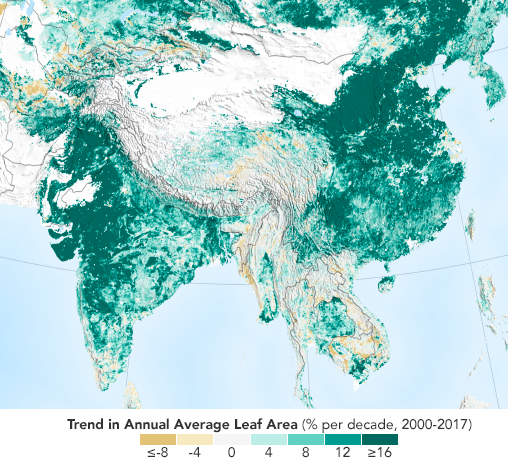
“China and India account for one-third of the greening, but contain only 9 percent of the planet’s land area covered in vegetation,” said Chi Chen, the lead author of a study he did with Ranga Myneni at Boston University. “That is a surprising finding, considering the general notion of land degradation in populous countries from overexploitation.”
The Boston University research team found that "global green leaf area has increased by 5 percent since the early 2000s, an area equivalent to all of the Amazon rainforests. At least 25 percent of that gain came in China. Overall, one-third of Earth’s vegetated lands are greening, while 5 percent are growing browner. The study was published on February 11, 2019, in the journal Nature Sustainability", according to NASA Earth Observatory.
Pakistan's arable land grew by about 600,000 hectares between 2014 and 2016, according to Food and Agriculture Organization (FAO). It increased from 36,252,000 hectares to 36,844,000 hectares. However, Pakistan has experienced deforestation in this period. The area under forests has shrunk from 1,515,000 hectares in 2014 to 1.429,000 hectares in 2016.
Two years ago, Prime Minister Imran Khan, then a politician whose party governed the Khyber PakhtunKhwa (KP) province, launched a program called the “Billion Tree Tsunami”. Eventually, hundreds of thousands of trees were planted across the region, timber smuggling was virtually wiped out, and a cottage industry of backyard nurseries flourished, according to Washington Post. Now, the PTI government led by Prime Minister Imran Khan, is aiming to replicate that success nationwide with a “10 Billion Tree Tsunami.”
Related Links:
Value Added Agriculture in Pakistan
Agribusiness Drawing Investors to Pakistan
China Pakistan Economic Corridor
An Indian Farmer Commits Suicide Every 30 Minutes
Views: 548
-
Comment by Riaz Haq 7 hours ago
-
How Thar Foundation and IUCN Pakistan are turning Thar into a model of sustainability - Branded Content - DAWN.COM
https://www.dawn.com/news/1952158
A 2022 IUCN study found that these trees have already absorbed over 123,000 tonnes of carbon. With a survival rate of 72 per cent, the forest stands as a living symbol of endurance and renewal.
“This project is special because it reflects the resilience of Thar’s people. When nurtured well, just like these trees, they thrive and turn what once seemed impossible into reality,” said Amir, reflecting on the programme’s success.
To sustain this green cover, drip irrigation and saline water utilisation techniques have been deployed, showing how technology and indigenous knowledge can come together to transform life in the desert.
An agricultural revolution against all odds
Frequent drought cycles in Thar create a domino effect for communities that depend on rainwater for growing fodder and crops. To counter this, Thar Foundation and IUCN have introduced saline agriculture, an innovative method of cultivating salt-tolerant crops that offers new hope and livelihoods to local farmers.
“We had no idea that crops could grow using saline water,” said 33-year-old farmer Manzoor Das. “The SECMC and Thar Foundation teams guided us and encouraged us to try it. Now we are seeing real results.”
With technical support, Manzoor began cultivating ladyfinger and tomatoes, both of which now thrive on his land and meet his family’s food needs. Encouraged by this success, he expanded to groundnuts and nutrient-rich fodder crops like Rhodes and King grass, ensuring feed for his livestock throughout the year.
Adding to his achievements, Manzoor also planted apple ber (jujube) trees on one acre of land. “The trees have grown well,” he said proudly. “This year, they will bear fruit for the first time.”
Across Thar, more than 165 acres of once-barren land have been transformed into productive farmland through modern irrigation systems and crop trials. Farmers are now cultivating apple ber, sesbania grass and other drought-resistant species.
For farmers like Manzoor, who had never experienced a steady income from agriculture, this means self-reliance and dignity. The saline agriculture project has tested over ten crop species, proving that Thar’s communities can grow food, earn livelihoods and conserve biodiversity at the same time.
Conserving biodiversity for future generations
Biodiversity loss is often invisible until it is too late. In Thar, however, some of the most visible guardians of nature are its birds, particularly vultures. When vulture populations collapsed across South Asia due to toxic veterinary drugs, Thar became one of their last remaining safe havens.
In 2018, Thar Foundation and IUCN launched a vulture conservation project to protect nesting sites and raise awareness among nearby communities. Through extensive engagement, they identified and safeguarded 250 nests, installed artificial nesting platforms and involved 15,000 residents across 48 villages. More than 2,000 young people were trained on the ecological importance of vultures.
Thanks to these sustained efforts, Thar is now recognised as a Vulture Safe Zone, with its vulture population recovering and making it a rare conservation success story in Pakistan.
The IUCN-SECMC partnership continues to build on over four years of work, including a comprehensive ecological baseline survey of Tharparkar’s flora and fauna. The survey documented 149 plant species, including two globally threatened trees, the Indian Bdellium and Desert Teak. Many of these native species provide essential ecosystem services that sustain both wildlife and local livelihoods.
“The Thar flora includes some of the most unique and threatened plant species in the world, including those listed on the IUCN Red List,” said Mahmood Akhtar Cheema, Country Representative, IUCN Pakistan. “The collaboration between IUCN and Thar Foundation is not only contributing to local ecological resilience but also advancing global biodiversity goals.”
Comment
- ‹ Previous
- 1
- 2
- Next ›
Twitter Feed
Live Traffic Feed
Sponsored Links
South Asia Investor Review
Investor Information Blog
Haq's Musings
Riaz Haq's Current Affairs Blog
Please Bookmark This Page!
Blog Posts
Nepal Tragedy Raises Fears of Massive Glacier Melt in Pakistani Mountains
Northern Pakistan is home to over 13,000 glaciers which pose a risk of catastrophic flash floods similar to the recent flash floods in Nepal. Pakistani officials have warned that shifts in glacier behavior are increasing the risk of glacial lake outburst floods (GLOF), particularly in Gilgit-Baltistan and Khyber Pakhtunkhwa, where communities face growing exposure to sudden flooding and landslides. …
ContinueAI on Wheels: My Experience With Tesla Full Self Drive (FSD)

Posted by Riaz Haq on August 24, 2026 at 5:00pm — 2 Comments
© 2026 Created by Riaz Haq.
Powered by


You need to be a member of PakAlumni Worldwide: The Global Social Network to add comments!
Join PakAlumni Worldwide: The Global Social Network