PakAlumni Worldwide: The Global Social Network
The Global Social Network
US News Ranks Pakistan Among World's 20 Most Powerful Nations
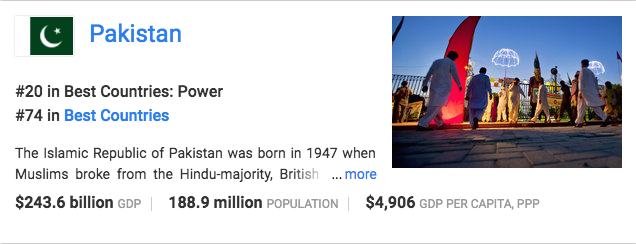
American journal US News & World Report (USNWR), known for its university rankings, has ranked Pakistan as the 20th most powerful country in the world in 2017. The United States tops the list followed by Russia at number 2 and China at number 3. Among Pakistan's neighbors, Iran ranks 14th and India 16th on the list. This latest ranking by an international publication is yet another indication of the failure of Indian leader Narendra Modi's sustained efforts to isolate Pakistan since he rose to power in 2014.
USNWR, Y&R BAV Consulting and Wharton Business School:
The US News & World Report says it developed the study and model used to score and rank countries with Y&R’s BAV Consulting and The Wharton School of Business at the University of Pennsylvania.
|

USNWR Methodology:
The journal says it identified a set of 65 country attributes – terms that can be used to describe a country and that are also relevant to the success of a modern nation. It surveyed more than 21,000 people from around the world to assess each country in terms of these attributes. Survey participants decided how closely they associated an attribute with a nation.
Each nation was then scored on each of the 65 country attributes based on a collection of individual survey responses. The more a country was perceived to exemplify a certain characteristic in relation to the average, the higher that country’s attribute score and vice versa. These scores were normalized to account for outliers and transformed into a scale that could be compared across the board.
USNWR defines powerful country in terms of "a leader, economically influential, politically influential, strong international alliances, strong military".
The USNR ranking of Pakistan among the top 20 most powerful countries is yet another indication of the failure of Indian leader Narendra Modi's sustained efforts to isolate Pakistan since he rose to power in 2014.
Summary:
American journal US News & World Report (USNWR), respected for its US university rankings and other international rankings, has ranked Pakistan as the 20th most powerful country in the world in 2017. This latest ranking by an international publication is yet another indication of the failure of Indian leader Narendra Modi's sustained efforts to isolate Pakistan since he rose to power in 2014.
Related Links:
Pakistan's Rising Middle Class
Smart Money to Follow China's Massive Investment in Pakistan
Fear, Uncertainty and Doubt About CPEC
Pakistan's 2nd Strike Capability and Nuclear Triad
Views: 1511
-
Comment by Riaz Haq on July 15, 2017 at 10:48am
-
#Iraq Ambassador: #Pakistan provided #Iraq with intelligence, training, arms, ammunition to defeat #ISIS in #Mosul https://www.dawn.com/news/1345432
Pakistan quietly helped Iraq in its fight against the militant Islamic State (IS) group, which reached a major milestone this week with the liberation of Mosul from the terrorist group’s control after three years of occupation.
Pakistan was among a number of countries that supported Iraq in fighting the IS, also known by its Arabic acronym Daesh, said Ambassador of Iraq Ali Yasin Muhammad Karim at a press conference at the embassy. The presser was held to brief Pakistani media about the eviction of the IS from Mosul.
Pakistan’s contribution to the fight against the IS in Iraq has never been mentioned earlier either by Pakistani officials or Iraqis.
Ancient Assyrian town Mosul, which is Iraq’s second largest city and was used by the IS during years of occupation as the seat of its proclaimed caliphate, was freed after a gruelling nine-month-long military campaign by Iraqi security forces that was backed by several countries.
Talking about Pakistan’s help, the ambassador said Iraq, besides getting intelligence on terrorists, also received arms and ammunition and military medical assistance from the country. He recalled some of the Iraqi pilots, who took part in action against the IS, had been trained in Pakistan.
The ambassador said the continuing intelligence cooperation between Iraq and Pakistan could help the latter deal with the expanding footprint of the IS in the region.
Underscoring the IS threat, he said, the outfit was the most dangerous terrorist group and likened its threat to “time bombs” and “booby traps”.
“We share the same enemy,” Mr Karim said.
While responding to a question, the envoy played down involvement of Pakistanis with IS activities in Iraq, saying that “the bad guys” represented a very small proportion of the population of Pakistan. People of over 100 nationalities, he added, were part of IS ranks.
The people of Pakistan were generally very supportive of Iraq in its war against the IS, he remarked.
He praised Pakistan’s policy of neutrality towards the Middle East.
After Mosul, Ambassador Karim said, Iraq was about to make a final push against the IS from its territory.
Mosul’s liberation has, however, come at a huge cost.
The city after remaining under the IS occupation for three years during the fight for its liberation is in complete ruins and almost a million of its population has been displaced. The same is the case with other areas that Iraq has succeeded in liberating from the IS. Reports from Mosul warn of an emerging humanitarian crisis.
The Iraqi ambassador called for support for reconstruction and restoration of services in the cities devastated by the war.
“We need help for rebuilding infrastructure, which is the next important task,” he said.
Comment
Twitter Feed
Live Traffic Feed
Sponsored Links
South Asia Investor Review
Investor Information Blog
Haq's Musings
Riaz Haq's Current Affairs Blog
Please Bookmark This Page!
Blog Posts
Tata's Boardroom Crisis: Will it Impact Philanthropy in India?
India's Tata Group is going through a major boardroom crisis. Noel Tata, the Chairman of the Tata holding company, has been removed from the Tata Group's board by N. Chandrasekaran, chairman of Tata Sons. Noel Tata has declared the decision illegal, a stance the board disputes. The crisis has been precipitated by a 2022 decision by India’s central bank to order the company to seek a stock market listing for Tata Sons, to comply with new rules governing systemically important…
ContinueXi-Trump Summit: US-China G2 Rapprochement to Avoid Thucydides Trap
The summit meeting of the leaders of China and the United States in Washington appears to signal a rapprochement between the two superpowers. President Trump has repeatedly referred to what he calls "G2", without mentioning "G7" or "G20", the groups that include many more countries. This development is seen as positive for world peace but it diminishes India's significance as a "counterweight to China" and the benefits Indians expected to flow from the US-China confrontation in…
ContinuePosted by Riaz Haq on September 25, 2026 at 5:30pm — 5 Comments
© 2026 Created by Riaz Haq.
Powered by


You need to be a member of PakAlumni Worldwide: The Global Social Network to add comments!
Join PakAlumni Worldwide: The Global Social Network