PakAlumni Worldwide: The Global Social Network
The Global Social Network
Pakistanis Rank High in Generosity
"Righteousness is not that ye turn your faces towards the east or the west, but righteousness is, one who believes in God, and the last day, and the angels, and the Book, and the prophets, and who gives wealth for His love to kindred, and orphans, and the poor, and the son of the road, beggars, and those in captivity; and who is steadfast in prayers, and gives alms." Quran 2:177
More Pakistanis gave to charities and the country saw the "largest jump in the rankings globally of 108 places, moving from 142nd to 34th in 2011", according to World Giving Index 2011. The report compiled by Charities Aid Foundation points out that "the floods did not lead to Pakistan's twenty-six percentage point rise in its World Giving Index score" because the survey was conducted before the 2010 floods.
World Giving Index Rankings in South Asia
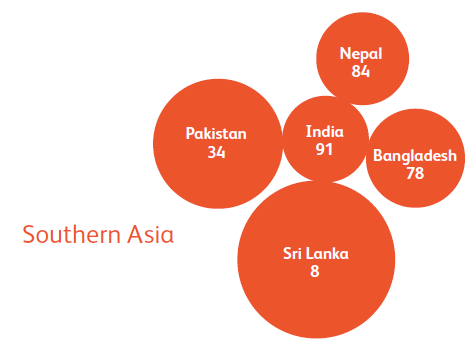
The United States is ranked as the most generous in the world for charitable giving. Sri Lanka, ranking 8th in the world, leads philanthropy South Asia region. It is followed by Pakistan (ranked 34th globally) in second place, Bangladesh (ranked 78 globally) in third place, Nepal (ranked 84 globally) in fourth place, and India (ranked 91 globally) in last place.
It appears that the country scores in the World Giving Index reflect the breadth of participation rather than the amount of money given as percentage of income or gdp. Here's how the report explains it:
In order to reflect a culturally diverse planet, the report looks at three aspects of giving behavior. The questions that feed the report are:
1. Donated money to a charity?
2. Volunteered your time to an organization?
3. Helped a stranger, or someone you didn't know who needed help?
Pakistan does well in South Asia in terms of the percentage of gdp given as charity as well. Given the lack of full documentation, the estimates of giving in Pakistan range from a low of 1% to a high of 5% of GDP. The upper end of 5% is more than twice the 2.2% of gdp annually contributed by Americans who lead in the world....
The low end of the estimate is by PCP that says Pakistanis contributed Rs.140 billion (US$1.7 billion), nearly 1% of the nation's gross domestic product of $170 billion in 2009.
The upper end of the estimate of 5% of GDP comes from Professor Anatol Lieven in his book Pakistan-A Hard Country. Lieven argues that the "levels of trust in Pakistani state institutions are extremely low, and for good reason. Partly in consequence, Pakistan has one of the lowest levels of tax collection outside Africa. On the other hand, charitable donations, at almost 5% of GDP, is one of the highest rates in the world".
The donations help organizations like Khana Ghar that feeds the hungry, Edhi Foundation which operates non-profit ambulance service, The Citizens Foundation which runs 700 schools serving 100,000 poor students, and Human Development Foundation which builds and operates schools and clinics for the poor.
Lieven lauds the work of TCF and several other charitable organizations, but he singles out Edhi Foundation for his most effusive praise of Pakistan's strong civil society filling the gaps left by the corrupt and incompetent government:
"There is no sight in Pakistan more moving than to visit some dusty, impoverished small town in arid wasteland, apparently abandoned by God and all sensible men and certainly abandoned by the Pakistani state and its own elected representatives- to see the flag of the Edhi Foundation flying over a concrete shack with a telephone, and the only ambulance in town standing in front. Here, if anywhere in Pakistan, lies the truth of human religion and human morality".
Related Links:
World Giving Index Report 2011
How Can Overseas Pakistanis Help Flood Victims?
Light a Candle, Don't Curse Darkness
Pakistan Center for Philanthropy
An Overview of Indian Philanthropy
Aaker Patel on Philathropy
Orangi Pilot Project
Three Cups of Tea
Views: 876
-
Comment by Riaz Haq on July 30, 2025 at 5:18pm
-
"Beggar" Pakistan is the 4th largest country and the 6th largest entity donor to the World Food Program. "Rich" India is missing from the top contributors list:
https://www.wfp.org/funding/2024
The top 15 largest contributors to global food programs, primarily the UN World Food Programme (WFP), are a mix of national governments and international organizations. The United States consistently ranks as the largest single donor, followed by Germany. Other significant contributors include the European Commission, various European nations, Japan, and the UN CERF (Central Emergency Response Fund).
Here's a more detailed breakdown:
National Governments:
United States: The largest bilateral donor, contributing billions of dollars annually, according to the Government Accountability Office (GAO).
Germany: The second-largest donor, contributing hundreds of millions of dollars annually.
Other European Nations: Including, but not limited to, France, Sweden, Norway, and Switzerland.
Japan: A significant contributor to the WFP.
Canada:
Pakistan:
International Organizations:
European Commission:
UN Central Emergency Response Fund (CERF):
Other UN Funds and Agencies (excluding CERF):
Other Notable Contributors:
Private Donors: Globally, private donors also contribute significantly to the WFP.
South Korea:
Australia:
United Kingdom:
Saudi Arabia:
https://www.instagram.com/p/DMs0D6SvK_Y/
-
-
Pakistan corporate philanthropy sees ‘landmark growth’ amid economic turmoil
https://www.alliancemagazine.org/blog/pakistan-corporate-philanthro...
Pakistan’s corporate philanthropy has achieved ‘landmark growth’ despite a turbulent economy, according to new figures released by the Pakistan Centre for Philanthropy.
In 2023, businesses allocated a combined 25.4 billion Pakistani rupees ($90 million) for philanthropic causes.
Public listed companies had the largest share of corporate philanthropy, providing 18.23 billion Pakistani rupees ($64 million).
Separately, publicly owned company not listed on a stock exchange contributed 3.28 billion rupees ($1.1 million). Private companies donated 3.93 billion rupees ($1.4 million).
Pakistan’s glass and ceramics businesses contributed over 7 per cent of their total profits, the highest share of any sector.
The top 100 companies listed on Pakistan’s stock exchange gave 15.24 billion rupees ($54 million), while the top 30 companies contributed PKR 8.80 billion ($3.1 million), which Pakistan Centre for Philanthropy says has set ‘a benchmark for charitable giving and aligning with national development goals.’
Pakistan’s Minister for Finance & Revenue Muhammad Aurangzeb, in an address made to business leaders, said the corporate philanthropy was helping to advance the country’s socio-economic development, given a volatile and shaky economic environment.
Economy powered by loans and corruption
A new report published by the International Monetary Fund in November has warned that corruption in Pakistan is behind an economic crisis driven by ‘state capture’ – where public policy is manipulated to benefit a narrow circle of political and business elites.
The 186-page report, requested by Pakistan’s government, says corruption is ‘persistent and corrosive’, eroding public trust and undermining economic stability.
Improved accountability could improve the country’s gross domestic product (GDP), currently at $410 billion.
Pakistani philanthropy has been hit hard by economic turmoil, with persistent cutbacks and staff laid off from charitable projects.
Almost every government – both military or civilian – has turned to International Monetary Fund bailouts 25 times since 1958, giving it the accolade of being one of the fund’s most frequent borrowers.
Comment
- ‹ Previous
- 1
- 2
- Next ›
Twitter Feed
Live Traffic Feed
Sponsored Links
South Asia Investor Review
Investor Information Blog
Haq's Musings
Riaz Haq's Current Affairs Blog
Please Bookmark This Page!
Blog Posts
Tata's Boardroom Crisis: Will it Impact Philanthropy in India?
India's Tata Group is going through a major boardroom crisis. Noel Tata, the Chairman of the Tata holding company, has been removed from the Tata Group's board by N. Chandrasekaran, chairman of Tata Sons. Noel Tata has declared the decision illegal, a stance the board disputes. The crisis has been precipitated by a 2022 decision by India’s central bank to order the company to seek a stock market listing for Tata Sons, to comply with new rules governing systemically important…
ContinueXi-Trump Summit: US-China G2 Rapprochement to Avoid Thucydides Trap
The summit meeting of the leaders of China and the United States in Washington appears to signal a rapprochement between the two superpowers. President Trump has repeatedly referred to what he calls "G2", without mentioning "G7" or "G20", the groups that include many more countries. This development is seen as positive for world peace but it diminishes India's significance as a "counterweight to China" and the benefits Indians expected to flow from the US-China confrontation in…
ContinuePosted by Riaz Haq on September 25, 2026 at 5:30pm — 5 Comments
© 2026 Created by Riaz Haq.
Powered by


You need to be a member of PakAlumni Worldwide: The Global Social Network to add comments!
Join PakAlumni Worldwide: The Global Social Network