PakAlumni Worldwide: The Global Social Network
The Global Social Network
Geopolitically Important Pakistan Brings China, Russia, US Together For 45-Nation Exercises Hosted by Pak Navy
Pakistan is hosting navies from 45 nations, including the United States, China and Russia, for a joint military exercise named "AMAN 2021" in the North Arabian Sea later this month. This is the first time in a decade that Russian naval ships will attend drills with multiple NATO members.
The news prompted Indian defense analyst Pravin Sawhney to tweet: "Pakistan Navy Aman 21 exercise brings US, China & Russian navies together - what more needs to be said of Pak’s geopolitical importance in times of change!"
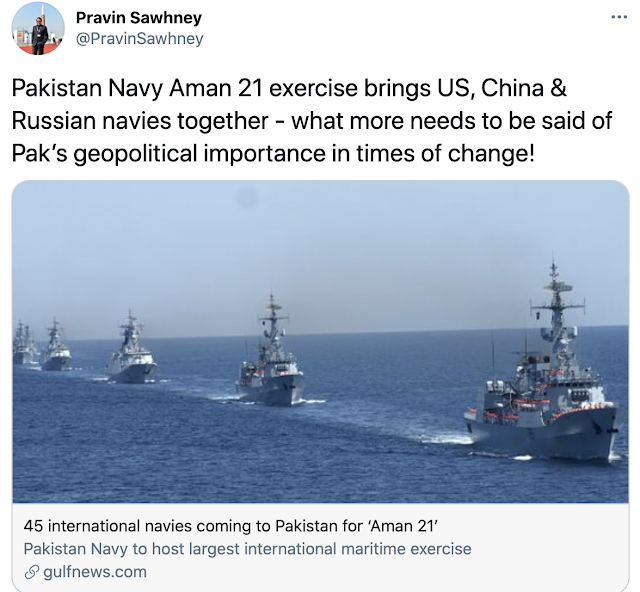 |
| Tweet by Indian Defense Analyst Pravin Sawhney |
United Kingdom, Turkey, Bangladesh, Sri Lanka, Indonesia, Malaysia and several countries from the African Union are also among participants of "AMAN 2021" The last time the Russian navy conducted joint military drills with NATO members was in the "Bold Monarch" exercise in 2011, which took place off the coast of Spain, according to Voice of America.
 |
| US-China Compete For Influence in Pakistan |
American business publication Wall Street Journal has produced a short video explaining how its staff sees what it describes as "US-China conflict brewing in Pakistan". What is at stake in the battle between China and the United States in Pakistan is the prize of global superpower status. Here are the key points it made back in 2019:
1. The US-China conflict brewing in Pakistan is about global dominance sought by the two great powers.
2. If China succeeds, it could become the new center of global trade. If the US wins, it could frustrate China's push to become a global power. The impact of it will be felt around the world for decades.
3. China has already surpassed the United States as the world's biggest exporter of goods and services.
4. The biggest project in China's Belt and Road Initiative (BRI) is China-Pakistan Economic Corridor (CPEC) in which China is investing heavily and providing massive loans.
5. China could use the infrastructure built in Pakistan under CPEC to gain access to the Indian Ocean and supplant the United States in Pakistan.
6. CPEC-related spending is sinking Pakistan deeper in debt to China. It could force Pakistan to seek $8 billion to $12 billion bailout by IMF where US is the biggest shareholder with veto power.
7. US does not want the IMF bailout money to be used to repay Chinese debt. Not bailing out Pakistan is not an option because it could cost US an important ally in the region.
8. US could, however, use IMF bailout to limit what Pakistan can borrow from China. Such a condition will achieve the US objective of significantly slowing down CPEC and BRI.
9. Pakistan's dilemma is that it needs both the infrastructure improvements financed by China and the IMF bailout to ease pressure on its dwindling foreign exchange reserves.
10. Whoever wins in Pakistan will become the number one global superpower.
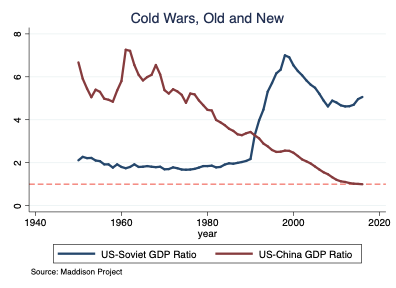 |
| Can US "Spend Them (Chinese) Into Oblivion"? |
Here's the Wall Street Journal video:
https://youtu.be/wvw-85CC1t4
Related Links:
Haq's Musings
South Asia Investor Review
Can Pakistan Avoid Recurring Balance of Payment Crisis?
Pakistan Economy Hobbled By Underinvestment
Pakistan's IT Exports Surging
Can Indian Economy Survive Without Western Capital Inflows?
Pakistan-China-Russia Vs India-Japan-US
Chinese Yuan to Replace US $ as Reserve Currency?
Remittances From Overseas Pakistanis
Can Imran Khan Lead Pakistan to the Next Level?
China to Expand Manufacturing in Special Economic Zones
Views: 1171
-
Comment by Riaz Haq on July 27, 2026 at 5:48pm
-
Pakistan’s Great Game
By Christophe Jaffrelot
https://www.institutmontaigne.org/en/expressions/pakistans-great-ga...
[3/3] Are my friends’ enemies my enemies? Not for Pakistan, which is capitalizing on its good relations with China and the United States. How should we interpret the recent rapprochement between Washington and Islamabad? What role does China play? The final installment of an analysis of Pakistan’s new foreign policy, by Christophe Jaffrelot.
The third level of analysis on which Pakistan’s strategy is based extends beyond the Middle East-even though it is centered there-as it concerns the relationships Islamabad is striving to maintain with the United States and China. While Islamabad has already appeared to be walking a tightrope between Iran and Saudi Arabia, its desire to maintain relations with both the United States and China seems even more of a balancing act. Yet this approach is part of a long-standing tradition.
The relationship between Pakistan and China is not the same as the one between Pakistan and the United States. China has, in fact, become and remained "an all weather friend" decade after decade since the 1950s.
Certainly, the relationship between Pakistan and China is not the same as the one between Pakistan and the United States. China has, in fact, become and remained "an all weather friend" decade after decade since the 1950s, without the two countries ever approaching a breaking point that would force them to rebuild ties afterward. In other words, it is a strategic relationship that is fueled by their hostility toward a common enemy, that is India. Pakistan-as we have seen-finds in China the ally that allows it to stand up to India (all the more so since Beijing helped it acquire the nuclear bomb), while China, by supporting Pakistan, has succeeded in pinning India down on its western border, guaranteeing itself free rein in Asia.
In the crisis stemming from the Iran War, Pakistan and China remain partners. The former, as is often the case, takes some of its orders from Beijing, while the latter uses the Pakistanis-and their effective diplomats with Washington’s ear-to hasten the end of hostilities. Even more so than other Asian countries, China is indeed paying a very high price for this war, which has caused its energy costs to skyrocket and is weakening an economy already shaken, among other things, by the rise of protectionism. That Pakistan has repeatedly "reported to Beijing" during the war is clearly evident from Deputy Prime Minister Ishaq Dar’s trips to the Chinese capital in late March and again from May 19 to 21. Five days later, it was Prime Minister Shabaz Sharif’s turn to visit Beijing, where he was congratulated by Xi for Pakistan’s mediation efforts. In fact, the head of the Pakistani military, Asim Munir, was in Tehran at the same time!
While Pakistan’s relationship with China is rooted in strategic logic, its relationship with the United States is more tactical in nature.
While Pakistan’s relationship with China is rooted in strategic logic, its relationship with the United States is more tactical in nature-and has been since the 1950s, when General Ayub Khan boasted of his ability to play "one lion against another" (referring to the United States and the USSR at the start of the Cold War). In its dealings with the United States, Pakistan has played the role of intermediary, or even "client," within a typical clientelist framework: in exchange for the services Islamabad provided to Washington, the United States provided Pakistan with substantial aid and agreed to sell it sophisticated weapons, and even to train its officers-a privilege greatly appreciated.
-
-
Pakistan’s Great Game
By Christophe Jaffrelot
https://www.institutmontaigne.org/en/expressions/pakistans-great-ga...
The first major service rendered by the Pakistanis to the Americans was none other than the intermediary role played by General Yahya Khan vis-à-vis Chairman Mao in the early 1970s, which led to the United States’ recognition of the People’s Republic of China. Over the following decade, Pakistan served as an intermediary between Washington and the mujahideen tasked with driving the Soviets out of Afghanistan. And in the 2000s, Pakistan was tasked by Washington with hunting down al-Qaeda-with much more mixed success this time, as evidenced by the discovery of bin Laden’s hideout in Abbottabad in 2011.
Whenever the United States no longer needed Pakistan-or even felt betrayed by it-it abandoned the country or even imposed sanctions on it.
Moreover, relations between the two countries had grown much more strained since then, following a classic pattern: whenever the United States no longer needed Pakistan-or even felt betrayed by it-it abandoned the country or even imposed sanctions on it. In 2017, Donald Trump decided to drastically cut the aid Pakistan received in connection with U.S. military operations in Afghanistan, to which Pakistan was supposed to contribute-something Trump was not convinced of.
Trump 2, reversing the mistrust he had felt toward Pakistan in 2017, instead bet on that country even before the war with Iran. This reversal can be explained by a diverse set of factors. As early as the beginning of 2025, the White House set its sights on Pakistan to serve as a regional security guarantor capable of combating Islamism in its area (particularly against the Taliban). In exchange, Pakistan was able to place orders for U.S. weapons that had previously been off-limits to it-much to the displeasure of New Delhi.
The blitzkrieg between India and Pakistan in the spring of 2025 dramatically accelerated the U.S.-Pakistan rapprochement. While New Delhi refused to acknowledge any role for the United States in the cessation of hostilities, Islamabad thanked Donald Trump for intervening to prevent an escalation (which Trump viewed as posing a nuclear risk). The U.S. president appreciated Pakistan’s attitude all the more because, in the wake of the conflict, Pakistan nominated him for the Nobel Peace Prize.
These goodwill gestures were accompanied by economic deals involving rare earth minerals-to which Pakistan agreed to grant the Americans access (particularly in Balochistan)-and cryptocurrencies. World Liberty Financial, the company owned by one of Trump’s sons and Zach Witkoff-the son of Special Envoy Steve Witkoff-signed an agreement with Pakistan in January 2026 to integrate the country’s payment system.
On the international stage, Pakistan also stepped up when Trump established a "Peace Council" for Gaza; its inauguration highlighted the close ties between President Trump, Marshal Munir, head of Pakistani intelligence, and Prime Minister Sharif. It was therefore only natural that Pakistan found itself in the role of mediator between the United States and Iran beginning in March 2026. On April 8, the country emerged as the facilitator that had made the conclusion of a ceasefire possible, and on April 11 and 12, Islamabad hosted the Iranian and American delegations, once again rendering effectively possible a dialogue-albeit indirect-that had been severed since 1979.
Pakistan’s role as a "good offices" mediator was praised by a large number of political leaders, including European ones. Last June, Kaja Kallas, the EU Vice President in charge of the Union’s international relations, on the occasion of the 8th Strategic Dialogue between Pakistan and the European Union in Islamabad, thanked Pakistan-"a major regional power"-for its efforts in helping to avert an "all-out war" in the Middle East.
Comment
- ‹ Previous
- 1
- …
- 3
- 4
- 5
- Next ›
Twitter Feed
Live Traffic Feed
Sponsored Links
South Asia Investor Review
Investor Information Blog
Haq's Musings
Riaz Haq's Current Affairs Blog
Please Bookmark This Page!
Blog Posts
Four Major Chinese EV Automakers Building Assembly Plants in Pakistan
Pakistani auto industry, currently dominated by Japanese automakers building ICE (Internal Combustion Engine) vehicles, is expected to be transformed with the arrival of Chinese new energy vehicles (NEV) manufacturers. Beyond Your Dreams (BYD), Chang'an, Great Wall Motors (GWM) and Shanghai Automotive Industry Corporation (SAIC) are planning to build plants in Pakistan. Coming on the heels of the ongoing solar revolution in the country, these new EV entrants are helping…
ContinuePosted by Riaz Haq on September 15, 2026 at 8:00pm
BAPS in France: Modi's Hindu Supremacy Boasts Come Under Scrutiny
"When you claim that your civilization is superior, is older, is the mother of democracy, is the mother of science....you antagonize others". Christophe Jaffrelot, French Political Scientist, speaking to Indian journalist Karan Thapar after expressions of outrage against BAPS Hindu leader’s recent visit to Eiffel Tower.
In an article published by Carnegie Endowment, Jaffrelot explained that "the majoritarian…
ContinuePosted by Riaz Haq on September 12, 2026 at 11:30am — 1 Comment
© 2026 Created by Riaz Haq.
Powered by


You need to be a member of PakAlumni Worldwide: The Global Social Network to add comments!
Join PakAlumni Worldwide: The Global Social Network