PakAlumni Worldwide: The Global Social Network
The Global Social Network
Khan Academy Urdu Version for Pakistan
The revolutionary Khan Academy is a brainchild of Bangladeshi-American Salman Khan. It is growing in popularity among Pakistanis wishing to take advantage of "Free World Class Education" offered online via short 10-15 minute videos. The subjects range from math, physics, chemistry and biology to astronomy, history, economics, finance, engineering and medicine. Khan counts Microsoft founder Bill Gates among his fans and students. Gates has described Sal Khan as his favorite teacher, and Gates Foundation has provided funding to enable Khan Academy to grow.

Former hedge fund analyst known as Sal Khan in Silicon Valley, the Academy founder has an MBA from Harvard Business School and three Bachelors degrees in Math, Electrical Engineering, and Computer Science from MIT. Here's how Khan explains on his website why he decided to become a teacher to the world: “A lot of my own educational experience was spent frustrated with how information was conveyed in textbooks and lectures. I felt like fascinating and intuitive concepts were almost intentionally being butchered into pages and pages of sleep-inducing text and monotonic, scripted lectures.”
The number of unique visitors to Khan Academy has grown fourfold from about a million a month in 2010 to 4 million in December, 2011. Bulk of the hits to the educational website still come from the United States, but the latest Alexa traffic data shows that Pakistan is among a handful of countries (shown in green on the map) which are bringing a growing number of learners to it.

Khan's ties to Pakistan go beyond Pakistani visitors to his online academy; his wife is from Karachi, and the man in charge of translating Khan's videos to Urdu and other foreign languages is former Pakistani president's son Bilal Musharraf who lives in Silicon Valley.
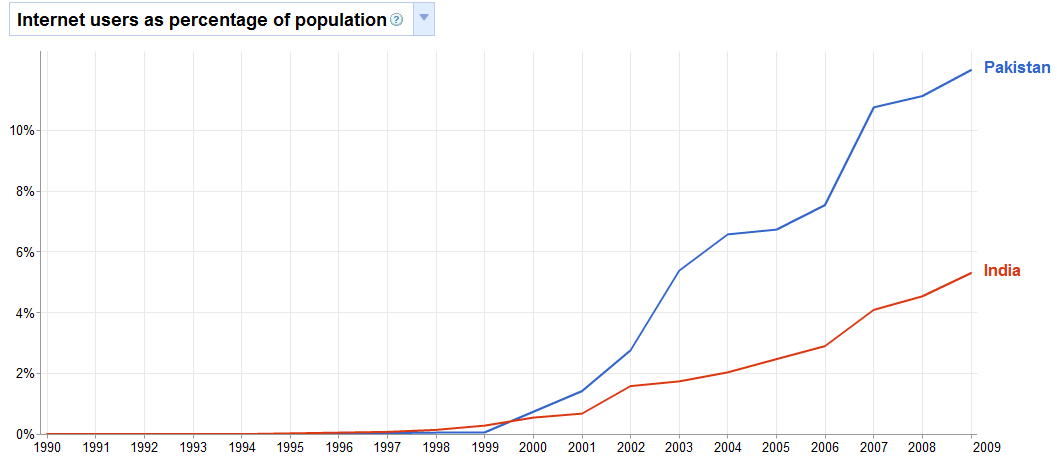
Pakistan is ranked fourth in the world for expansion in broadband Internet access which is fueling growth in traffic to video sites like Khan Academy. Planned Urdu translations of video tutorials will only add to the already increasing traffic.
Bilal Musharraf told Pakistan's Dawn newspaper that the goal is to have 1000 videos ready in 10 different languages in a year or two. And the project is mostly volunteer-driven. Khan academy offers best practices of “how-to-dub or re-do Sal’s existing videos, and volunteers take it from there. At present, someone in Japan is working on an Indonesian playlist and engineering students in Saudi Arabia are working on an Arabic playlist. In a matter of months, hundreds of videos have already been translated. You can now learn the Khan way in Spanish, Portuguese, Russian, Arabic, Bengali, Cantonese, French, German, Hindi, Indonesian, Japanese, Korean, Mandarin, Polish, Sinhalese, Tamil, Thai and Urdu.
Sal Khan's efforts are reinventing education and making quality teaching accessible to global population of students everywhere, including developing nations like Pakistan. One example of innovation inspired by Khan can be seen at Los Altos schools in Silicon Valley, CA, as shown by a recent CBS 60 Minutes segment.
"There are no textbooks and no teacher lecturing at the blackboard. Instead, students watch Khan videos at home the night before to learn a concept, then they come to class the next day and do problem sets called "modules," to make sure they understand. If they get stuck they can get one-on-one help from the teacher. Less lecturing, more interaction. What you think of as homework you do at school, and school work you do at home. It's called "flipping the classroom"..."
While anyone can benefit by watching Khan Academy video tutorials online any time and anywhere, it's also important to integrate Khan's video lessons as part of the classrooms learning in a way that is currently being piloted by Los Altos schools.
Here's a video clip from Khan Academy in Urdu:
Related Links:
Pakistan Rolls Out 50Mbps Broadband Service
More Pakistan Students Studying Abroad
Inquiry Based Learning in Pakistan
Online Courses at Top International Universities
Pasi Sahlberg on why Finland leads the world in education
Intellectual Wealth of Nations
Pakistan Primary Education Crisis
Indian Students' Poor Performance on PISA and TIMSS
Pakistan's Demographic Dividend
India Shining, Bharat Drowning
Teaching Facts versus Reasoning
Poor Quality of Education in South Asia
Infections Cause Low IQs in South Asia, Africa?
CNN's Fixing Education in America-Fareed Zakaria
Views: 5027
-
Comment by Riaz Haq on March 28, 2012 at 5:56pm
-
Here's a Daily Times report on a traveling exhibit to promote chemistry learning in Pakistan:
The International Traveling Expo ‘It’s all about Chemistry’ opened at Allama Iqbal Open University (AIOU) on Wednesday.
Pakistan Science Foundation (PSF) in collaboration with the embassy of France in Islamabad and Scientific, Technical, Industrial and Cultural Centre (CCSTI), France has arranged the Expo, prepared by Centre Sciences-France, UNESCO and partners, for providing a first-hand picture of the role of chemistry in daily life to students and general public.
The Expo is aimed at increasing the interest of young people in Chemistry and to generate enthusiasm among students for take chemistry as a subject of their studies.
The expo started its journey in Pakistan from Karachi in January and after travelling through Tandojam, Khairpur, DG Khan, Multan, Lahore, Mansehra, Peshawar and Swat has reached Islamabad from where it would travel to Sibbi and conclude in Quetta.
Study of Chemistry is critical in addressing challenges such as global climate change, in providing sustainable sources of clean water, food energy and in well-being of people.
The science of chemistry and its applications produce medicines, fuels, metals and virtually all other manufactured products.
PSF Chairman Prof Dr Manzoor Soomro inaugurated the 3-day Expo while French Attache for Cooperation Gilles Angles, AIOU Faculty of Sciences Dean Prof Dr Noshad Khan and AIOU Chemistry Department’s Chairperson Prof Dr Naghmana Rashid were also present on this occasion.
The displays of the expo include Black and White Chemistry, Molecules in Action, Nature Returns with a bang, Intelligent Textiles-Dress Intelligently, Dress Usefully, Materials that Heal Automatically, Oil-bases or Water-based paint, Pure air at home, What’s Going on in my saucepan, Town Water or field Water, Experts against Fraud, When Art and Science Meet, Molecular Motors, Bio-fuels for Green Driving and Responsible Farming etc.
Dr Manzoor Soomro highlighted the PSF programmes and activities for promotion of science in the country for mental developmental of the nation and socio-economic development of the country.
He said PSF’s subsidiary organisation Pakistan Museum of Natural History is playing an important role in imparting education on natural sciences through informal means.
He appreciated French embassy for its cooperation to PSF in its different programmes as well as providing opportunity of higher education to students of far flung areas of Pakistan through its scholarships programme...
http://www.dailytimes.com.pk/default.asp?page=2012\03\29\story_29-3-2012_pg5_5
-
-
Here's an excerpt of a BR report on smartphone market in Pakistan:
(Pakistan currently has) five to six million smartphone users.
A rather bullish estimate is cast by Ericsson Pakistan which anticipates some 50 million smartphone users in Pakistan by 2016, accounting for 70 percent of operator revenues.
It could, however, be misleading to equate the potential mobile broadband uptake entirely with the incidence of smartphone users in Pakistan.
The cue might actually lie in the current mobile internet usage, which is reportedly growing despite high tariffs and laggard speeds on GPRS/EDGE networks.
According to PTA Chairman, mobile internet users crossed 15 million in June 2011, just four million shy of PC internet users.
Telenor Pakistan, arguably the dominant player in mobile internet services, shared with BR Research that every fourth Telenor customer is a mobile internet user.
High adoption rate is found in the 18-26 age, cohort and significantly higher data consumption is witnessed among business users who are mostly aged 30 and above.
Rural and semi-urban areas in the North are reported to have surprisingly high usage.
Interestingly, just three percent of total handsets on Telenors network are smartphones, when over a quarter of its customers have been mobile internet users.
This possibly means that the feature phones are at work here, which are not smartphones but have additional functions over dumb phones, including internet settings.
This could imply that the barriers to smartphone adoption may not really hold back the mobile broadband uptake, because a feature phone would suffice to access high-speed internet.
However, the appeal of a smartphone - which is capable to communicate with platforms like Android Market, Apple Store, and Blackberry App World, along with a plethora of third-party mobile applications - cannot be matched.
Besides handset functionality, the telecom leaders in their interactions with BR Research have cited two other decisive factors for the growth in mobile broadband users.
These are the development of local language content and creative mobile applications, and pricing of the data services as per needs of various segments.
There is a strong case for a large-scale mobile broadband adoption in Pakistan given the current data consumption trends.
A high penetration of mobile broadband can go much beyond mobile entertainment, social networking, and business usage.
It will augur well for areas, like education, healthcare and governance that are in dire need to be turned around for Pakistans socioeconomic progress.
http://www.brecorder.com/br-research/35:35/2382:smartphones-and-the...
-
-
I have been told there are ways to get around the YouTube ban in Pakistan by using proxies to access videos....that's how many MOOC students in Pakistan are taking courses at Udacity, Coursera, Khan Academy etc. have been able to continue taking classes.
They work by masking IP addresses.
Here's an example:
-
-
Here's an excerpt from TechCrunch on Raspberry Pi computer in developing nations:
Asked about the global sales distribution of the Pi, the Foundation provided TechCrunch with some “very rough”, internal estimates of Pi sales to developing/emerging nations — and the figures (listed below) suggest that the first million+ Pi sales have overwhelmingly been powered by wealthier nations.
The most Pi-populous country on the developing/emerging nations list (India) can lay claim to roughly 0.5%-0.6% of total global Pi sales to-date, according to this data. While, collectively, these listed nations make up between only 1.4% and 1.7% of total global Pi shipments. So more than 98% of the Pi pie has been sold to the world’s wealthiest countries thus far.
India 6000
Indonesia 1200
Lao P.Dem.R. 600
Malaysia 3400
Philippines 500
Pakistan 100
Sri Lanka 50
Thailand 2000
Vietnam 500
Egypt 150
South Africa 2000
Tunisia 200
Zimbabwe 50
Bolivia 100
Chile 400
Colombia 20
Peru 50There are also, of course, scores of (apparently) Pi-less developing nations that do not make this list at all. One of which – the Kingdom of Bhutan — does actually have a princely one Pi sale to its name at present, according to the Foundation. “It’s a server for Khan Academy Lite in a school, whose 64GB SD card costs more than twice what the Pi cost,” the Foundation’s Liz Upton tells TechCrunch. “We’re working on getting more out there!”
It’s likely that some of the Pis shipped to developed countries have found their way to less wealthy nations – via charities and other ‘suitcase schemes’ such as the Cameroon school project mentioned above which took out 30 Pis. Or via individual buyers seeking to avoid high import tariffs that can push up the price of bulk commercial imports (such as in Brazil).
But even factoring in some extra spread, there’s no doubt the Pi is predominantly disrupting the living rooms and schools of the developed world. Which, it should be noted, was the original ambition of the Pi founders — specifically they wanted to get more U.K. kids coding, following a national slump in interest in computer science education....
http://techcrunch.com/2013/04/12/raspberry-pi-global-sales-spread/
-
-
Here's an AP story on Youtube ban in Pakistan:
ToffeeTV has hit an unexpected snag. The Internet startup depended on YouTube to promote "Hokey-Pokey," ''The Umm Nyum Nyum Song" and other language-teaching clips it produces for children, but the video-sharing website has been banned in Pakistan for nearly a year.
---
ToffeeTV has had to save its clips on its own servers and delay the rollout of its apps, says company co-founder Rabia Garib. "It threw us off our feet," she said. "We're off schedule by about eight months."
While the tech-savvy have ways to get around the ban, the vast majority of Pakistanis who try to view YouTube get this: "Surf Safely! ... The site you are trying to access contains content that is prohibited for viewership from within Pakistan."
The made-in-America trailer for "Innocence of Muslims," the movie of which has never reached cinemas, provoked uproar throughout the Muslim world, and several U.S. diplomatic missions were targeted. In Pakistan, clashes between police and protesters left 19 people dead.
YouTube as well as Facebook were initially blocked although the government soon exempted Facebook, saying it removed the offensive material. At the time, U.S. President Barack Obama's administration asked Google, YouTube's parent, to take down the video. But the company refused, saying the trailer didn't violate its content standards.
The only other countries that block YouTube are Tajikistan, China and Iran, according to Google's transparency report that tracks restrictions of its products. Another 56 countries have localized versions of YouTube that allow for tailoring content to local standards.
Pakistan, a nation of roughly 180 million, has a democratically elected government and a legal system inherited from its former British rulers. But that system also contains significant religious strictures, and disputes over religion frequently end in bloodshed. So at the time the YouTube ban was imposed, many saw it as a necessary calming measure.
Now an advocacy group called Bytes for All is petitioning the Lahore High Court to order an end to all Internet censorship.
Muzzling YouTube "could lead to the opening up of an entire Pandora's box of moral policing and dictatorial controls despite the democracy being in place," said Furhan Hussain of Bytes for All.
At the organization's Islamabad offices, activists say the YouTube case is just the latest example. Over the years the government has periodically banned Facebook, Twitter and Tumblr, but the YouTube ban has lasted the longest.
It can be circumvented via VPNs, virtual private networks that mask the user's computer but are prone to viruses and slow the Internet connection.
These proxies are too cumbersome for his staff to deal with, says Jawwad Ahmed Farid, founder and CEO of Karachi-based Alchemy Technologies, which does risk-management training for financial professionals.
It posts short videos of its classes on YouTube to attract business, but uploads fewer of them following the ban, and the volume of Pakistani customers referred through YouTube has fallen, Farid said. "My team finds it very difficult to work with all the proxies in place. It certainly slows it down a bit," he said.
Sidra Qasim is co-CEO of HOMETOWN, a Lahore-based company that helps leather workers to market products such as shoes and belts online. It used YouTube to reach customers and also to teach the workers new techniques. "Now that training part is stopped totally," she said.
http://www.sfgate.com/business/technology/article/Free-YouTube-Paki...
-
-
‘Pakistan fastest growing market for YouTube’
https://www.dawn.com/news/1723154
“Pakistan is one of the fastest growing markets for YouTube globally,” said Marc Lefkowitz, company’s director of partner development and management for Asia Pacific.
-------
KARACHI: YouTube Pakistan brought out the big guns on Thursday evening for its maiden Brandcast — a loud show of song and dance with hundreds of young content creators gathered under one roof to dazzle the deep-pocketed advertisers of the country’s “No. 1 online video and music platform”.
Beginning with a short concert and effusive presentations by popular YouTubers, the event featured what seemed like sales pitches to advertisers by top YouTube officials.
“Pakistan is one of the fastest growing markets for YouTube globally,” said Marc Lefkowitz, company’s director of partner development and management for Asia Pacific.
As many as 62 per cent of online Pakistanis between the ages of 18 and 24 reported watching YouTube at least once a month, he said. Citing a study conducted by parent company Google and research firm Kantar, he said 78pc of internet users in Pakistan said YouTube was the video platform they went to when they wanted to watch shows and online content.
The same study showed 76pc of internet users believed YouTube helped them “learn something new”. Three-quarters of internet users claimed the video platform carried content that helped them “dig deeper into their interests”.
In a separate interaction with reporters after the event, Mr Lefkowitz said the number of YouTube channels making Rs1 million or more in revenue has gone up 110pc on a year-on-year basis. There’re currently more than 5,400 YouTube channels with more than 100,000 subscribers in Pakistan, up 35pc on an annual basis. More than 350 of these channels have more than a million subscribers.
In his presentation and subsequent talk with the press, Google Country Director Farhan Siddique Qureshi said YouTube has become the centre of modern life as it fulfils educational, professional and entertainment needs of ordinary people, he said.
He urged businesses to capitalise on the “deep connections” that YouTube users have built on the platform to remain at the “top of (their) minds” for achieving a “greater sales uplift”.
A case study shared with the press showed Nestle Fruita Vitals was experiencing low sales in a few cities. It decided to test which advertising channel — TV or YouTube — would yield “efficient results”. YouTube surpassed TV’s reach on the third day, the case study showed. The on-target reach of YouTube versus the TV campaign was three times higher while its cost was 70pc lower, it said.
PR minders of the firm kept hovering over the YouTube representatives during the press briefing in an apparent attempt to stop them from oversharing. Mr Qureshi didn’t state any numbers with respect to the size of YouTube’s business in Pakistan, its earnings, payments to local content creators or taxes.
In response to a question about the perception that local content creators don’t make as much money as their counterparts from other parts of the world, Mr Qureshi said advertising rates are auction-based, not fixed.
Comment
Twitter Feed
Live Traffic Feed
Sponsored Links
South Asia Investor Review
Investor Information Blog
Haq's Musings
Riaz Haq's Current Affairs Blog
Please Bookmark This Page!
Blog Posts
Tata's Boardroom Crisis: Will it Impact Philanthropy in India?
India's Tata Group is going through a major boardroom crisis. Noel Tata, the Chairman of the Tata holding company, has been removed from the Tata Group's board by N. Chandrasekaran, chairman of Tata Sons. Noel Tata has declared the decision illegal, a stance the board disputes. The crisis has been precipitated by a 2022 decision by India’s central bank to order the company to seek a stock market listing for Tata Sons, to comply with new rules governing systemically important…
ContinueXi-Trump Summit: US-China G2 Rapprochement to Avoid Thucydides Trap
The summit meeting of the leaders of China and the United States in Washington appears to signal a rapprochement between the two superpowers. President Trump has repeatedly referred to what he calls "G2", without mentioning "G7" or "G20", the groups that include many more countries. This development is seen as positive for world peace but it diminishes India's significance as a "counterweight to China" and the benefits Indians expected to flow from the US-China confrontation in…
ContinuePosted by Riaz Haq on September 25, 2026 at 5:30pm — 5 Comments
© 2026 Created by Riaz Haq.
Powered by


You need to be a member of PakAlumni Worldwide: The Global Social Network to add comments!
Join PakAlumni Worldwide: The Global Social Network