PakAlumni Worldwide: The Global Social Network
The Global Social Network
Pakistan Nuclear Power Generation Soared 66% in 2021
Nuclear power plants in Pakistan generated 15,540 GWH of electricity in 2021, a jump of 66% over 2020. Overall, Pakistan's power plants produced 136,572 GWH of power, an increase of 10.6% over 2020, indicating robust economic recovery amid the COVID19 pandemic.
 |
| Pakistan Electric Power Generation. Source: Arif Habib |
Hydroelectric dams contributed 37,689 GWH of electricity or 27.6% of the total power generated, making hydropower the biggest contributor to power generated in the country. It is followed by coal (20%), LNG (19%) and nuclear (11.4%).
 |
| Cost Per Unit of Electricity in Pakistan. Source: Arif Habib |
Nuclear offers the lowest cost of fuel for electricity (one rupee per KWH) while furnace oil is the most expensive (Rs. 22.2 per KWH).
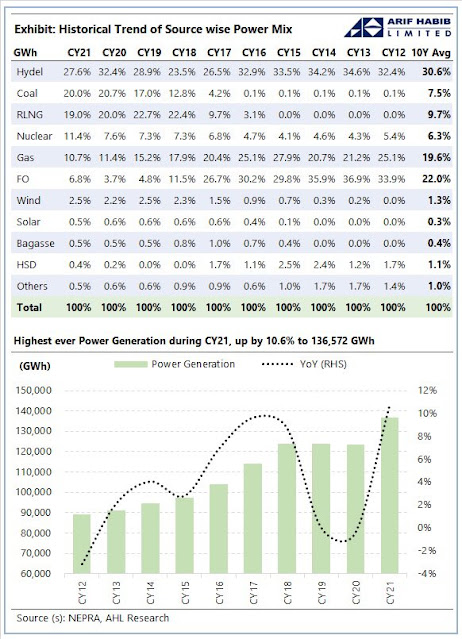 |
| Pakistan Electric Power Generation Fuel MiX. Source: Arif Habib |
Construction of 1,100 MW nuclear power reactor K2 unit in Karachi was completed by China National Nuclear Corporation in 2019, according to media reports. Fuel is being loaded in a similar reactor unit K3 which will add another 1,100 MW of nuclear power to the grid in 2022. Chinese Hualong One reactors being installed in Pakistan are based on improved Westinghouse AP1000 design which is far safer than Chernobyl and Fukushima plants.
The biggest and most important source of low-carbon energy in Pakistan is its hydroelectric power plants, followed by nuclear power. Pakistan ranked third in the world by adding nearly 2,500 MW of hydropower in 2018, according to Hydropower Status Report 2019. China added the most capacity with the installation of 8,540 megawatts, followed by Brazil (3,866 MW), Pakistan (2,487 MW), Turkey (1,085 MW), Angola (668 MW), Tajikistan (605 MW), Ecuador (556 MW), India (535 MW), Norway (419 MW) and Canada (401 MW).
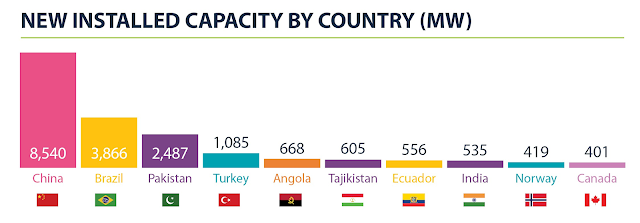 |
| New Installed Hydroelectric Power Capacity in 2018. Source: Hydrowo... |
Hydropower now makes up about 28% of the total installed capacity of 33,836 MW as of February, 2019. WAPDA reports contributing 25.63 billion units of hydroelectricity to the national grid during the year, “despite the fact that water flows in 2018 remained historically low.” This contribution “greatly helped the country in meeting electricity needs and lowering the electricity tariff for the consumers.”
 |
| Pakistan's Current Account Balance vs International Oil Prices. Sou... |
Recent history shows that Pakistan's current account deficits vary with international oil prices. Pakistan's trade deficits balloon with rising imported energy prices. One of the keys to managing external account balances lies in reducing the country's dependence on foreign oil and gas.
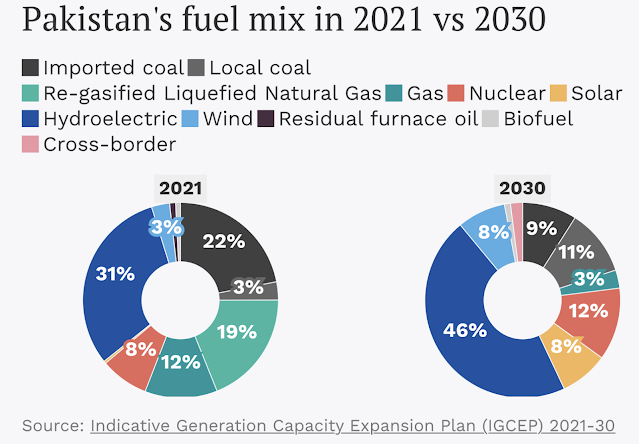 |
| Pakistan Power Generation Fuel Mix. Source: Third Pole |
It is true that Pakistan has relied on imported fossil fuels to generate electricity. The cost of these expensive imported fuels like furnace oil mainly used by independent power producers (IPPs) has been and continues to be a major contributor to the "exaggerated external demand driven by its rentier economy" referred to by Atif Mian in a recent tweet. However, Pakistan has recently been adding hydro, nuclear and indigenous coal-fired power plants to gradually reduce dependence on imported fossil fuels.
Related Links:
Haq's Musings
South Asia Investor Review
Pakistan Among World's Largest Food Producers
Food in Pakistan 2nd Cheapest in the World
Indian Economy Grew Just 0.2% Annually in Last Two Years
Pakistan to Become World's 6th Largest Cement Producer by 2030
Has Bangladesh Surged Past India and Pakistan in Per Capita Income?
Pakistan's Computer Services Exports Jump 26% Amid COVID19 Lockdown
Coronavirus, Lives and Livelihoods in Pakistan
Vast Majority of Pakistanis Support Imran Khan's Handling of Covid1...
Pakistani-American Woman Featured in Netflix Documentary "Pandemic"
Incomes of Poorest Pakistanis Growing Faster Than Their Richest Cou...
Can Pakistan Effectively Respond to Coronavirus Outbreak?
How Grim is Pakistan's Social Sector Progress?
Double Digit Growth in Pakistan's Energy Consumption Confirms Econo...
Trump Picks Muslim-American to Lead Vaccine Effort
COVID Lockdown Decimates India's Middle Class
Pakistan to be World's 7th Largest Consumer Market by 2030
Pakistan's Balance of Payments Crisis
How Has India Built Large Forex Reserves Despite Perennial Trade De...
Conspiracy Theories About Pakistan Elections"
PTI Triumphs Over Corrupt Dynastic Political Parties
Strikingly Similar Narratives of Donald Trump and Nawaz Sharif
Nawaz Sharif's Report Card
Riaz Haq's Youtube Channel
Views: 1415
-
Comment by Riaz Haq 1 hour ago
-
Chashma 5 safeguards agreement signed
The agreement was signed in Vienna by Pakistan Atomic Energy Commission Chairman Raja Ali Raza Anwar and IAEA Director General Rafael Mariano Grossi, following unanimous approval by the IAEA Board of Governors in March.
https://www.neimagazine.com/news/chashma-5-safeguards-agreement-sig...
Pakistan and the International Atomic Energy Agency (IAEA) have signed a safeguards agreement for the 1,200 MWe Chashma 5 (C-5) nuclear power plant. The agreement was signed at the IAEA headquarters in Vienna by Pakistan Atomic Energy Commission (PAEC) Chairman Dr Raja Ali Raza Anwar and IAEA Director General Rafael Mariano Grossi, on the sidelines of the 70th IAEA General Conference. This official signing follows unanimous approval of the safeguards by the IAEA Board of Governors in March.
The signing ceremony was witnessed by Shan Zhongde, Chairman of the China Atomic Energy Authority (CAEA), highlighting China’s central role in constructing the pressurised water reactor. The project has progressed rapidly—with its reactor building dome completed ahead of schedule—and is now scheduled for commissioning in 2028.
First concrete for the unit was poured in December 2024. A ceremonial launch attended by Chinese and Pakistani officials followed in early January 2025. The unit will have a HPR1000 (Hualong One) design, which features both active and passive safety systems and a double-shell containment structure. The project is being built by China National Nuclear Corporation (CNNC) and its subsidiary, CNNC China Zhongyuan Engineering Corp, under a cooperation agreement with the Pakistan Atomic Energy Commission (PAEC). The project is estimated to cost approximately $4.8bn, largely financed through Chinese credit.
Chashma 5 will be Pakistan’s largest nuclear plant. The cooperation agreement for the reactor, was signed with China in 2017. The groundbreaking ceremony took place in July 2023. The Chashma site at Mianwali in Punjab already hosts four operating Chinese-supplied CNP-300 PWRs. Pakistan currently operates six nuclear power units with a combined installed capacity of 3,530 Mwe. These plants have maintained an average capacity factor exceeding 90% with more than 100 reactor-years of operational experience.
In line with the IAEA’s statute, states accept safeguards through the conclusion of such agreements with the agency. Safeguards are implemented in the three states that are not party to the Non-Proliferation Treaty – India, Pakistan and Israel. They are based on item-specific agreements concluded with the Agency.
Comment
- ‹ Previous
- 1
- …
- 4
- 5
- 6
- Next ›
Twitter Feed
Live Traffic Feed
Sponsored Links
South Asia Investor Review
Investor Information Blog
Haq's Musings
Riaz Haq's Current Affairs Blog
Please Bookmark This Page!
Blog Posts
Four Major Chinese EV Automakers Building Assembly Plants in Pakistan
Pakistani auto industry, currently dominated by Japanese automakers building ICE (Internal Combustion Engine) vehicles, is expected to be transformed with the arrival of Chinese new energy vehicles (NEV) manufacturers. Beyond Your Dreams (BYD), Chang'an, Great Wall Motors (GWM) and Shanghai Automotive Industry Corporation (SAIC) are planning to build plants in Pakistan. Coming on the heels of the ongoing solar revolution in the country, these new EV entrants are helping…
ContinuePosted by Riaz Haq on September 15, 2026 at 8:00pm
BAPS in France: Modi's Hindu Supremacy Boasts Come Under Scrutiny
"When you claim that your civilization is superior, is older, is the mother of democracy, is the mother of science....you antagonize others". Christophe Jaffrelot, French Political Scientist, speaking to Indian journalist Karan Thapar after expressions of outrage against BAPS Hindu leader’s recent visit to Eiffel Tower.
In an article published by Carnegie Endowment, Jaffrelot explained that "the majoritarian…
ContinuePosted by Riaz Haq on September 12, 2026 at 11:30am — 1 Comment
© 2026 Created by Riaz Haq.
Powered by


You need to be a member of PakAlumni Worldwide: The Global Social Network to add comments!
Join PakAlumni Worldwide: The Global Social Network