PakAlumni Worldwide: The Global Social Network
The Global Social Network
Pakistani-American Surgeon Transplants Pig Heart into A Human Patient
Pakistani-American heart surgeon Dr. Mohammad Mansoor Mohiuddin and Dr. Bartley Griffith performed the first successful genetically-modified pig heart transplant into a human patient today at University of Maryland School of Medicine (UMSOM) hospital in Baltimore, according to the University's press release. Considered one of the world’s foremost experts on transplanting animal organs, known as xenotransplantation, Muhammad M. Mohiuddin, MD, Professor of Surgery at UMSOM, joined the UMSOM faculty five years ago and established the Cardiac Xenotransplantation Program with Dr. Griffith. Dr. Mohiuddin serves as the program’s Scientific/Program Director and Dr. Griffith as its Clinical Director.
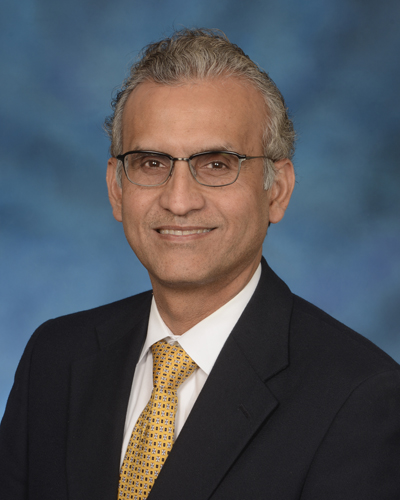 |
| Dr. Mohammad Mansoor Mohiuddin |
Dr. Mohiuddin is a 1989 graduate of the Dow University of Health Sciences, Karachi, Pakistan. He came to the United States in the early 1990s and did a fellowship in Transplantation Biology and Immunology, Department of Cardiothoracic Surgery Harrison Department of Surgical Research, University of Pennsylvania Medical Center, Philadelphia, PA .
A practicing Muslim, he believes it is acceptable to use pig organs if it helps save human life. Some Islamic scholars have ruled that it is prohibited to use pig for organ transplants. However, almost all research in the field of xenotransplantation is now carried out using pigs. Researchers say pigs are a preferred choice because they grow fast and the size of their organs is similar to that of humans. There is a worldwide shortage of organ donors. Successful use of genetically modified pig hearts and other organs will help save lives in the absence of human donors.
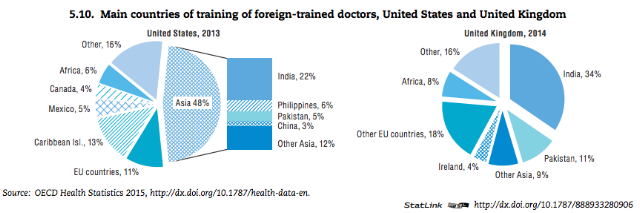 |
| Foreign Doctors in US, UK. Source: OECD |
As of 2013, there were over 12,000 Pakistani doctors, or about 5% of all foreign physicians and surgeons, in practice in the United States. Pakistan is the third largest source of foreign-trained doctors. India tops with 22%, or 52,800 doctors. It is followed by the Philippines with 6%, or 14,400 foreign-trained doctors. India and Pakistan also rank as the top two sources of foreign doctors in the United Kingdom.
http://www.youtube.com/embed/D00T14balpI"; title="YouTube video player" width="560"></iframe>" height="315" src="https://img1.blogblog.com/img/video_object.png" width="560" style="cursor: move; background-color: #b2b2b2;" />
Related Links:
Haq's Musings
South Asia Investor Review
Pakistani-American Health Professional Featured in Netflix Document...
Pakistan is the 3rd Largest Source of Foreign Doctors in America
Pakistani-Americans Largest Foreign-Born Muslim Group in Silicon Va...
Racial Slurs Hurled at Pakistani-American Doctor in St. Louis, Miss...
Islamophobia in America
Silicon Valley Pakistani-Americans
Pakistani-American Leads Silicon Valley's Top Incubator
Silicon Valley Pakistanis Enabling 2nd Machine Revolution
Karachi-born Triple Oscar Winning Graphics Artist
Pakistani-American Ashar Aziz's Fire-eye Goes Public
Pakistani-American Doctor Honored By President Obama
Pakistani-American's Game-Changing Vision
Minorities Are Majority in Silicon Valley
Views: 702
-
Comment by Riaz Haq on January 10, 2022 at 8:16pm
-
Excerpts of "Our Man", biography of late Richard Holbrooke, President Obama's Special Representative for Afghanistan and Pakistan (SRAP), by George Packer
Holbrooke died in December 13,2010 after his aorta ruptured.
His emergency heart surgery was performed by Dr. Farzad Najam, a Pakistani-American heart surgeon at George Washington Hospital in Washington DC.
-------------------
Hillary Clinton’s doctor, Jehan El-Bayoumi, worked at George Washington and heard from a Clinton aide that an important person was coming their way. A young cardiologist named Monica Mukherjee met the ambulance at the doors and led the gurney through the emergency room to radiology.--------
Mukherjee called the hospital’s chief cardiac surgeon, who was fifteen minutes away. “You need to come right now. It’s a VIP.” “Who is it?” “His name is (Richard) Holbrooke.” He was wheeled into the triage trauma bay and a curtain was drawn around the gurney. Feldman was on his left side, holding his hand, and LaVine was at the foot of the bed. Mukherjee was trying to get a catheter into his right wrist to monitor blood pressure, but he was in such turmoil that she couldn’t do it. His skin was cold and clammy and he looked as if he was about to pass out, but Mukherjee was struck by how he dominated the room—not just his size but his sheer presence, the light in his ice-blue eyes.
--------------------
They wheeled him to the elevator and took him up to the second floor. He kept instructing Feldman. “Tell Mort Janklow. No, wait till the operation is over, and don’t release a press statement till it’s over.” In the intensive care unit the surgeon introduced himself. “Mr. Holbrooke, I am Dr. Farzad Najam, the cardiac surgeon here.” “Any Indian-American doctor is okay with me,” Holbrooke said. Still putting on. Najam and Mukherjee exchanged a look. Najam was a Pakistani American, from Lahore. He knew about Holbrooke’s work. “Just tell me it’s going to be okay.” “Mr. Holbrooke, you have an acute aortic dissection—the aorta has ripped. It’s a surgical emergency and we need to take you to the operating room.” Najam would have to cut through the breastbone, put him on a bypass pump, and replace the aorta and perhaps the valve.
Packer, George. Our Man . Knopf Doubleday Publishing Group. Kindle Edition.
-
-
The following article from the Journal of American Medical Association (JAMA) says there are 14,352 Pakistan-i-American doctors of in America.
https://jamanetwork.com/journals/jamanetworkopen/fullarticle/2767883
Prevalence of International Medical Graduates From Muslim-Majority Nations in the US Physician Workforce From 2009 to 2019
John R. Boulet, PhD; Robbert J. Duvivier, MD, PhD; William W. Pinsky, MD
Of 1 065 606 physicians in the American Medical Association Physician Masterfile, 263 029 (24.7%) were IMGs, of whom 48 354 were citizens of Muslim-majority countries at time of entry to medical school, representing 18.4% of all IMGs. Overall, 1 in 22 physicians in the US was an IMG from a Muslim-majority nation, representing 4.5% of the total US physician workforce. More than half of IMGs from Muslim-majority nations (24 491 [50.6%]) come from 3 countries: Pakistan (14 352 [29.7%]), Iran (5288 [10.9%]), and Egypt (4851 [10.0%]). The most prevalent specialties include internal medicine (10 934 [23.6%]), family medicine (3430 [7.5%]), pediatrics (2767 [5.9%]), and psychiatry (2251 [4.8%]), with 18 229 (38.1%) practicing in primary care specialties. The number of applicants for Educational Commission for Foreign Medical Graduates certification from Muslim-majority countries increased from 2009 (3227 applicants) to 2015 (4244 applicants), then decreased by 2.1% in 2016 to 4254 applicants, 4.3% in 2017 to 4073 applicants, and 11.5% in 2018 to 3604 applicants. Much of this decrease could be attributed to fewer citizens from Pakistan (1042 applicants in 2015 to 919 applicants in 2018), Egypt (493 applicants in 2015 to 309 applicants in 2018), Iran (281 applicants in 2015 to 182 applicants in 2018), and Saudi Arabia (337 applicants in 2015 to 163 applicants in 2018) applying for certification.
-
-
Sheikh is one of the first female transplant surgeons from Pakistan
University of Alabama at Birmingham Assistant Professor Saulat Sajjad Sheikh, MBBS Division of Transplantation is one of the first female transplant surgeons from her originating country, Pakistan.
Sheikh attended medical school at the Aga Khan University in Karachi, Pakistan, where she was conferred the “Best Graduate” award. She subsequently completed her general surgery residency at York Hospital, York, Pennsylvania. Sheikh graduated from UAB’s Abdominal Transplantation and Hepatobiliary Surgery Fellowship in 2020.
During her residency, Sheikh considered specializing in gastrointestinal surgery; but after experiencing the gratification of changing an individual’s life by successfully transplanting a kidney or liver, abdominal transplant surgery was her new goal. Curing end-stage organ disease and offering a renewed chance at life for a patient became a passion for Sheikh.
Sheikh had several barriers to overcome before she could become a transplant surgeon. The Journal of Pakistan Medical Association reported in 2016 that 69.6 percent of registered medical doctors were male. When she decided on the field, Sheikh knew it was rare for a female medical doctor to specialize in surgery, let alone abdominal transplantation.
“Transplant surgery in Pakistan is not easily accessible, and there are only a few established transplant centers,” Sheikh said. “It was such a privilege and honor to attend one of the finest medical schools in Pakistan and then complete the rest of my training in the United States.”
According to a recent study conducted by Aga Khan University Hospital, where Sheikh attended medical school, 72 percent of female surgeons in the AKUH Department of Surgery said cultural barriers to a surgical career existed because of their gender. Further, about 40 percent of the women report having been discouraged by family or close friends from pursuing surgery as a career field.
Not only did she face gender barriers, but Sheikh also had personal challenges. She simultaneously began her two-year fellowship while single-handedly caregiving for her 7-month-old daughter. At the time, her husband, current UAB Acute Care Surgery Fellow Zain Hashmi, M.D., was still finishing his general surgery residency at the Sinai Hospital of Baltimore.
“It was certainly difficult raising a child and completing my fellowship, but I had to remind myself of my ‘why,’” Sheikh said. “I chose UAB because of the potential for growth, mentorship and stability. Dr. Jayme Locke is an incredible role model for me. She was the only female faculty in transplant at UAB when she started here. I have been with the UAB Division of Transplantation for just over two years, and I feel like I am barely scratching the surface with how far I can go.”
As an only female child from a conservative family, Sheikh said she was lucky her parents permitted her to capitalize on the available opportunities and sent her off into the world to pursue her goal of becoming a transplant surgeon. Both her mother and father are retired physicians —her mother is an OBGYN, and her father practices family medicine.
“My parents were and continue to be supportive of my pursuing my dreams to become a transplant surgeon, even though they often received side comments from the community, doubting my career and life path,” Sheikh said. “When I first started out on this journey, it felt like a distant dream; but now here I am, living my dream every day.”
Comment
Twitter Feed
Live Traffic Feed
Sponsored Links
South Asia Investor Review
Investor Information Blog
Haq's Musings
Riaz Haq's Current Affairs Blog
Please Bookmark This Page!
Blog Posts
Is Rapid Electrification Stimulating Pakistan's Economy?
Pakistan's electricity demand has soared 21% in just two years. Rapid electrification is positively impacting all sectors of Pakistan's economy. thanks to growing deployment of distributed solar, estimated at 38 GW as of June, 2025. In 2025, 44% of solar deployment was residential, followed by industry (26%), agriculture (21%) and commercial users (9%). It is stimulating demand for a variety of products ranging from air conditioners and refrigerators to washing machines and…
ContinuePakistan Needs to Address Its Significant Data Quality Challenges
Policy-makers need data to formulate good policies. Good data produced by government agencies can be expected to lead to good policies and desirable outcomes. But data collection and statistical analyses require adequate methodologies and resources. Unfortunately, Pakistan's data quality gets a "C" grade by international agencies like the International Monetary Fund (IMF). Clearly the country faces significant data quality challenges. These challenges range from estimation of the size…
ContinuePosted by Riaz Haq on July 7, 2026 at 9:30am — 8 Comments
© 2026 Created by Riaz Haq.
Powered by


You need to be a member of PakAlumni Worldwide: The Global Social Network to add comments!
Join PakAlumni Worldwide: The Global Social Network